
Readings for the Twenty Second Sunday after Pentecost (Year A) Proper 25 – Track 2
This sermon was preached at Christ Episcopal Church in Eureka CA on Sunday October 29, 2023.

Our Scripture readings today focus on the heart. The Book of Leviticus commands God’s people not to harbor any hate in their hearts, especially not for their own kin (Lev 19:17). According to the Psalm, when our hearts delight in the Torah (the teachings of God) we become like a tree planted by streams of water (Psalm 1:3). In his first letter to the Thessalonians (which is considered the first NT book to be written and therefore the earliest Christian text we have), Paul describes God as one who tests our hearts (1 Thess 2:4). And then in the Gospel, Jesus distills all 613 commandments of the Torah into two: love your neighbor as yourself (from Leviticus) and most importantly, the command recited several times a day by devout Jews, the command included in the Shema: Shema, Israel, Adonai Elohenu Adonai Echud…v’ahavta et Adonai Elohecha bekol levavcha. So, the heart of Judaism and the heart of Christianity is to love God with all your heart. This core teaching of Western spirituality invites us to get in touch with our heart sense, to become aware of our heartbeat and to ask ourselves, “Who does our heart beat for?”
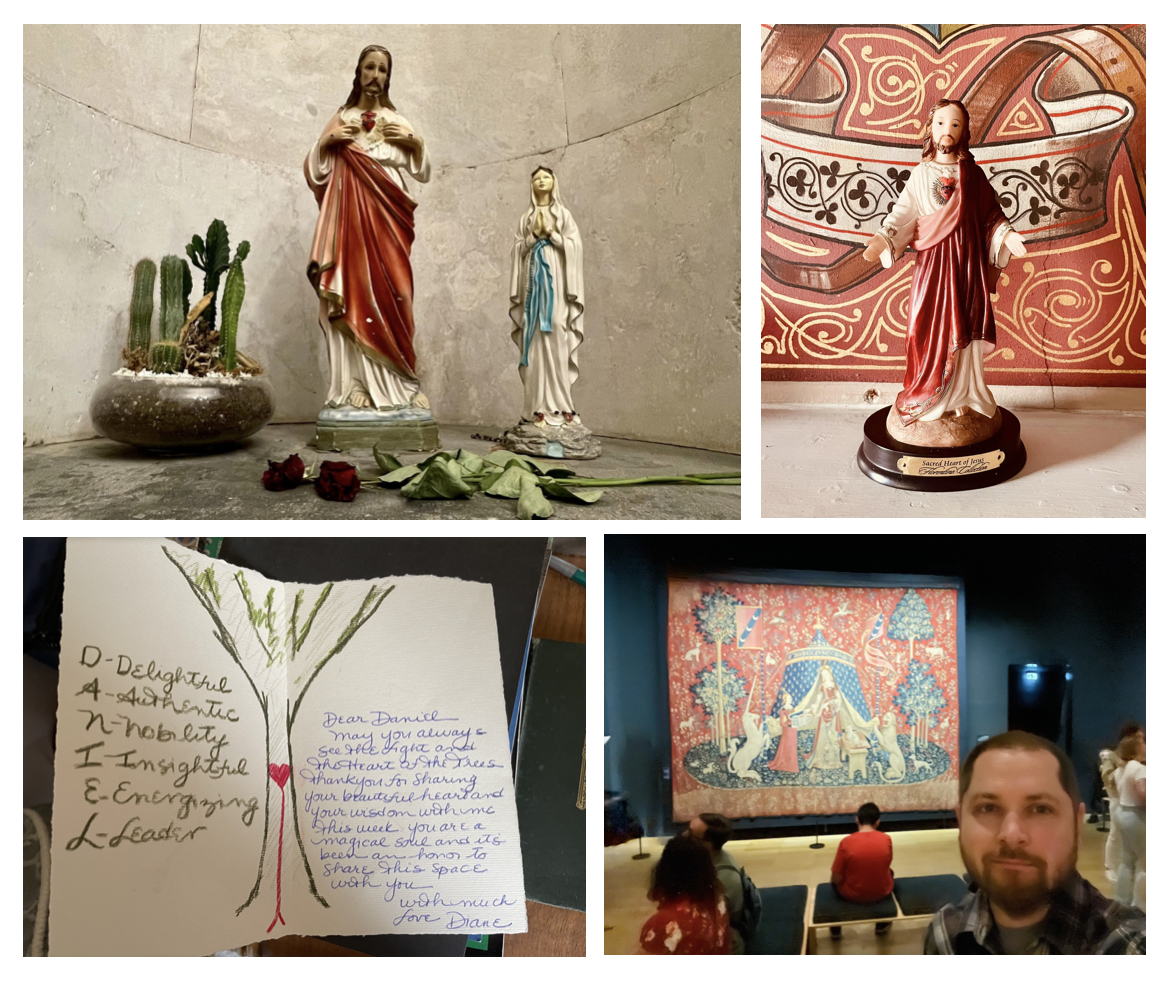
This invitation to get more in touch with the heart sense was a theme that kept emerging throughout my Sabbatical. During my Forest Therapy Guide Training in England, we talked about listening to the heart of trees. Statues of the Most Sacred Heart of Jesus kept showing up, especially throughout Italy. And I got to visit one of the most creative medieval portrayals of the heart sense at the Cluny Museum in Paris, which houses the six tapestries of The Lady and The Unicorn (La Dame et la Licorne). Five of the tapestries portray each of the five bodily senses (we have a copy of the hearing sense tapestry in our narthex) while the sixth tapestry portrays the sixth sense, which is the heart (A mon seul désir).
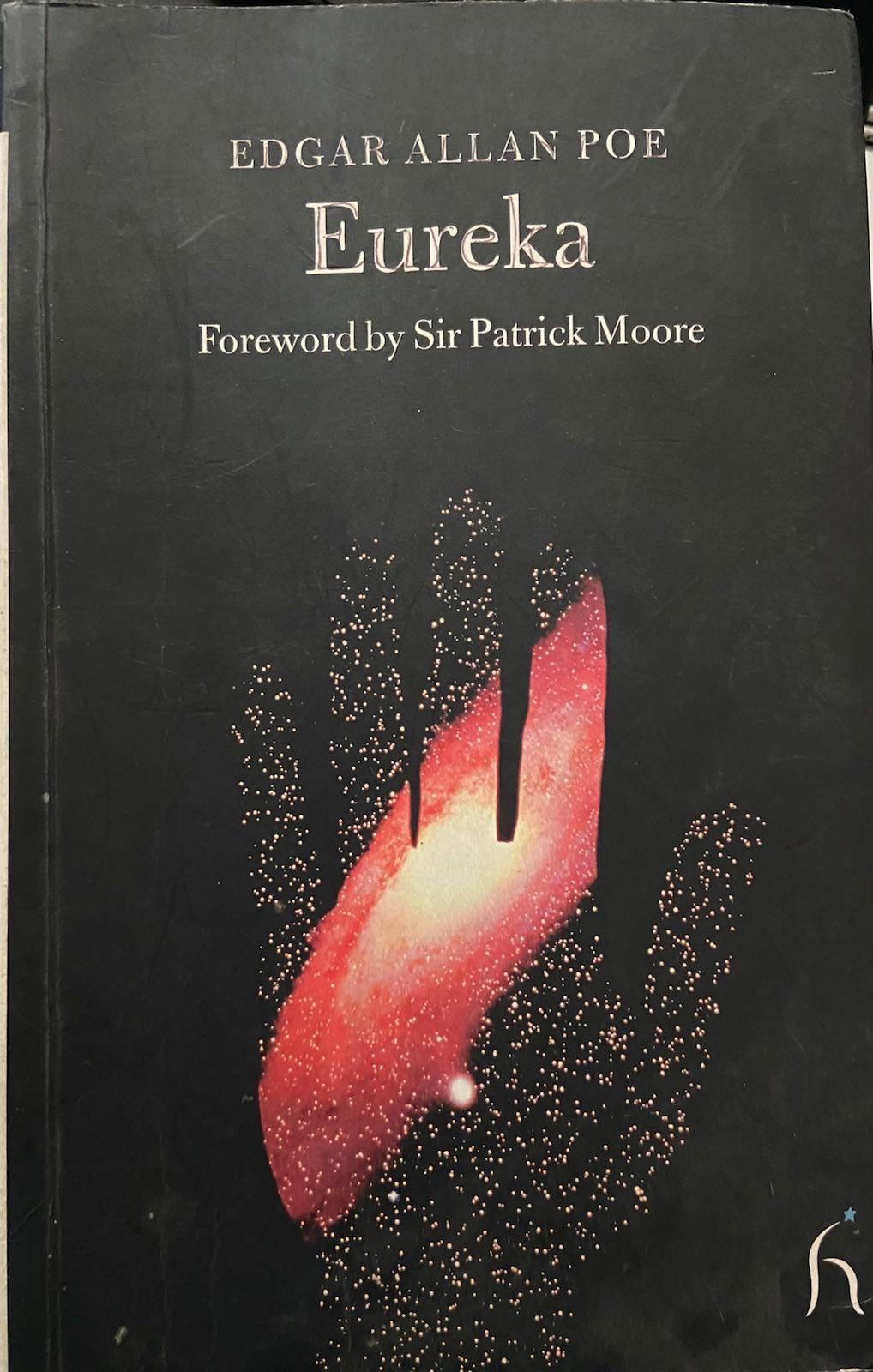
This morning I want to share with you the most unexpected invitation to get in touch with the heart sense during my Sabbatical. A couple days after visiting the Cluny Museum in Paris, I visited an English-language bookstore called The Red Wheelbarrow. While browsing the shelves, I came across a book titled Eureka which was dedicated to Alexander von Humboldt (!) and which was written by an Episcopalian. As an Episcopal priest from Eureka in Humboldt County, I felt particularly compelled to check out this book which I had never even heard of before. I was certainly familiar with the author, who is considered one of the most famous American poets ever, the inventor of detective stories and a pioneer of science fiction. He also happens to be the most macabre and morbid and mysterious Episcopalian and seems very appropriate to be talking about during this Halloween weekend: the one and only Edgar Allan Poe.[1]
Eureka was the last major work that Poe published before he died prematurely and mysteriously at age 40. He insisted that Eureka was his masterpiece and the magnum opus of his entire writing career, even claiming that the book was more important than the discovery of gravity. The full title is Eureka: A Prose Poem and the subtitle attempts to convey the genre of this book, which is written in prose –even at times scientific prose—but which has a poetic pulse to it. In the first page, he sets out his goal, which is to “speak…of the material and spiritual universe; of its essence, its origin, its creation, its present condition and its destiny.”[2] A tall task indeed. The text was first read as a lecture that he delivered at the New York Society Library to an audience of only about 60 people. The lecture, which was mostly a flop at the time, must have been about four-and-a-half hours long since the book is over 100 pages and I honestly found it to be, for the most part, quite tedious. However, at the same time, I could not stop reading it. In Eureka, Poe explores the limitations of science and philosophy and the power of poetic imagination and “irresistible intuition,”[3] the mind-boggling concept of infinity and the awe-inspiring activity of minute atoms and colossal planets and stars.[4] Decades before their discovery in the scientific community, Poe was writing in Eureka about black holes,[5] the Big Bang, the expansion of the universe, and even the theory of relativity [the concepts that matter is energy[6], that space and time are one[7]], which would not be published until 50 years later by Einstein, who thought Eureka was “a beautiful achievement of an unusually independent mind.”[8]
What kept this Episcopal priest from Eureka CA intrigued by this book was Poe’s consistent references to God and angels and archangels and spirituality,[9] which are integrated seamlessly into his scientifically informed cosmology. In his dramatic conclusion, he says, “The plots of God are perfect [and] the universe is a plot of God.”[10] In fact, the universe “in the supremeness of its symmetry, is but the most sublime of poems.”[11] When Poe reflects on electricity and radiation and gravity, he realizes that not only is everything in the universe expanding, but everything is also struggling towards union, an ultimate in-gathering.[12] Although the universe may be expanding now, everything will eventually return to a state similar to when the universe began where God remains “all in all.”[13] And then the cycle repeats itself. Poe writes, “The processes we have here ventured to contemplate will be renewed forever, and forever, and forever; a novel universe swelling into existence, and then subsiding into nothingness, at every throb of the heart divine. And now—this heart divine—what is it? It is our own.”[14] So, the 13.7-billion-year history of our universe has been and continues to be the contraction of a single heartbeat of God pumping life and existence into all things, seen and unseen. We exist in the heart of God. “What you call the universe of stars,” Poe says, “is but [God’s] present expansive existence.”[15] And we can connect with the divine universal heartbeat by getting in touch with our own heart sense, simply by placing our hands on our hearts and sending love to God and one another. This heart-love is the ground of being for the entire universe.
In a different context, Poe said, “I was never really insane except upon occasions when my heart was touched.”[16] By getting in touch with his heart, Poe tapped into the infinite mystery of God, which our finite minds cannot grasp without risking some insanity. However, we can begin to grasp the infinite mystery or at least be grasped by it by using our hearts. And that’s the invitation of all our readings today, especially that ancient Jewish commandment repeated by Christ to love God with all our heart, a commandment that now glimmers with new cosmic meaning for me in the light of the radical insights of Halloween’s favorite Episcopalian, Edgar Allan Poe.

[1] Poe was likely baptized at the historic St. John’s Episcopal Church in Richmond VA. See Jeffrey Meyers, Edgard Allan Poe: His Life and Legacy (New York: Charles Scribner’s Sons, 2008).
[2] Edgar Allan Poe, Eureka: A Prose Poem (Surrey UK: Alma Books, 2018), 1.
[3] Poe, Eureka, 31.
[4] Poe, Eureka, 25, 25 – 29, 71, 84.
[5] He calls them “non-luminous suns.” Poe, Eureka, 57.
[6] “Matter exists only as attraction and repulsion…attraction and repulsion are matter.” Poe, Eureka, 24, 97.
[7] “Space and duration are one” Poe, Eureka, 82.
[8] Albert Einstein, 1934 Letter, http://www.bo.astro.it/~cappi/poe.html
[9] Poe, Eureka, 15, 17, 30, 38, 42, 46, 54, 55, 62, 71, 76, 77, 78, 84,94, 96, 97, 98, 100, 101.
[10] Poe, Eureka, 84.
[11] Poe, Eureka, 91.
[12] “We perceive at once a satisfiable tendency to union.” Poe, Eureka, 46. “All matter is…now returning to its orginal unity.” Poe, Eureka, 88.
[13] Poe, Eureka, 97, 98. St. Paul also uses the phrase: “Then the Son himself will be made subject to him who put everything under him, so that God may be all in all” (1 Corinthians 15:28).
[14] Poe, Eureka, 98.
[15] Poe, Eureka, 100.
[16] Poe, Letter to Maria Clemm, July 7, 1849, https://www.eapoe.org/works/letters/p4907070.htm

 DANIEL DeFOREST LONDON