
Readings for the Eighteenth Sunday after Pentecost (Year A) Proper 21 – Track 2
This sermon was preached at Christ Episcopal Church in Eureka CA on Sunday October 1, 2023.
May the words of my mouth and the meditations of all our hearts be in alignment with the same wisdom that was in Christ Jesus who did not regard equality with God as something to be exploited but who emptied himself, becoming obedient to the point of death, even death on a cross. Amen.
In our Epistle this morning, St. Paul asks his friends in Philippi (which is in modern-day Greece) to make his joy complete,[1] a request that feels both affirming and appropriate on this Sunday when we launch our Joy Mass Family Service. St. Paul’s joy would be made complete if his readers (including us) could emulate the humility of Christ, which is described poetically in the following verses that comprise an ancient Christian poem known as the Christ Hymn or the Kenosis Hymn. Some say that the entire book of Philippians is best understood as a commentary and reflection on this powerful poem, which has been considered the earliest confession of Christian faith that we know of, written centuries before the creeds we use today: Christ Jesus, who though he was in the form of God, did not regard equality with God as something to be exploited, but emptied [ekenosen] himself – the Greek word for self-emptying is “kenosis,” which is where the hymn gets its name – taking the form of a slave, being born in human likeness. And being found in human form, he humbled himself and became obedient to the point of death –even death on a cross. Therefore God also highly exalted him…so that at the name of Jesus every knee should bend…and every tongue confess that he is Lord, to the glory of God the Father.[2] After sharing this poem, Paul urges his readers (us) to discern how we ourselves might embody a similar kind of self-emptying humility in our lives, a discernment that may include some “fear and trembling,” but which ultimately leads to our sharing in the glory and good pleasure and joy of our God.[3] When we humble ourselves in the sight of the Lord, he lifts us up.[4]
This Gospel message of humility and joy spoke to me in a new way this last week as I was learning about the Anglican province for which we pray this Sunday in the Anglican Cycle of Prayer: the Nippon Sei Ko Kai, which translates to the “Japanese Holy Catholic Church,” a name that reminds us Anglicans that we are indeed “Catholic” which literally means “world-wide.” Not only are we part of the worldwide Anglican communion, which is composed of 80 million members, we also remain part of the larger worldwide church of over 2 billion people.[5]
During my Sabbatical, my experience and appreciation for the worldwide Anglican communion deepened as I encountered the inspiring ways that other indigenous cultures have received and understood the Gospel of Jesus Christ, ways that can help us all to see the Gospel in a new light. In learning how the Māori in Aotearoa New Zealand have adopted and translated the Gospel into their own cultural understanding, I’ve grown more interested in learning how other indigenous cultures have done the same. In reading about the Nippon Sei Ko Kai, I learned about the indigenous peoples of Japan who are known as the Ainu people, a community of about 25,000 who still live in northern Japan today. In the year 1880, an Anglican (CMS) missionary named the Rev. John Batchelor felt called to minister to the Ainu, as they were being discriminated against by the Japanese, whose integration policy was supplanting their language and culture. The Rev. Batchelor was given the name “the father of the Ainu” for editing the Ainu Language Dictionary and the Ainu Language Bible and for working to defend their rights while also baptizing many of them, including a young woman named Yukie Chiri. Before the age of 19, Yukie Chiri transcribed the most beloved epic tales of the Ainu in a compilation called Yukar. Yukie Chiri saw the Gospel of Jesus Christ present in these ancient indigenous tales, especially in the story of the owl god, a story that captures well the meaning of the ancient Kenosis Hymn from Philippians.[6]

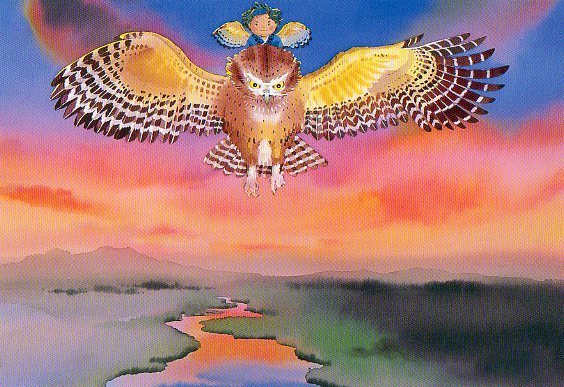
In the story, the owl god sings while flying over a group of children, who upon realizing that the owl is divine decide to try shooting it down from the sky. The story is told from the perspective of the owl, who can tell by the quality of the children’s clothes that they come from wealthy families, but even though they are using the finest metal bows and arrows, they keep missing their moving target. “Among them was one child who carried a bow and arrow made only of rough wood…[who] was from a poor household.” When the poor child tried shooting at the owl, the rich children begin to laugh at him and mock him, saying, “You silly pauper! That’s a divine bird. It will never accept your rotten wooden arrows when it won’t even accept our shiny metal arrows. Not in a million years.” The rich children then proceeded to kick the poor child with their legs and punch him with their fists. “However,” according to the owl, “the poor boy ignored them and carefully aimed his arrow at me. I watched him and was moved with compassion.” The poor boy put one leg behind him and set the other firmly in front, bit his lower lip, and steadied his aim and released his arrow into the sky. The tiny arrow flew clean and straight towards the owl who stretched out its claw to pluck it from the air and then plunge it into himself as he fluttered to the ground, where all the children gathered round. This made the rich children even more angry and violent and upset with the poor child, who ignored them and brought the owl to his home. When the poor family saw the owl, they recognized it as divine and honored it with repeated ceremonial bows saying, “Welcome to our humble, meager house. We are so grateful for your presence.” The owl god then came back to life and began flying above the house while singing joyfully and pouring down blessings upon the home, which became full of beautiful and divine treasures. Quickly news spread that this poor family now supposedly boasted the most beautiful house of all, overflowing with delicious food and wine, the favorite drink of the gods. The rich families laughed in disbelief and were going to go mock the family when the poor child invited them over for a banquet. When the families arrived, they realized the truth and apologized profusely for their cruel and arrogant behavior; and the humble family, now enjoying abundance, forgave them and said, “From now on we will be friends.” And thus ends the tale of the owl god.[7]
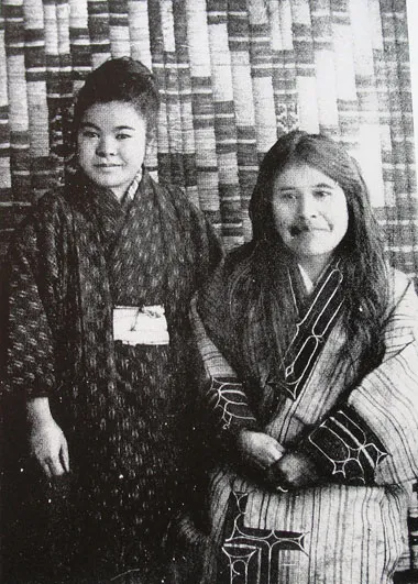
The young indigenous Anglican woman of Japan Yukie Chiri transcribed this ancient tale and felt that it beautifully expressed the humble compassion of Christ, who like the owl god, emptied himself even to the point of death. And when this same humility and compassion and forgiveness were emulated by the people, the human race became a human family, a family of friends, blessed by the divine. Japanese linguist Kyōsuke Kindaichi said that every time Yukie Chiri heard a story in which someone was the victim, she prayed for them. She understood Christ as “the victim of the people and [also] th most wonderful person”[8] because he was a self-giving victim who forgave those who denied him and betrayed him and even those who crucified him so that humanity could become a family of friends. When I read in Philippians about every knee bending and every tongue confessing that Christ is Lord in light of Yukie Chiri’s story of the owl god, I hear it less now as the domineering triumphalism that Christians so often espouse and more as a poetic description of a humble family of friends who have forgiven each other and reconciled under the shadow of the wings of the One who is the perfect embodiment of God’s love, the One who delights in us while singing joyfully like the owl, and releasing a downpour of abundant blessings for us all. What a beautiful vision for us to look forward to, a vision that can indeed make our joy complete. Amen.

[1] Philippians 2:2
[2] Philippians 2:5-11
[3] Philippians 2:12-14
[4] James 4:10
[5] As one Anglo-Catholic author it, “The Church of England is not a branch of the Church, but is a part of the Church of the West as distinguished from the Church of the East. We belong to Western Christendom” Alfred Edye Manning Foster, Anglo-Catholicism (London: Dodge, 1913), 17 – 18. He also quotes Cyril of Jerusalem who said, “The Church is called Catholic because it is throughout the world, from one end of the earth to the other; and because it teaches universally and completely all the truths which ought to come to men’s knowledge, concerning things visible and invisible, heavenly and earthly.”
[6] Renta Nishihara, “The Nippon Sei Ko Kai (The Anglican Communion in Japan)” in The Wiley-Blackwell Companion to the Anglican Communion, edited by Ian S. Markham, J. Barney Hawkins IV, Justyn Terry, and Leslie Nuñez Steffenson (Malden MA: Wiley-Blackwell, 2013),264 – 265.
[7] Quotes from Renta Nishihara, “The Nippon Sei Ko Kai,” 265 – 266. See Chiri Yukie, The Song The Owl God Sang: The Collected Ainu Legends of Chiri Yukie, translated by Benjamin Peterson (Las Vegas NV: BJS Books, 2013), 3 – 11.
[8] Renta Nishihara, “The Nippon Sei Ko Kai,” 265.

 DANIEL DeFOREST LONDON