
Readings for the Sixteenth Sunday after Pentecost (Year A) Proper 19 – Track 2
This sermon was preached at Christ Episcopal Church in Eureka CA on Sunday September 17, 2023.
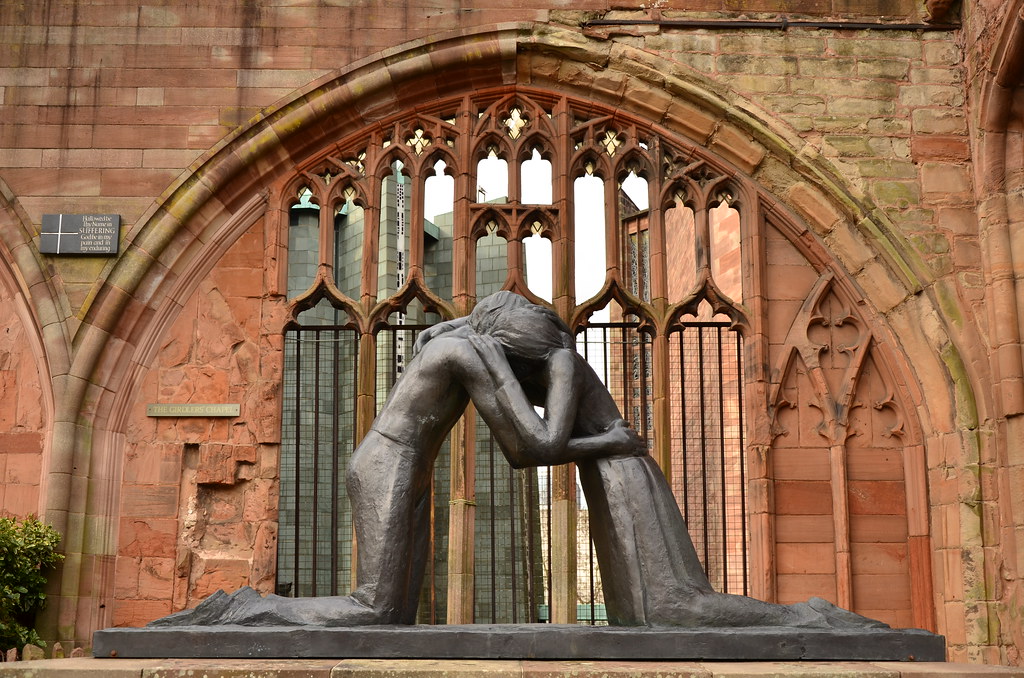
Last Sunday, our Scripture readings invited us to choose life. Today our readings remind us that choosing life means choosing forgiveness. Rabbi Joseph Gelberman, who lost his entire family in the Nazi Holocaust, forgave even Hitler because he knew that, by doing so, Hitler would no longer have any power over him. He knew that choosing life and healing and wholeness meant choosing forgiveness.[1] We are called to forgive others not so much for their sake, but for our own sake, for our own joy and happiness and freedom.
God loves us unconditionally and God forgives us; however, Jesus makes it clear that we cannot fully receive God’s forgiveness if we refuse to forgive others. God forgives us, but we don’t receive that gift of divine forgiveness unless we also forgive. In fact, Jesus says that we should not even approach the altar to worship God if we are holding a grudge against our neighbor. He says we need to first forgive and reconcile with our neighbor and then come offer our worship at the altar. That’s why we exchange the peace before communion, as a sign of our forgiveness and reconciliation. Trappist monk and Forgiveness Guru William Meninger says bluntly, “If you are to be a Christian, you must forgive!”[2] The parable this morning teaches us that if we refuse to forgive, we condemn ourselves.
In this Parable of the Unforgiving Servant, Jesus uses language and rhetoric that can “sound vengeful, hateful and condemnatory,” especially when we hear about the lord in the parable handing the servant over to be tortured, followed by the threat that our heavenly Father will do the same to us if we do not forgive others.[3] William Meninger explains that this threat “must be seen in the full context of God’s unconditional love, in the total giving of his Son who died for our sins and rose for our justification. In fact,” he says, “it isn’t God who tortures us but we who torture ourselves. Only when we allow our wounds to heal and let forgiveness occur will we free ourselves from our self-imposed prison cells. We forgive [others] for our own sakes. Forgiveness is for us.”[4]

In this powerful parable, Jesus is teaching us what Bishop Jack Thompson apparently used to teach from this pulpit when he served as rector here many decades ago. According to the Very Rev. Don Brown, who grew up in this congregation and who also preached from this pulpit four years ago almost to the day, the Right Rev. Jack Thompson would say, “God does not punish us for our sins. We are punished by our sins.”[5] Likewise, God doesn’t punish us for our refusal to forgive, it is our refusal to forgive that punishes us and can even torture us. Sometimes we think that withholding forgiveness from someone hurts the other person or gives us some kind of power over them, but withholding forgiveness is like drinking rat poison and waiting for the rat to die. It doesn’t impact the rat at all, but it poisons us.
Choosing life means choosing forgiveness, but many of us don’t know how to forgive because many of us don’t really know what forgiveness is. Forgiveness is not forgetting despite the popular phrase “forgive and forget.” Forgetting might sometimes be a byproduct of forgiveness, after wounds have healed, but they are not the same thing at all.[6] Did Joseph just forget that his brothers stripped him and sold him off into slavery in Egypt? Absolutely not! Forgiveness also does not mean that we condone the wrongdoing of someone who hurt us. Our offenders still must answer for what they have done, but when we forgive, we are letting go of the pompous idea that we are the divine judge, we are letting God be God, as Joseph does when he asks, “Am I in the place of God?” (Gen 50:19). Forgiveness is also not something that we force ourselves to do while gritting our teeth, suppressing our emotions, and ignoring our pain. William Meninger explains that “Forgiveness is usually not a simple act of the will. It is often a process. Sometimes the best we can do is merely begin the process.”[7] And the best way to begin the process of forgiveness is to pray. That might mean praying, “God, I want to forgive, but I don’t know how” or it might mean praying, “God, I’m angry and upset and hurt and I don’t want to forgive, but I want to want to forgive.”[8] And sometimes the only prayer we can pray for the person who hurt us is for them to be more aware of the “depth and extent of the harm they have done.”[9] As long as we pray with a willingness to be transformed, to let God’s will be done, and to eventually forgive, the process of forgiveness has begun within us. And this process might take a lifetime or longer to reach its fulfillment, but let the process begin now, for your own sake.
This last Friday was the sixtieth anniversary of the racially motivated bombing of the 16th Street Baptist Church in Birmingham Alabama, which killed four young girls. The sermon that day was from the Gospel of Matthew and was titled “The Love that Forgives.” How could anyone forgive the perpetrators of such horrific, racist violence? But that is exactly what we are called to do as followers of Christ, as followers of the One whose last words on the Cross were “Father, forgive them.” This last Monday was the 22nd anniversary of the terrorist attacks on the World Trade Center and the Pentagon. William Meninger said that even on that tragic day, September 11, 2001, he felt the nagging of the Holy Spirit, reminding him that he will need to forgive the terrorists who hijacked those planes. He knew there was no way he could do that, but he was willing to at least begin the process of wanting to want to want to maybe forgive someday. And if that’s all we can do in the moment, then that’s enough, but at least begin the process because choosing life means choosing forgiveness.
When it comes to my friend Jacob who took his life in May and whose memorial service I just attended yesterday in Occidental, I believe God has already forgiven him. Although Jacob made a choice that has wounded me permanently, I find that when I give myself over to the process of forgiveness, I experience more healing, wholeness, freedom, and love as well as an openness to the real possibility that he is loving me back with “eternal love from afar,” which is how he signed off his final letter to me.
If there is anyone you need to forgive, begin the process now by bringing your desire to forgive to the altar. Maybe you need to forgive your parents, your children, your spouse, your sibling, your fellow parishioner, your rector (for being gone too long on Sabbatical or not being gone long enough!) or perhaps even yourself. Whoever it might be, begin the process because withholding forgiveness, according to today’s parable is self-torture, but choosing forgiveness means choosing wholeness and healing and life. Amen.

[1] William A. Meninger O.C.S.O., The Process of Forgiveness (New York: Continuum, 1996), 32.
[2] Meninger, Forgiveness, 17.
[3] Meninger, Forgiveness, 27.
[4] Meninger, Forgiveness, 27.
[5] Don Brown, “Holy Cross Sermon” September 15, 2019. https://www.youtube.com/watch?v=1CMN3JVoKGE
[6] Meninger, Forgiveness, 31.
[7] Meninger, Forgiveness, 18 – 19.
[8] Meninger says that sometimes the only real gift we can bring before God at the altar is “our confusion, our despair, even our anger.” Meninger, Forgiveness, 23.
[9] Meninger, Forgiveness, 54.

 DANIEL DeFOREST LONDON