

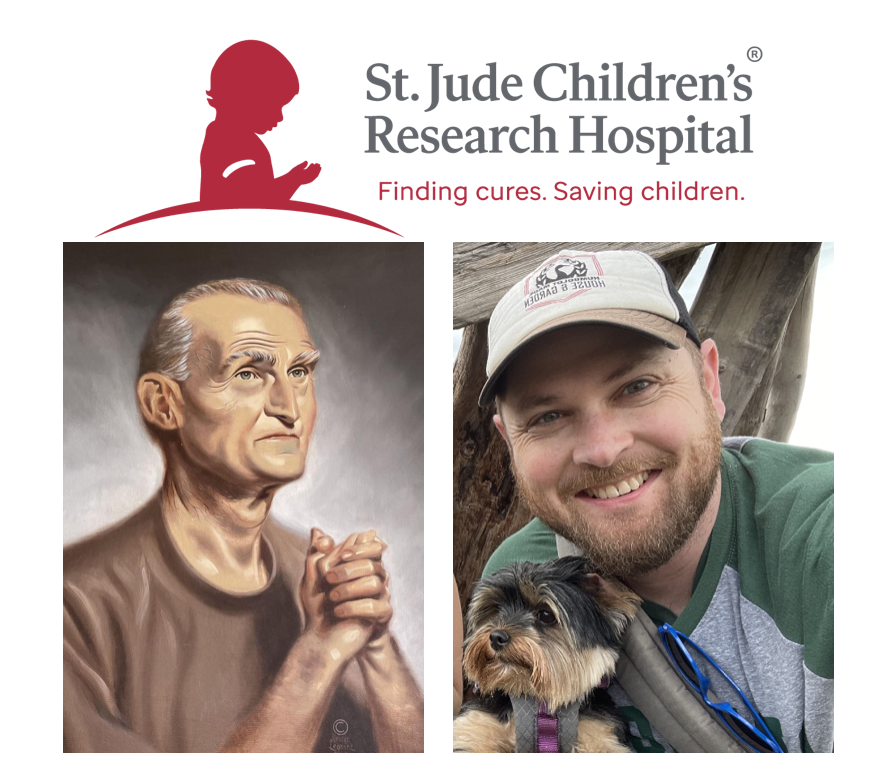
A reflection on St. Judas Thaddeus inspired by the oil painting of Fr. George Leonard Shultz (1896 – 1971). This same reflection was published in the Times-Standard on Saturday September 16, 2023 as Supporting the ‘Saint of Hopeless Causes’
Since the fall of 2020, I have been offering reflections on Father Shultz’s paintings of the 12 apostles, which are now housed in the parish hall of Christ Episcopal Church, and I believe I have saved the best for last: St. Judas Thaddeus, who has historically been overshadowed by the disciple who betrayed Jesus Christ, Judas Iscariot.
The name Judas is the Greek form of the Hebrew name Judah, which means “thanksgiving” or “praise” and St. Judas has been praised as the patron saint of hopeless causes and desperate situations. As the pious explanation goes, Christians rarely invoked St. Judas Thaddeus in their prayers because they were afraid that they might accidentally get the unwanted attention of Judas Iscariot. Poor Judas Thaddeus was so disappointed by the lack of invocations he received from Christians that he became eager to assist anyone who sought his assistance, even if that meant helping those in the most desperate and hopeless situations. His PR campaign then improved when early English translators of the Bible gave him the name “Jude” rather than Judas to help distinguish him from the betrayer. Since then, his popularity has grown, inspiring a novel, a record album and perhaps even a Beatles song, indirectly.
During the Great Depression, the National Shrine of St. Jude was founded in Chicago to lift the spirits of the unemployed. Along with relics of the apostle, the shrine includes statues and stained-glass windows of St. Jude, who is often depicted with a medallion or Mandylion (cloth) image of the face of Christ.
According to legend, St. Jude healed King Agbar of Edessa of a fatal illness by showing him the image of Christ. Today, the apostle remains associated with healing the sick and helping the hopeless by always pointing to the life-giving power of his teacher, Jesus Christ.
Fr. Shultz portrays the apostle as an older man with hands clasped in prayer, inviting the viewer to reflect less on him and more on the One to whom he prays. The portrayal of Jude as an older man likely speaks to the fruitful ministry he enjoyed later in life, a ministry that involved bringing Christianity to Armenia with his fellow apostle Bartholomew. The slightly angled orientation of Jude’s prayer posture in Shultz’s painting reminds me of another image associated with the apostle: the logo of the St. Jude Children’s Research Hospital, which is the silhouette of a child at prayer.
The hospital was founded by actor Danny Thomas, who began his career during the Great Depression. One day, while desperately broke and unemployed, Danny prayed to the saint of hopeless causes, asking for help and guidance. A couple days later, he was called to one fancy club, and then another, and then to Hollywood, where he enjoyed enormous success and wealth. He never forgot his prayer to St. Jude and wanted to thank the apostle whose name means “thanksgiving.” So, in 1962, when childhood cancer was considered incurable, Danny Thomas decided to put the saint of hopeless causes to work by founding the St. Jude Hospital, which has, over the years, pushed the childhood cancer survival rate from 4% to 94%.
Inspired by the witness of St. Jude, I will be participating in and fundraising for the St. Jude 5K Walk/Run on Sept. 30 to support the kids of St. Jude Children’s Research. If you feel at all inspired by the life of St. Jude, I invite you to consider supporting me in the St. Jude Walk/Run by donating here: https://fundraising.stjude.org/site/TR/Walk/Walk?px=8031013&pg=personal&fr_id=144763 or finding the link on the Christ Episcopal Church Eureka website homepage. All proceeds go to St. Jude, whose name inspires gratitude. Thank you!

 DANIEL DeFOREST LONDON