

Readings for the Seventh Sunday of Easter (Year A)
This sermon was preached at Christ Episcopal Church in Eureka CA on Sunday May 21, 2023.
Today is the last Sunday before my three-month Sabbatical; and today’s Gospel comes from the final section of the Farewell Discourse in the Gospel of John.[1] Scholars divide the Gospel of John into two main sections or books: the Book of Signs (Chs. 1 – 12) and the Book of Glory (Chs. 13 – 21). We previously read several portions from the Book of Signs during Lent this year, portions that invited us to experience the tangible signs of Christ’s presence among us through our senses. We listened to the wind with Nicodemus, tasted the living water with the Samaritan woman, moved from merely looking to a deeper kind of seeing with the man born blind, and smelled the aroma of the afterlife with Mary, Martha, and Lazarus. Those were all in the Book of Signs. The Book of Glory can be understood as a long reflection on our sense of touch. We saw that emphasis when we read about the resurrection accounts with Mary Magdalene and Thomas, but the references to touch show up right away in the Book of Glory.[2] The first thing that Jesus does at the beginning of the Book of Glory, chapter 13, is get up in the middle of a meal, remove his clothes, and then wrap himself in a towel as he washes his disciples’ feet.[3] Some suggest that the stoles that are worn by deacons and priests are symbols of the towel Jesus used when he washed his disciples’ feet. Another name for the stole is the orarium, which means liturgical towel or liturgical napkin.[4]
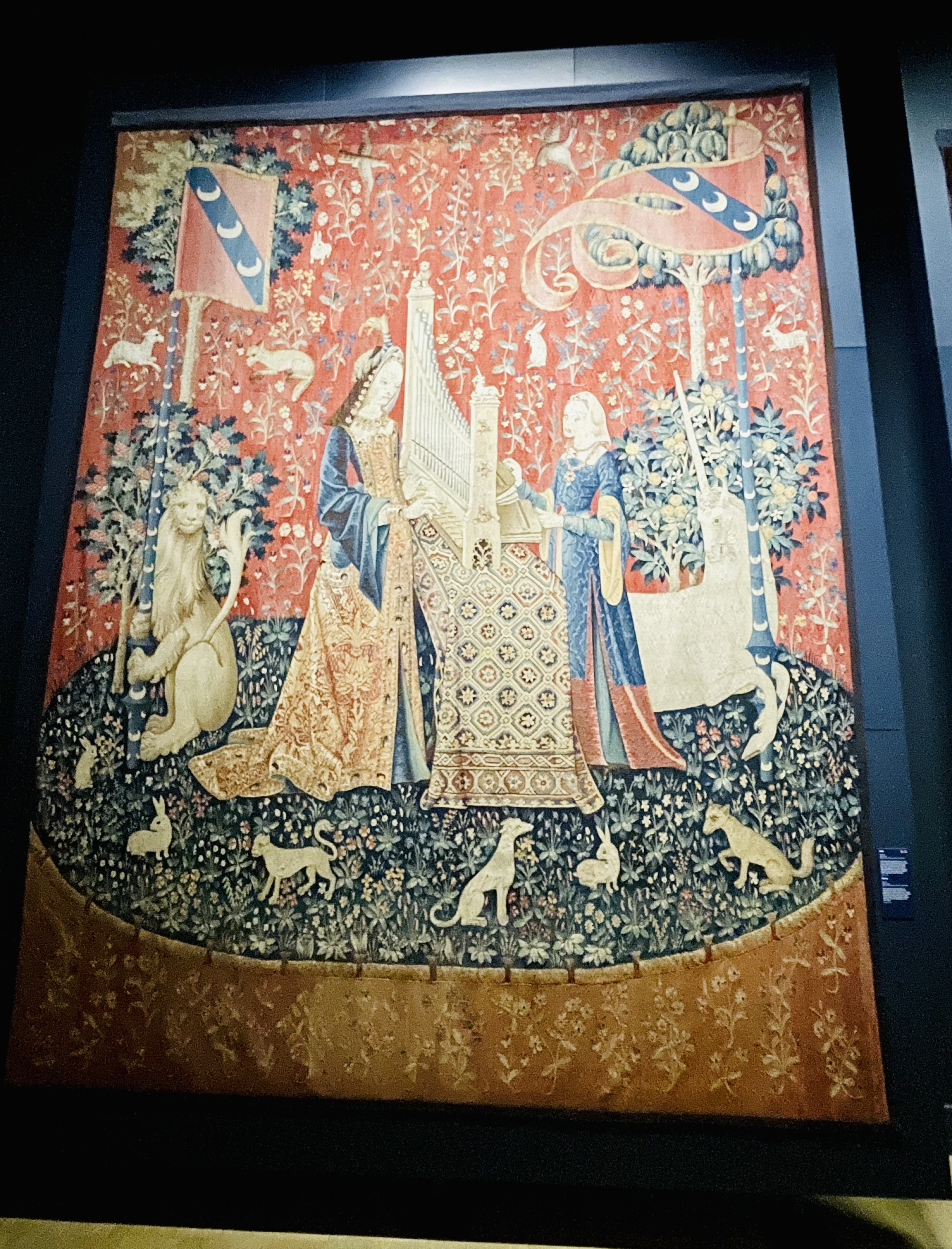
The Book of Glory, from the beginning, invites us to engage with our sense of touch, but it also invites to engage with a sixth sense. As I was studying the Gospel of John and the five senses these last few months, I learned about a series of six medieval tapestries which are considered one of the most powerful evocations of the five senses. They are called “The Lady and the Unicorn” and they have been hailed as “the Mona Lisa of the Middle Ages.” Each one of these tapestries portrays a Lady and a Unicorn engaging with one of the five senses; and as I looked at them online, I quickly realized that we have one of them hanging in our narthex! Our tapestry here represents our sense of hearing as the Lady plays a portative organ while her maidservant operates the billows and while the unicorn and other happy creatures enjoy listening to the music. (The inclusion of the organ in the tapestry is apt, considering the prominence of our custom designed Kegg Pipe Organ.)
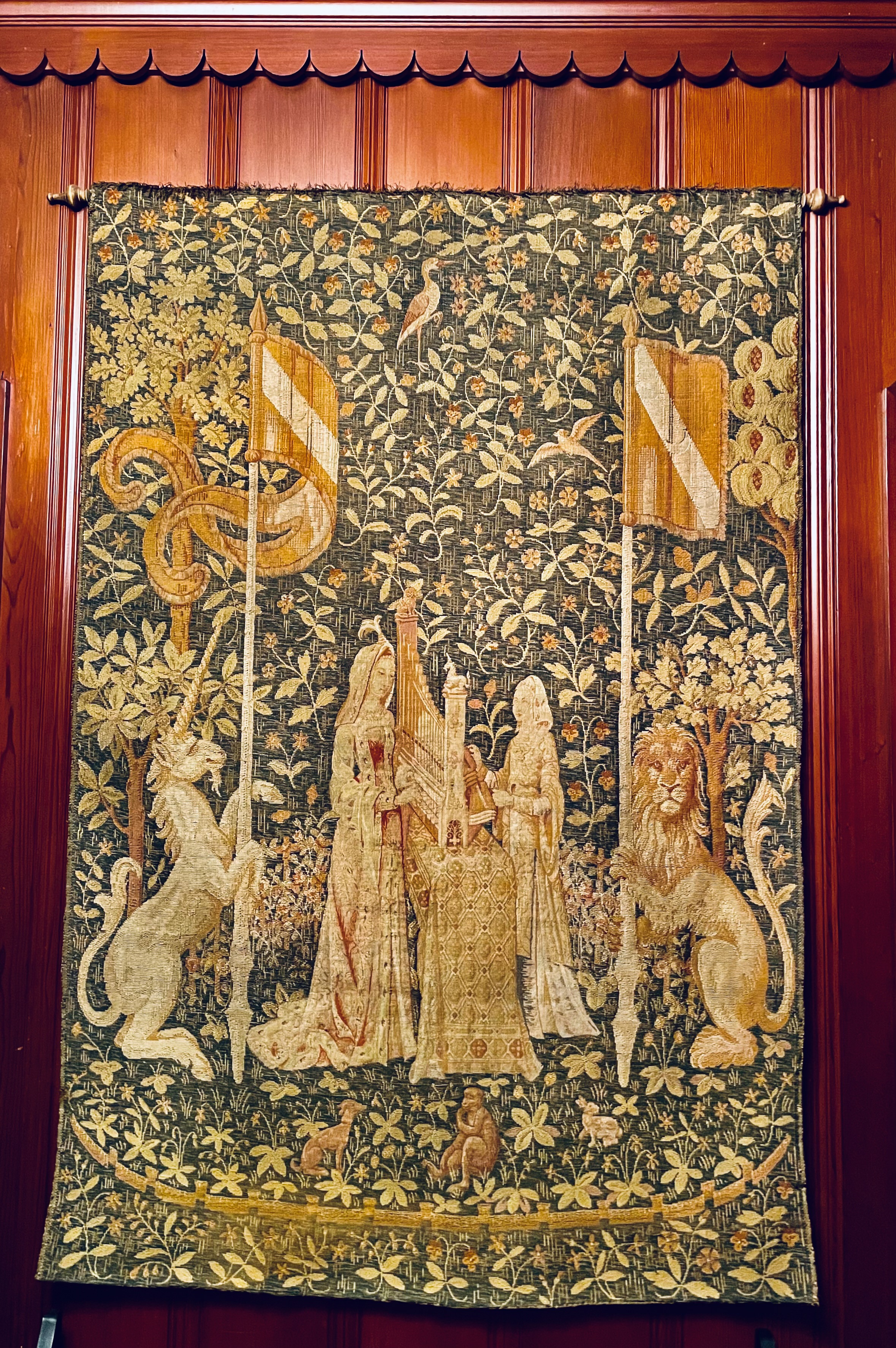
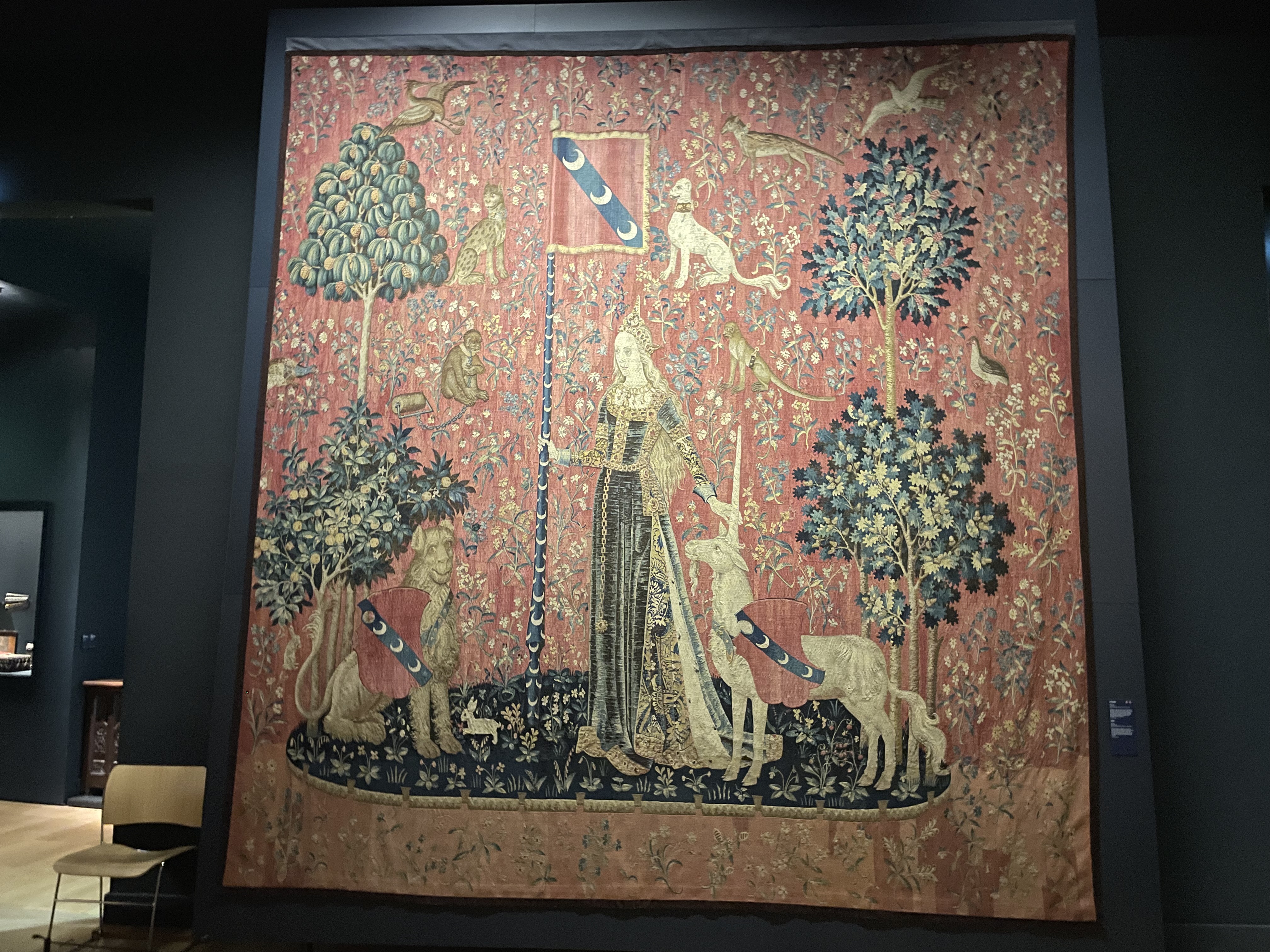
However, there are six tapestries in this series, portraying the five senses: our sense of touch, as the lady touches the unicorn’s horn; our sense of taste, as the lady feeds candy to her parakeet; our sense of smell, as the lady enjoys the aroma of a bouquet of flowers; and our sense of sight, as the unicorn peers at its reflection in a mirror. These colorful tapestries are known as the “Mona Lisa of the Middle Ages” and have appeared in films, novels, and album artwork. Because we do not know the artist, we are left to interpret the artwork for ourselves; and it is the sixth tapestry that invites the most interpretive engagement from the viewer. In this tapestry, the Lady removes her necklace (just as Jesus removed his outer garments) and lays bare her heart. Although there are several interpretations, I see this tapestry representing our heart sense. And it is the heart sense which is emphasized the most in Jesus’s Farewell Discourse in the Gospel of John.


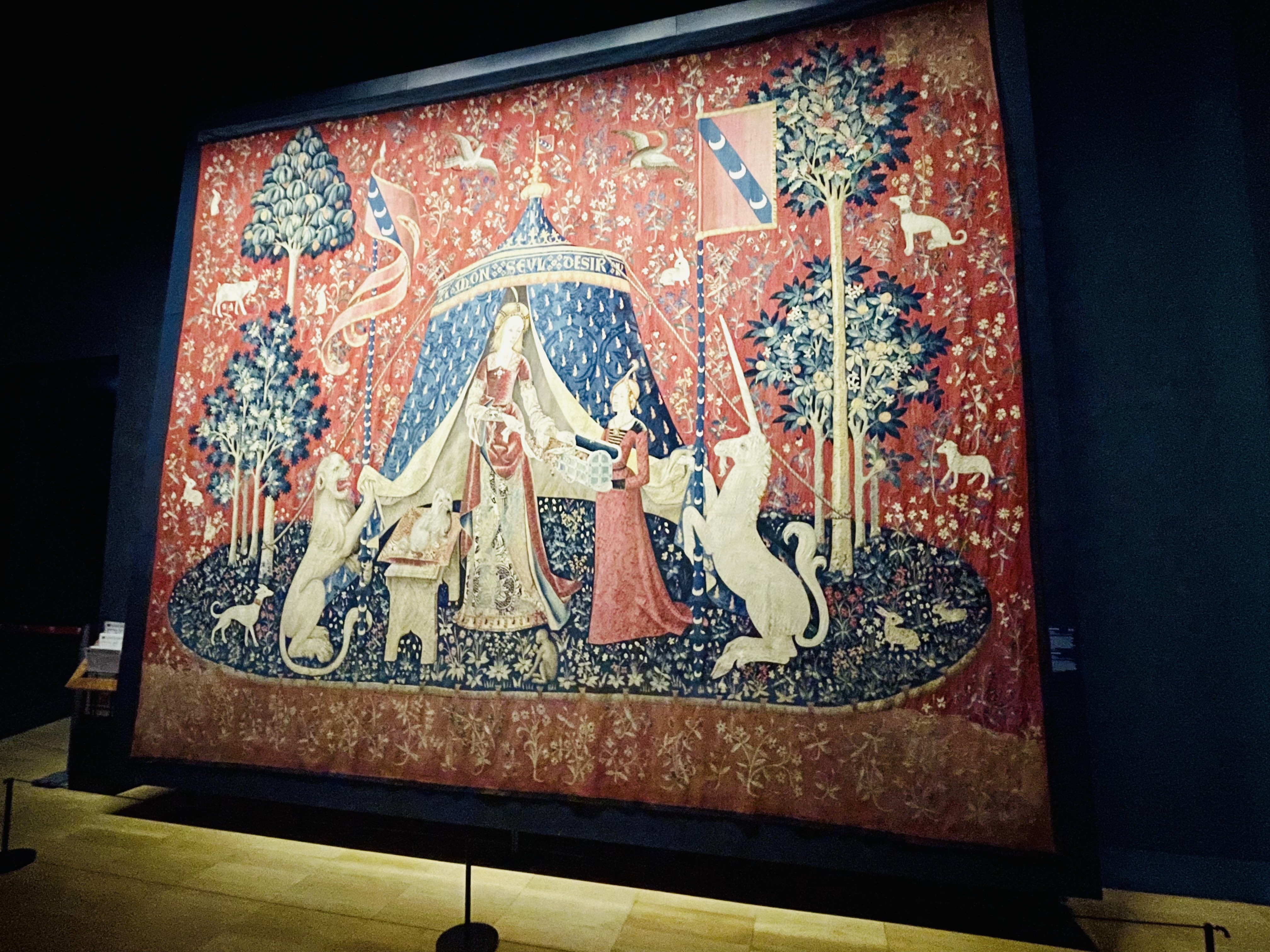
In the Farewell Discourse, Jesus says, “Do not let your hearts be troubled. Believe in God; believe also in me. In my Father’s house there are many rooms. I’m going up there now to prepare a place for you that where I am there you may also be” (John 14:1-3). Jesus says, “Because I have said these things to you, sorrow has filled your heart [kardian]” (John 16:6). He says, “You have pain now; but I will see you again, and your hearts [kardia] will rejoice, and no one will take your joy from you” (16:22). Jesus can see and feel what is and what will be in his disciples’ hearts. Also, while Jesus is speaking, the beloved disciple (who is the author of John’s Gospel) at one point is described as resting on the bosom of Jesus (John 13:23), and the Celtic Christians believed that he was listening to the heartbeat of Christ.[5] At the center of the Farewell Discourse is the invitation to rest and abide in the prayer of the heart and draw strength from Christ just as a branch draws strength and nourishment from its vine. Jesus says that if we do not abide in the prayer of the heart, we will not bear any fruit (John 15:5). So how do we get in touch with our heart sense enough to abide in the prayer of the heart? It’s actually quite easy. Simply place your hand on your heart, where Christ is already present. If you think or feel like he’s not present and you want him there, then just invite him in. Place your hand on your heart and notice what you feel and try to verbalize those feelings into prayers.
At the end of this service, I will remove my stole (just as the Lady removed her necklace and Jesus removed his outer garments) and I will place this symbol of service and footwashing here on this pulpit. And I invite you, when you see this stole, this orarium, this liturgical towel, during these three months, to get in touch with your heart, to even place your hand on your heart and to pray. Pray for me and remember that I will be praying for you. Pray with the constancy of the apostles in Acts, who were “constantly devoting themselves to prayer” (Acts 1:14). Pray as Peter calls us to pray by casting all our anxiety on God because he cares for us. Pray for growth and pray for what Jesus prayed for in today’s Gospel, in the final words of the Farewell Discourse. Pray for unity among God’s people. Pray for unity in the Anglican Communion, in the wider Episcopal Church, in this parish, that we may be one as the Father and Son are one.
Let us place our hands on our hearts now and pray together.
God, we cast all our anxieties on you because you care for us, and you invite us to rest and abide in you. Give us the will and desire to pray with the same consistency of your first apostles and help us to listen to you and feel your presence in our own hearts, guiding us towards greater unity, growth, and love during this season of Sabbatical. And may everyone here know that they are loved perfectly by you and imperfectly but sincerely by me, in Christ’s Name we pray. Amen.
[1] In the Farewell Discourse, Jesus assures his disciples that he will return “in a little while” (John 16:16) and that, in the meantime, he will send the Holy Spirit, the Advocate. I will also return in a little while and in the meantime the Holy Spirit will be with you in a variety of ways, including in the able leadership of Mother Lesley. The Church will be celebrating the coming of the Holy Spirit next Sunday at Pentecost; and I will be thinking of you and holding you all in my heart as I celebrate Pentecost at Canterbury Cathedral, the Mecca of the global Anglican Communion. After Canterbury Cathedral, I will travel up to Yorkshire to complete my training as a Forest Therapy Guide and to commence my Sabbatical which I’m calling “a Sabbatical of the Senses.”
[2] Helen Keller said, “Paradise is attained by touch; for in touch is all love and intelligence.” Helen Keller, The World I Live In (London: Hodder and Stoughton, 1904), 3.
[3] Everything in the five chapters of the Farewell Discourse ought to be understood in the light of the footwashing, a practice that we liturgical Christians rarely ever do even though Jesus explicitly told us to do it.
[4] https://www.britannica.com/topic/stole
[5] John Philip Newell, Listening for the Heartbeat of God: A Celtic Spirituality (Mahwah NJ: Paulist Press, 1997)

 DANIEL DeFOREST LONDON