
Readings for the Fifth Sunday of Easter (Year A)
This sermon was preached at Christ Episcopal Church in Eureka CA on Sunday May 7, 2023.
This weekend, our Anglican siblings across the pond celebrated an elaborate Eucharist as they crowned their new king, Charles III, at Westminster Abbey, an ancient building that was filled with people singing and cheering the Latin words, “Vivat Rex Carolus!” (Long live King Charles). Who here got up at 3 AM to watch the coronation service on Saturday? Later yesterday morning, several of us gathered here to celebrate our own Rex with a Eucharist and Burial Service for our brother John Rex White. Who here got up at 3 AM to watch the coronation service and then came here for Rex’s service for a Double Rex Day? I watched the coronation live and then officiated Rex’s service here and, although I’m sleep-deprived, I appreciated how these two services coincided on the same day. Not only did they both revolve around a “Rex,” but they also expressed a uniquely Anglican openness to other faith traditions. At the coronation service, faith leaders and representatives from the Jewish, Sunni and Shia Muslim, Sikh, Buddhist, Hindu, Jain, Bahai, and Zoroastrian communities were part of the procession into Westminster Abbey. At Rex’s service, we celebrated our Episcopal brother’s spiritual journey which included explorations into Qi Gong, Tantra, Tarot, Yoga, Kabbalah, and Vedanta and more; and I described how these were among the “many dwelling places within the Father’s house,” to use Jesus’s words from today’s Gospel, which is the same Gospel we read yesterday.

When I first met Rex, I was reading a book by Harvard professor Harvey Cox titled Many Mansions: A Christian’s Encounter with Other Faiths. The title Many Mansions is a reference to the Gospel we just heard read. “Mansions” is another translation for “dwelling places.” In the book, the author writes, “Those who look with appreciation on other faiths frequently cite John 14:2 and suggest that the ‘many mansions’ may refer to the heavenly palaces in which Hindus and Buddhists will dwell—alongside Christians—in the hereafter.”[1] However, in this same passage we have another verse that is often used as a tool or weapon for Christian exclusion: John 14:6 in which Jesus says, “No one comes to the Father except through me.” Harvey Cox says, “Those who insist that all others must accept Christ or be damned…prefer to cite John 14:6 and declare that Jesus alone is the one true way to salvation. What can we say about this curious juxtaposition of seemingly contradictory texts? Could it be telling us about the need to hold the universal and the particular together and about the central place Jesus must have for Christians even in the most expansive interfaith dialogue?”[2]

When we look at today’s Gospel in the larger context of John, we see that when Jesus says, “I am the way,” he is saying “I am embodying the way to heaven” and it is the way of love. No one comes to the Father except through self-giving love. Conversely, no one comes to the Father through hatred, anger, violence, power-grabbing, ego, and division. So, if we ever use these words of Jesus to exclude and condemn others to eternal damnation or to clobber them into conversion, then we are committing a form of blasphemy because we are taking the very words that call us to welcome and love others and using them to exclude and to divide. And sadly, we Christians have been guilty of this blasphemy; and many Christians still blaspheme in this way today.
Queen Elizabeth II understood the Way of Love that Christ embodied and endorsed and mandated when she said in 2012, “The concept of our established Church is occasionally misunderstood and, I believe, commonly under-appreciated. Its role is not to defend Anglicanism to the exclusion of other religions. Instead, the Church has a duty to protect the free practice of all faiths in this country.”[3] That’s part of how the Church embodies the Way of Love. If we use our religion to hurt others, then we are not walking in the Way of Love; rather we are behaving like the violent religious leaders who stoned Stephen to death, as we heard in our reading from Acts. And what were the first Christians called in the book of Acts? That first generation of Christians of which Stephen was a part? They were called followers of “the Way.” The first Christians were not known for believing and confessing the Nicene Creed. It hadn’t been written yet. They were known for walking in the Way of Love and emulating the One who perfectly embodied the Way to such an extent that he was the Way: Jesus Christ.
This understanding opens up opportunities and possibilities for interfaith learning and dialogue and partnerships like the ones expressed at the coronation and in Rex’s life and like those we enjoy here through our participation in the Humboldt Interfaith Fellowship. However, I am not in favor of interfaith partnerships that water down traditions and strip them of their uniqueness and integrity, insisting that we’re all basically saying the same thing, because we’re not. At the coronation service, the worship bulletin highlighted “the importance of [including] other faiths whilst respecting the integrities of the different traditions.”[4] We Christians do believe that Jesus Christ is the perfect embodiment of God’s Love. Let’s not be afraid or ashamed to proclaim that.
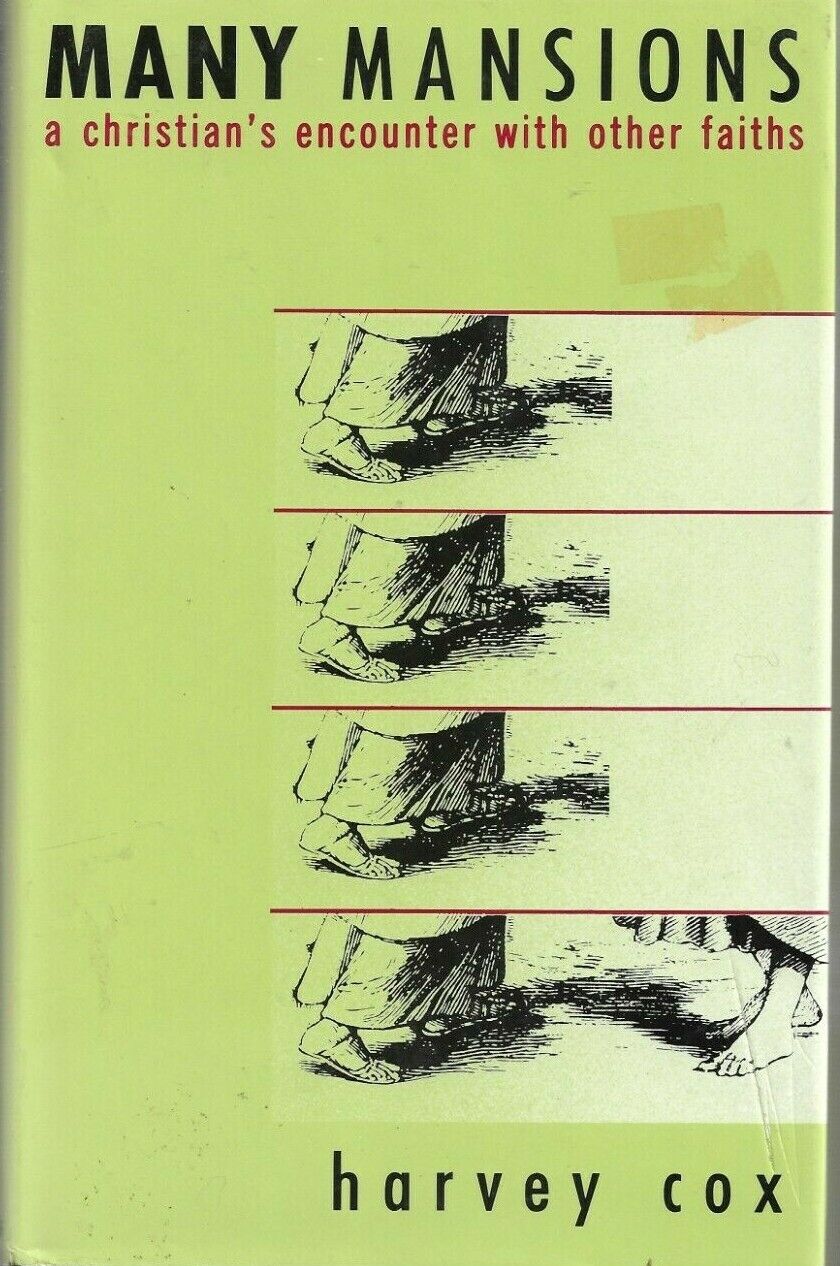
Harvey Cox learned that interfaith dialogue tactics that play down the Jesus factor are counterproductive because it is “just this factor that the non-Christian participants often seem most interested in and most eager to get to.”[5] By placing the figure of Jesus on the agenda, we are not killing interfaith dialogue, we are enlivening it. Might we learn how to talk about Jesus as the perfect embodiment of God’s love in a non-threatening way while also understanding that there are many mansions in God’s house?
Harvey Cox concludes his thoughts on today’s Gospel by saying, “From Jesus I have learned both that he is the Way and that in God’s house there are many mansions. I do not believe these two sayings are contradictory. In fact I have come to see that only by understanding one can we come to understand the other.”[6]
A tree grows best when its roots are strong; and it is by rooting ourselves strongly within our own tradition and our own conviction that Jesus Christ is the Way that we can extend our branches and engage authentically with those outside of our tradition to embody that expansive Anglican virtue of “openness,” a virtue that will serve us well as we walk together in the Way of Love.
[1] Harvey Cox, Many Mansions: A Christian’s Encounter with Other Faiths (Boston: Beacon, 1988), 10.
[2] Harvey Cox, Many Mansions: A Christian’s Encounter with Other Faiths (Boston: Beacon, 1988), 10.
[3] https://mcusercontent.com/884713712461d5df7ee1d45ea/files/ed35e72e-31c5-4ea8-63bd-968ec026bbae/23_24132_Coronation_Liturgy_Commentary.pdf, p. 7.
[4] https://mcusercontent.com/884713712461d5df7ee1d45ea/files/ed35e72e-31c5-4ea8-63bd-968ec026bbae/23_24132_Coronation_Liturgy_Commentary.pdf, p. 2
[5] Harvey Cox, Many Mansions: A Christian’s Encounter with Other Faiths (Boston: Beacon, 1988), 8.
[6] Harvey Cox, Many Mansions: A Christian’s Encounter with Other Faiths (Boston: Beacon, 1988), 19.

 DANIEL DeFOREST LONDON