
Readings for the Third Sunday of Easter (Year A)
This sermon was preached at Christ Episcopal Church in Eureka CA on Sunday April 23, 2023.

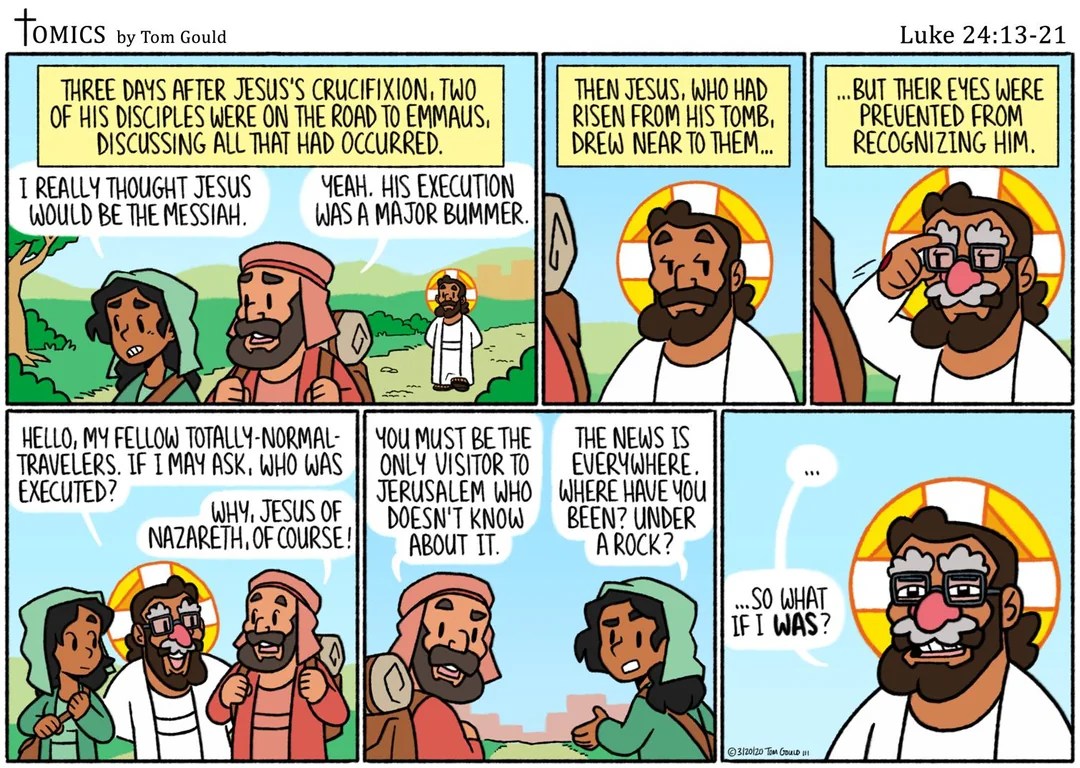
Last Sunday was Holy Humor Sunday, but the Easter laughter (the risus paschalis) persists in today’s Gospel reading in which Jesus seems to play a kind of practical joke on the disciples on their way to Emmaus. Now many of us might feel uncomfortable associating Jesus with humor and jokes, since humor can sometimes be offensive or hurtful, but we know Jesus was a tremendously engaging and charismatic preacher who drew enormous crowds and we also know he offended many people, which is why he got crucified. So, it’s hard to imagine that he didn’t employ humor often in his teachings. Many biblical scholars insist that the wit and playful humor of Jesus are “the most impressive and yet underappreciated features of the Gospels.”[1] And I personally see the playfulness of Jesus perhaps most clearly in this beloved story in which the disciples on the Emmaus Road, according to Garrison Keillor, were the happy victims of one of the greatest practical jokes of all time. Jesus approaches two of his followers in some kind of natural or supernatural disguise and says, “Hey guys! What are you talking about?” And they say, “We’re talking about the only thing that everybody’s talking about. Are you the only person on the planet who doesn’t know what’s happened in the last few days? Have you been living under a rock?” Ironically, Jesus had indeed been buried behind a rock, but even more ironically, he was the only person on the planet who truly knew the meaning of what had happened in the last few days. The irony here is thicker than the heavy stone which was removed from the tomb.
And Jesus continues to play dumb, asking, “What things? What did I miss?” He is clearly having way too much fun with this. So, the disciples then describe the crucifixion of a prophet named Jesus of Nazareth whom they hoped was to be the Messiah; and then they mention some unbelievable accounts from women about angels and the empty tomb.
Then Jesus has more fun when he says, “It’s actually you who are the ignorant ones here! Don’t you know the Messiah had to suffer these things before entering into glory, as the prophets proclaimed?” And he uses this phrase “slow of heart” (bradeis te kardia). Not only are the disciples ignorant of the prophets they are also “slow of heart to believe” (bradeis te kardia tou pistooein). When it comes to understanding the sacred Scriptures, we must read them not only with our heads but also with our hearts. We might be very quick to comprehend things up here [pointing to the head] while at the same time being very slow to understand things here [pointing to the heart]. Remember that the word “credo” which is usually translated as “I believe” means to “give one’s heart to.” So, when we say the Nicene Creed in a few moments, we will be giving our hearts to the Creator, the Christ, and the Creative Spirit.
Jesus then leads the disciples in a Bible Study while they continue walking. This is the first Christian Sacred Saunter. And I’m not just saying that to be cute. This story is a real affirmation of our Sacred Saunters and our parish vision to be a community of companions walking together in the way of Christ’s love for all. Our Sacred Saunters are not just a gimmick. They are in fact a re-enactment of the first Easter Eucharist because that is exactly what this is. This story serves as the foundation for the liturgical structure of the Holy Eucharist, of what we’re doing right now. We begin with the Liturgy of the Word as we listen to the Scriptures with our minds and hearts and then hear them interpreted from a Christian perspective. We do this now while sitting in a beautiful church building, but the playful Risen Christ prefers to do this part while walking outside, as we do at Sacred Saunter. After the Liturgy of the Word, we shift to the Liturgy of the Table.
“As they came near the village to which they were going, [Jesus] walked ahead as if he were going on. But they urged him strongly, saying, ‘Stay with us, because it is almost evening and the day is now nearly over.’ So he went in to stay with them” (Luke 24:29). From a literary perspective, this verse is the center of the narrative. The disciples do not yet recognize Jesus, at least not with their minds, but their hearts desperately want him to stay. This verse has inspired a lovely Collect in our Evening Prayer office on page 124 of your prayer book called the Collect for the Presence of Christ: “Lord Jesus, stay with us, for evening is at hand and the day is past; be our companion in the way, kindle our hearts, and awaken hope, that we may know you as you are revealed in Scripture and the breaking of bread. Grant this for the sake of your love. Amen.”
When Jesus was at table with the disciples, he does exactly what we’ll do here in a few moments. He takes bread, blesses it, breaks it, and gives it to them. And then their eyes are opened, and they recognize him. And when I read this story with my heart, I can’t help but see Jesus with a twinkle in his eye, smiling and then winking before vanishing from their sight.
Every Sunday before Eucharist, I pray that Jesus be known to us in the breaking of the bread just as he made himself known at this first Easter Eucharist. Whether it be here or at Sacred Saunter, may we open our hearts to the playful presence of Christ in the Word and in the breaking of bread. Abide in him and invite him to stay with you. Although we may be slow to recognize him and although we might be “slow of heart to believe,” Christ is here now, with a twinkle in his eye, smiling almost mischievously, because he knows that when we look back on this Eucharist perhaps later this week or later this year or perhaps not until we’re on the other side of the grave, we will realize that our hearts were burning in his presence here and he was being revealed to us, mysteriously, powerfully, and even playfully, in the breaking of the bread. Amen.

[1] Terri Bednarz, Humor in the Gospels: A Sourcebook for the Study of Humor in the New Testament, 1863 – 2014 (Lanham MD: Lexington, 2015),45.

 DANIEL DeFOREST LONDON
❤️