
Readings for the Third Sunday in Lent (Year A)
This sermon was preached at Christ Episcopal Church Eureka on Sunday March 12, 2023.
Last Sunday, I echoed and emphasized Christ’s invitation to listen to the wind, including the wind that breathes through our own bodies. We’ve had some especially gusty days this last week, and I’ve enjoyed hearing from some of you about the wisdom that you heard whispering in the wind. Some heard a gentle and reassuring voice and others heard a loud and awe-inspiring roar. Amidst the wind, I heard the voice of the late Frank Griswold, the former Presiding Bishop of the Episcopal Church who died last Sunday (March 5) and who reminded me of George Herbert’s definition of prayer as “God’s breath in man returning to his birth.” Some of you heard in the wind the voice of Fr. Shewmaker, whose presence is still felt here and especially in our chapel, when we gather for Centering Prayer on Tuesday nights. However, this last Tuesday, when we sat together in silent meditation, it was not so much wind that we heard, but water, the splattering gush of rainwater spilling out of the gutters into the courtyard. It was a deluge that seemed to grow louder during our meditation time and then dissipated just in time for our post-meditation conversation.
Listening to the sound of water is, of course, heavenly, as the Hebrew language underscores in its word for heaven: shemayim, a combination of the word shema, which means “listen” and mayim, which means “water.” The sound of water flowing from the rock of Horeb, after Moses struck it with his staff, must have sounded heavenly to the parched Israelites in the desert. It must have also been quite a sight to behold: this natural spring gushing forth from a dry stone. The Hebrew word for a spring of water is ayin, which is the same word for the eye that sees, including the eye of God.[1] So water, which existed with God at the beginning of creation according to the Bible and which existed at least before our sun according to astronomers, engages our senses of audition and vision, but it is our sense of taste that the Gospel most clearly underscores when it comes to water.[2] Our Gospel this morning is all about tasting water and food in ways that truly satisfy our hunger and quench our deepest thirst. With this emphasis on taste, I can’t help but invite us this week to practice mindful eating and drinking, taking the time to try to slowly savor our food and drink the way the French novelist Marcel Proust enjoyed his tea and Petite Madeleine cookie, an experience he describes eloquently in Remembrance of Things Past. He writes, “Weary after a dull day and already depressed about tomorrow, I raised to my lips a spoonful of the tea in which I had soaked a morsel of the Madeleine cookie. No sooner had the warm liquid, and the crumbs with it, touched my palate, a shudder ran through my whole body, and I stopped, intent upon the extraordinary changes that were taking place. An exquisite pleasure had invaded my senses; and at once the vicissitudes of life had become indifferent to me, its disasters innocuous, its brevity illusory—this new sensation having had on me the effect which love has of filling me with a precious essence; or rather this essence was not in me, it was me. I had ceased now to feel mediocre, accidental, mortal. What caused this all-powerful joy? It was the taste of the tea and cookie.” Now that’s how to enjoy our sense of taste!

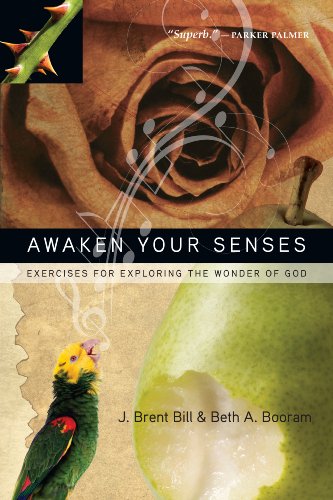
However, although I invite us to eat and drink mindfully with gratitude, we notice that Jesus, who asks for a drink of water while his disciples are out buying food, never actually seems to drink any water or eat any food throughout this whole passage. And when Jesus is finally told by his disciples to “eat something” he says that his “food is to do the will of him who sent me” (4:34). Jesus does not seem to be physically tasting anything and yet he is still feasting spiritually. Jesus’s own hunger and thirst were quenched by sharing the good news of God’s love with the Samaritan woman, using his words. This leads me to offer another invitation for us, inspired by John 4 as well as a book titled Awaken Your Senses: Exercises for Exploring the Wonder of God. In this book, the authors connect our sense of taste with the taste of words. There’s a condition called lexical-gustatory synesthesia in which people experience an actual taste in their mouths upon hearing or saying words. Some people taste a burnt, scorched flavor in their mouth upon hearing the words fire or smoke and I’ve met some people who say they get nauseous upon hearing the word moist. We don’t need to have lexical-gustatory synesthesia to appreciate the satiating power of words, words that we hear and words that we speak. “Words evoke a variety of ‘flavors.’ Some are sweet and appetizing, while others are bitter and distasteful. Some bless and build up; others tear down and wound. Pay attention to your reaction to these words: Loving, kind, good-hearted, sweet, honest, beautiful, sincere, valiant. How do these words ‘taste’? Now watch your reaction to [these words]: ugly, ungrateful, wretched, cruel, worthless, vile, evil, despicable. How do you describe their flavors? As the proverb suggests, ‘Words kill, words give life; they’re either poison or fruit—you choose’ (Proverbs 18:21).”[3]
So, I invite you this week to taste words! Consider words or phrases that you find especially tasty and delicious and nutritious and life-giving. This invitation is appropriately inspired by the Gospel that begins with the Word, the Word that was with God, and the Word that was God.[4] By tasting words that we speak and that we hear spoken (including the words of our liturgy), we remain open to having our deepest hungers and thirsts quenched by Christ, who is the source of Living Waters, the Rock from which Living Waters flow. When I speak, something inside my body, which is 70% water, is vibrating something inside your body, which is also mostly water. By tasting words, we are, in a sense, tasting the water that is within us.

This last summer, I invited the Sisters of the Transfiguration to share their favorite tasty words with me and I wrote them down. So, in conclusion, I offer these delicious words from Anglican nuns to you, as some food for thought as you eat and drink mindfully this week and as you feast on your own favorite nutritious words, especially the One who is the Word made Flesh.
Here are some of their tasty words and phrases:
Luminous
Welcome
Be still
Lenticular clouds
Enchiladas
Monkey-puzzle tree
Tacos from Pancho’s
Chocolate ice cream
Garlic
Bread of Heaven
Last day of school
Fresh Mountain Spring Water
Grace
Amen.
[1] The reading from Exodus 17:1-17 emphasizes this etymological connection when it says, “Moses did this in the sight of the elders of Israel.”
[2] Alan Watts writes, “In the third chapter of Saint John’s Gospel, Jesus is reported to have said that if a man would enter the Kingdom of God he must be born again of Water and the Spirit. Further, in the first chapter of Genesis, it is said that before the creation of the world the Spirit moved upon the face of the waters. It seems to follow, therefore, that these two elements, water and spirit, are necessary to Divine Creation, whether it is the creation of a universe or of a son of God.” Watts, “The Birth of the Divine Son: A Study of a Christian Symbol” in Become What You Are (Boulder: Shambala, 2018), 165. Diana Butler Bass writes, “Perhaps God is water as well as spirit. It is easy to to imagine John’s Jesus saying, ‘We enter into the sacred presence through water and wind.” Bass, Gounded, 70. Regarding water’s pre-solar origins, see https://www.thestar.com/news/canada/2023/03/13/scientists-may-have-discovered-the-origin-of-water-in-our-solar-system.html.
[3] Beth Booram and J. Brent Bill, Awaken Your Sense: Exercises for Exploring the Wonder of God, 50 – 51. Biblical quote from The Message.
[4] Origen of Alexandria makes a similar point when he interprets Jesus’s statement to the Samaritan woman, “You worship what you do not know; we worship what we know, for salvation is from the Jews” (4:22). Origen writes, “the ‘we’ according to the letter means the Jews but taken allegorically means I the Word, and those formed in accordance with me, who have salvation from the Jewish words.” Origen, Commentary on the Gospel according to John 13.101, translated by Ronald E. Heine (Washington DC: Catholic University of America, 1993), 89, as cited in Miriam DeCock, Interpreting the Gospel of John in Antioch and Alexandria (Atlanta: SBL Press, 2020), 105. Origen also relates each of the Samaritan woman’s five husbands to the five senses. Origen, Commentary on John 13.51, as cited in DeCock, 108.

 DANIEL DeFOREST LONDON