
Readings for the Feast of the Christ Mass
This sermon was preached at Christ Episcopal Church Eureka for the Christmas Day service on Sunday December 25, 2022.

Our Gospel reading today includes the most central and crucial phrase in all of Christianity, according to Archbishop William Temple: “The Word became flesh.” In Christ, God chose to use human flesh as a vehicle, as the vehicle par excellence, for his glory. By doing this, God reaffirmed the proclamation made at the beginning of creation when God looked all that he had made, including human flesh, and saw that “it was very good” (tov m’od).
The Gospel of John continues to echo this affirmation by inviting us to appreciate the gift of our flesh, particularly our bodily senses: to listen to the wind with Nicodemus (John 3:8), to quench our thirst with the Samaritan woman (John 4:14), to see God at work in the messy muddiness of our lives with the man born blind (John 9:6), to smell the aroma of grief laced with joy with Mary, Martha, and Lazarus (John 11:39; 12:3), and to touch the feet of Christ with the disciples (13:5) and to touch the Body of Christ with Mary Magdalene and Thomas, to experience the Body of Christ that is made manifest in the beloved community (John 20:25) and made present to us in the consecrated bread and wine, which we bring into our own fleshy bodies (John 6). Throughout the Fourth Gospel, the Word Made Flesh invites us to be refreshed by the gift of our own flesh, our own temples of the Holy Spirit (1 Cor 6:19). On this Christmas day, on this feast of the Incarnation, the Gospel of John invites us to appreciate the gift of our bodies, these vehicles through which God chose to manifest his glory perfectly in Christ Jesus. As our reading from Hebrews says, Christ in human form is “the reflection of God’s glory and the exact imprint of God’s very being” (Hebrews 1:3).
Theologian Elizabeth Johnson reflects on John’s prologue and that consequential phrase “The Word became flesh” when she writes:
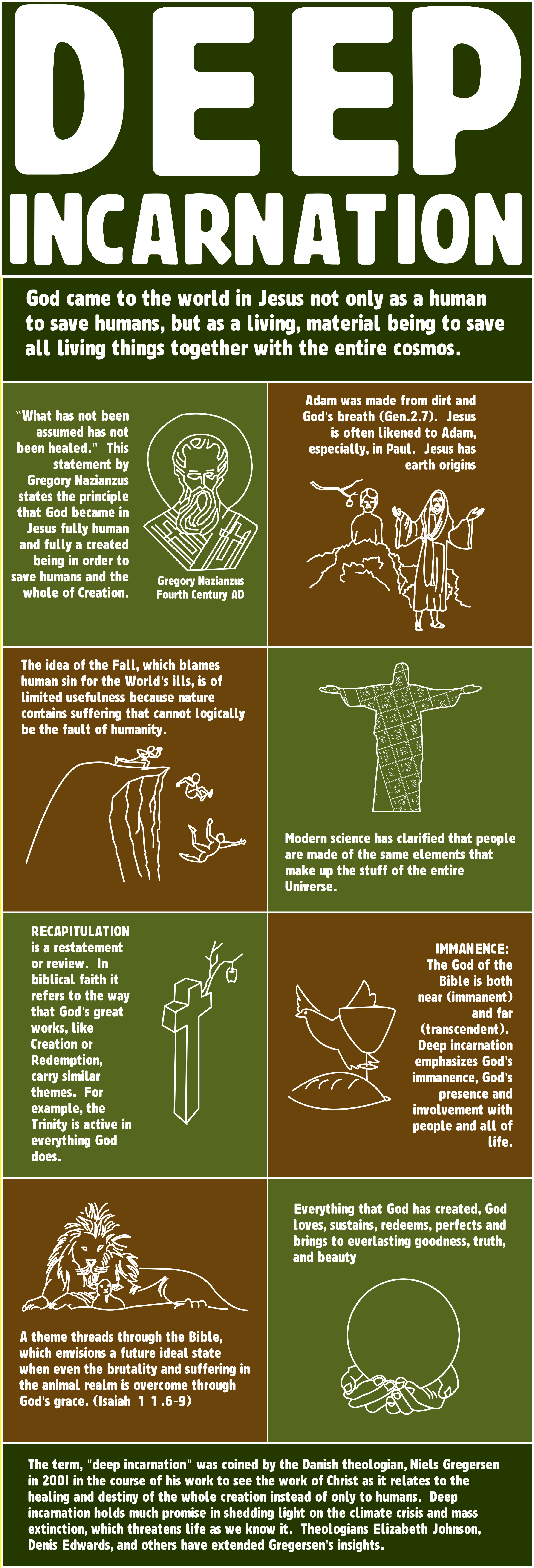
“Born of a woman (Gal 4:4) and the Hebrew gene pool, Jesus of Nazareth was a creature of earth, a complex unit of minerals and fluids, an item in the carbon, oxygen and nitrogen cycles, a moment in the biological evolution of this planet. Like all human beings, he carried within himself the signature of the supernovas and the geology and life history of the Earth. The atoms comprising his body once belonged to other creatures.”[1]
This is a description of what theologians call “deep incarnation,” which is the idea that God came to the world in Jesus not only as a human to save humans, but as a living, material being to save all living things together with the entire cosmos. God did not become incarnate in a human body on this earth to cut us off from our human bodies and from the earth and snatch us up to some distant heaven. God became incarnate as a human so that we might become fully human and more fully alive in our human bodies on this earth and then eventually in our resurrected bodies. St. Irenaeus said, “The glory of God is a human being fully alive.” And although we don’t know all the details and mechanics of it, we know that God’s plan is not to discard this earth, but rather to bring heaven to earth, which is why Christ taught us to pray, “May your kingdom come and your will be done on earth as it is in heaven.”
Hildegard of Bingen said, “If we fall in love with creation deeper and deeper, we will respond to its endangerment with passion.” We protect what we love. The Gospel of John invites us to love and affirm (and thus protect) what God loves and affirms: our human bodies and this earth, this world that “God so loved the world” (John 3:16). The Bible is full of invitations to love and affirm and appreciate the gift of our bodies and our senses and the natural world. Even our short reading from Isaiah this morning calls us to admire the beauty of mountains and the beauty of human feet, to look, to listen, and to sing! However, Christianity has so often missed this.
Author Thomas Ryan uses a Johannine metaphor when he says, “[the] biblical legacy is fine wine, but alas, Christianity has poured copious water into its wine and resisted the radical nature of its own good news where the body is concerned. On the one hand, it has the highest theological evaluation of the body among all the religions of the world, and on the other hand, it has given little attention to the body’s role in the spiritual life in positive terms. High theology; low practice.”[2]
In John’s Gospel, I see high theology as well as invitations to spiritual practice as it offers several practical ways to deepen our love for these fleshy vehicles of God’s glory. John invites us to listen to the wind, to enjoy the refreshing taste of cold water, to go outside and pick up a handful of dirt and observe all the tiniest details the human eye can see, to smell the fresh air in a forest, to touch our feet and wiggle our toes, to place our hand on our heart and to rest and abide in the God who gave you your body and who became enfleshed in a body so that you may know that this gift, on this Christmas morning, is very good. Amen.
[1] Elizabeth Johnson, “Deep Incarnation: Prepare to be Astonished,” paper given at the VI International UNIFAS Conference, Rio de Janeiro, July 7 – 14, 2010, https://sgfp.wordpress.com/2011/02/15/deep-incarnation-prepare-to-be-astonished/
[2] Thomas Ryan, Reclaiming the Body in Christian Spirituality (Paulist Press: Mahwah NJ, 2004), xi.

 DANIEL DeFOREST LONDON