
Readings for the Second Sunday of Advent (Year A)
Isaiah 11:1-10
Psalm 72:1-7, 18-19
Romans 15:4-13
Matthew 3:1-12
This sermon was preached at Christ Episcopal Church in Eureka CA on December 4, 2022.
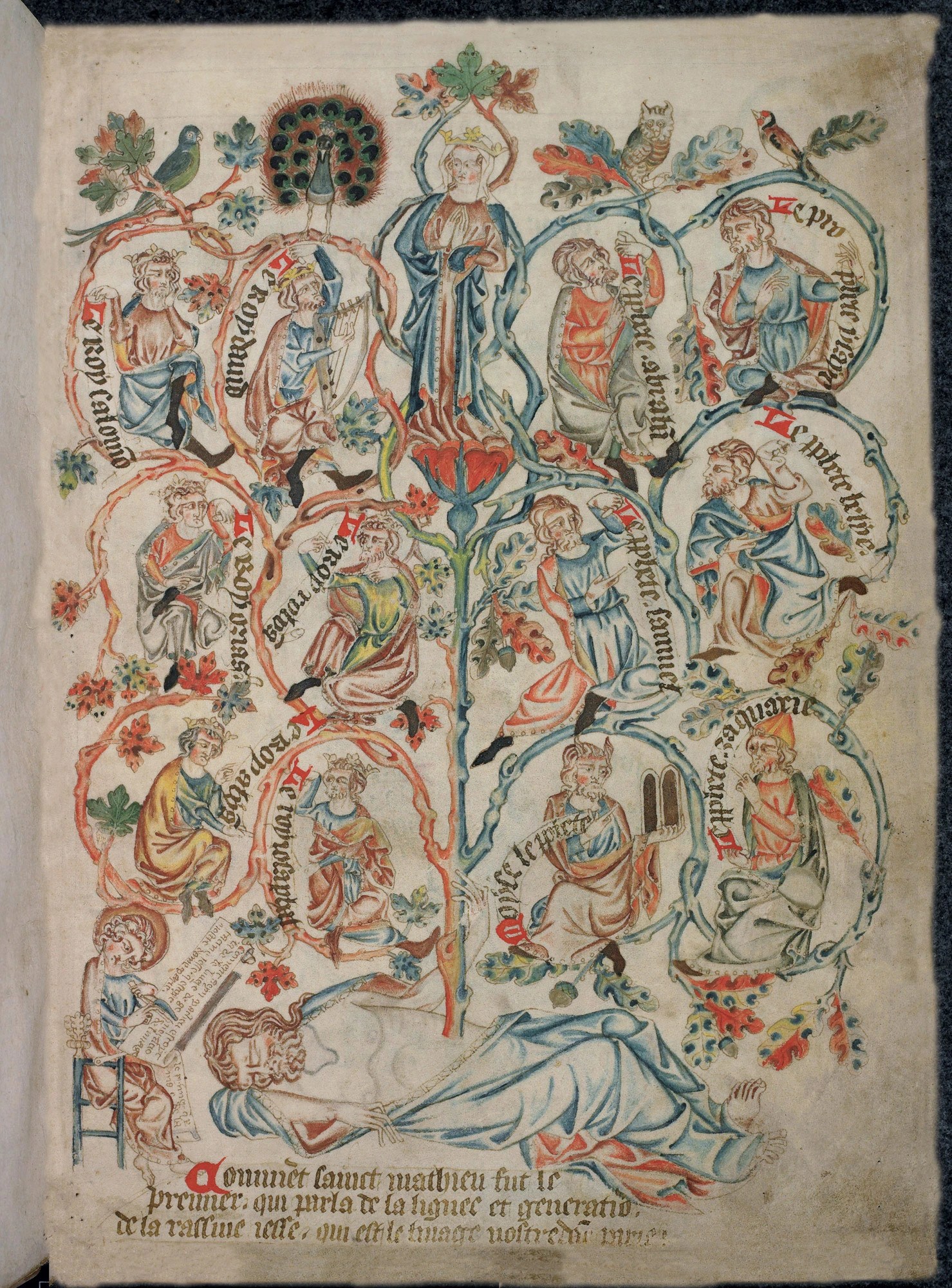
I often think of this morning’s reading from Isaiah when I walk through the woods and see a new shoot emerging from an old stump. There’s one particular redwood stump in Sequoia Park with a spruce emerging from it that often grabs my attention; and just yesterday, while walking through redwood park in Arcata, I saw the ruins of a fallen tree providing the base and nutrients for a much larger tree shooting out of its remains. As I observe this phenomenon in nature, I often hear today’s words of Isaiah echoing in my head, “A shoot shall come out from the stump of Jesse, and a branch shall grow out of his roots” (Isaiah 11:1). This reading reminds us once again how often the Bible refers to trees, and appropriately so on this Second Sunday of Advent when many of us are in the process of putting up trees within our own homes. Along with Christmas trees, many of our Roman Catholic siblings are putting up smaller trees called “Jesse Trees,” during Advent, which are inspired by this verse from Isaiah chapter 11. In fact, medieval depictions of Jesse Trees are the inspiration and origin for family trees. The Jesse Tree, as portrayed in art, depicted the family tree of Jesus. And that’s what today’s sermon is all about: the family tree of Jesus and why that matters to you.

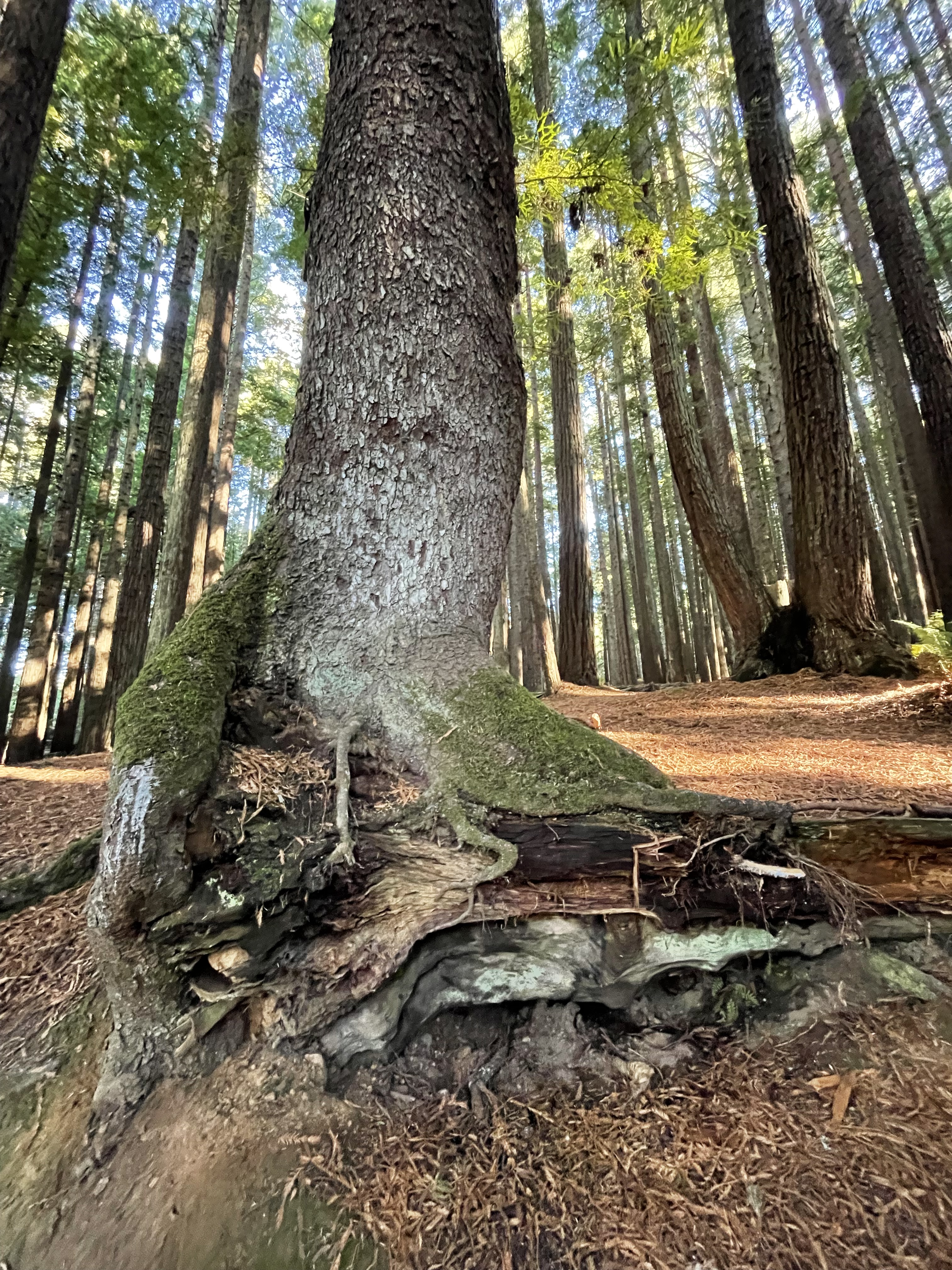
When the prophet Isaiah promises that a shoot shall come out from the stump of Jesse, he is saying that the Messiah will come from the same line of King David, whose father was named Jesse. However, in referring to a stump the prophet is implying that the original tree has fallen. The prophet makes this explicit in the previous chapter (Ch 10), when he says, “Look, the Sovereign, the LORD of hosts, will lop the boughs with terrifying power; the tallest trees will be cut down, and the lofty be brought low. He will hack down the thickets of the forest with an ax, and Lebanon with its majestic trees will fall” (10:33 – 34). This is not a description of God going out to the woods to chop down a Christmas tree or to deck the halls with boughs of holly. This is a prophetic description of destruction; and it is exactly what John the Baptist is referencing when he preaches in our Gospel reading today, saying, “Even now the ax is lying at the root of the trees” (Matthew 3:10). This prophecy of destruction was fulfilled when the Jewish temple was destroyed by the Romans in the year 70 AD. When that temple was destroyed, the Judaism of Jesus’s day (known as Second Temple Judaism) was like a tree that had been cut down. The Judaism of Jesus’s day no longer exists. What sprung up from the stump of Second Temple Judaism (which is deeply connected to King David and Jesse and can therefore also be called “the stump of Jesse”) was Rabbinic Judaism (the Judaism of today) and Christianity and some might also include Islam. The Jewish leaders who colluded with Rome to bring about the crucifixion of Jesus were part of a Judaism that no longer exists today. Judaism today is a sibling shoot that has sprung up from the same stump as Christianity. And this is a major point that Paul makes in his letter to the church in Rome, in which he describes Jews and Gentiles living together in harmony. Any Christian who denigrates the Jewish people has completely misread and distorted the Gospels and the writings of Paul.
Back in October, some of us here gathered in Redding for our first in-person diocesan convention in three years and we had the honor and privilege of being addressed by one of the most prominent biblical scholars in the world, Bishop Tom Wright, who elaborated on this morning’s reading from Paul’s letter to the Romans. In fact, he said that this morning’s passage from Romans 15 is “really where the entire argument of Romans is heading.” He said that Romans has been misread by Christians who regularly assume “that the point of Christianity is to enable sinners to go to heaven when they die.” But that’s really not the point of Christianity. The stump of Jesse is still rooted in the earth. God didn’t cut down the tree in order to plant a better one up in heaven. God cut down the tree in order for new shoots to emerge from it, in order for God’s kingdom to reign here on earth. That’s why John the Baptist and Jesus kept saying, “The kingdom of God is coming here on earth.”
As Tom Wright says, “Jesus came not to snatch sinners away from earth to a distant heaven, but to enable heaven’s life, heaven’s rule, heaven’s kingdom to infiltrate and transform and rescue the sad and sinful state of earth and us earthlings.”[1] So, Isaiah’s description of the wolf living with the lamb and the leopard lying down with the kid is not a description of some distant heaven, but rather of heaven on earth, even now. Paul believes that this prophecy is already being fulfilled in the church insofar as the church lives up to its call to be an “advance signpost to the coming day in which God will renew the whole creation just as surely as Jesus was raised from the dead.” This still involves our personal salvation, but we are not saved just to get to heaven but rather to be part of God’s process of bringing heaven to earth.[2]
The new life emerging from the old stump is an advance signpost of God’s new creation which has already been launched in the resurrection of Christ. And according to St. Paul, the church lives into its calling as a sign of new creation through its inner worshipping life, its daily work for justice and peace, and its embodiment of trans-ethnic and trans-cultural unity and reconciliation. Sadly, the church has done a rotten job with the latter, especially here in the US where 11 o’clock on a Sunday morning is the most segregated hour.
Bishop Wright even addressed the Black Lives Matter movement, saying, “Many devout Christians have been alarmed at this new [movement] – despite its rather obvious urgency, granted appalling policing practices on both sides of the Atlantic – because of its links with communist and anarchist movements. But, as often, that only happened because for generations the churches hadn’t been doing their job. We followers of Jesus were supposed to be the original multi-ethnic, multi-cultural family.”[3] Being part of Jesus’s family means being part of a multi-ethnic and multi-cultural family. And I would argue that being part of Jesus’s family tree means being part of a multi-faith family, where we can learn and grow and work for peace justice not only with fellow Christians but also with others who grow alongside us from that shared common stump of Jesse.
Today, in the Anglican Cycle of Prayer, we pray for the Episcopal Church in Jerusalem and the Middle East, where the churches strive to share the love of Christ with Muslims and Jews, with Palestinians and Israelis, with Iranians and Syrians and Lebanese, not by proselytizing, but by providing hospitals, health care, education, and community development. Although Jerusalem itself has been plagued with conflict and violence, the Episcopal Church in Jerusalem has served as a sign of new creation, as a multi-cultural, multi-ethnic, and in some cases multi-faith family. On this second Sunday of Advent, when we light what some refer to as the “Peace Candle,” may we pray for the peace of Jerusalem, a troubled city whose name ironically means “foundation of peace.” Although violent wolves still attack and devour lambs in our sin-sick world (for which we pray), we trust with Paul that God will put all things right in his new creation, which he has already launched in the new shoots from Jesse’s stump and in that fruitful branch of Christ’s multi-cultural, multi-ethnic, and multi-faith family tree.
[1] N. T. Wright, “New Creation and the Mission of the Church: Reflections by Bishop Tom Wright,” Address to the Diocesan Convention of the Episcopal Diocese of Northern California, October 22, 2022, 1. (https://vimeo.com/762988161)
[2] Wright says, “Through the Gospel and the Spirit, [God] puts human beings right in the present time so that we can become part of his ‘putting-right’ purpose for the world.” The church is to be “a sign of new creation to the world as well as a power of new creation in the world.”
https://www.norcalepiscopal.org/wp-content/uploads/2022/10/NTWrightpresentationtoConvention.pdf, 3, 5.
[3] Wright, “New Creation and the Mission of the Church: Reflections by Bishop Tom Wright, 4. https://www.norcalepiscopal.org/wp-content/uploads/2022/10/NTWrightpresentationtoConvention.pdf

 DANIEL DeFOREST LONDON