

Readings for Thanksgiving (Year C)
Deuteronomy 26:1-11
Psalm 100
Philippians 4:4-9
John 6:25-35
This sermon was preached at Christ Episcopal Church in Eureka CA on November 23, 2022.
All who hunger sing together, Jesus Christ is living bread. Come from loneliness and longing. Here, in peace, we have been fed. Blest are those who from this table live their days in gratitude. Taste and see the grace eternal. Taste and see that God is good. I speak in the Name of the Father and of the Son and of the Holy Spirit. Amen.
While teaching an online class on Anglican Identity this Fall, the students and I had the joy of reading poetry by some of the great classic Anglicans of the 16th and 17th century: Bishop Lancelot Andrewes, John Donne, George Herbert, and Thomas Traherne. We read chapters from a book titled The Poetic Imagination: An Anglican Spiritual Tradition, in which the author Bill Countryman highlights the following four characteristics of the Anglican poetic tradition: 1) A high (but distinctive) regard for Scripture, 2) a sense of the spiritual value of nature, 3) an investment in the life of the church, and 4) a sense of the accessibility of the Holy in and through the ordinary and the childlike.[1] In my lecture, I suggested adding a fifth characteristic which I have seen expressed in the Anglican poetic tradition and that is an invitation to practice gratitude.
Anglicanism’s primary focus has not been so much on defining itself but on turning toward God in worship. Queen Elizabeth, who was a poet herself, did not want to make windows into men’s souls, but she wanted her people to worship God together in common prayer. Queen Elizabeth’s poetic approach to the church was deeply biblical, since the Bible, which is composed mostly of poetry, commands us to “Praise the Lord” more frequently than it commands us to do anything else. Bishop Lancelot Andrewes said, “Gratitude is the praise we offer God.” Our psalm today urges us to “Enter his gates with thanksgiving and go into his courts with praise; give thanks to God and praise his name.” We praise God by giving him thanks. And in so doing, we receive the gift that keeps on giving. We receive the gift of gratitude, which transforms our lives almost instantly for the better.
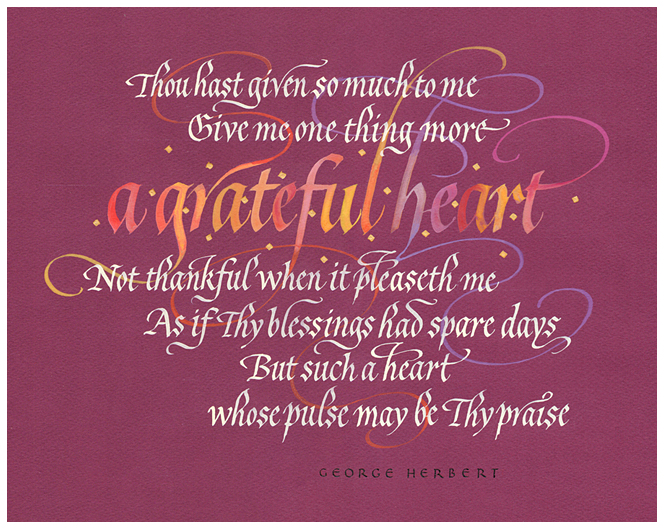
The beloved priest George Herbert is considered by many to be one of the greatest English poets, if not the greatest. He was a simple country parson who never published any poems during his lifetime. When he was dying of tuberculosis, he gave all his poems to his friend, the deacon Nicholars Ferrar; and he told Ferrar to burn all his poetry unless Ferrar thought they might cheer any dejected poor soul. After reading the brilliant poems, the deacon published them in 1633 and they still remain in print today. One of Herbert’s poems that beautifully captures the invitation to practice gratitude is one aptly titled “Gratefulness,” in which he says, “Thou that hast giv’n so much to me, Give one thing more, a grateful heart. Not thankfull, when it pleaseth me; As if thy blessings had spare dayes: But such a heart, whose pulse may be thy praise.” A grateful heart is the gift that keeps on giving; and a grateful heart becomes the source of true, long-lasting happiness.
Another Anglican poet and mystic of the 17th century named Thomas Traherne spent years seeking happiness and found its source in gratitude. He wrote, “When I came into the country, and being seated among silent trees and meads and hills had all my time in mine own hands, I resolved to spend it all, whatever it cost me, in search of happiness.”[2] Traherne chose to live simply on only ten pounds a year, which would be like living on about $2,000 a year today. He chose to wear simple clothes and eat only bread and water. In his search for happiness, he learned these simple truths: “to have blessings and not to prize them is to be in hell. To prize blessings and not to have them is also to be in hell. But to have blessings and to prize them is to be in heaven.” God provided for Thomas Traherne so much so that he felt like he was living “a kingly life” in a world that was turning more and more into Eden each day. Although he ate only bread and water, he feasted daily on the life-giving bread of gratitude.
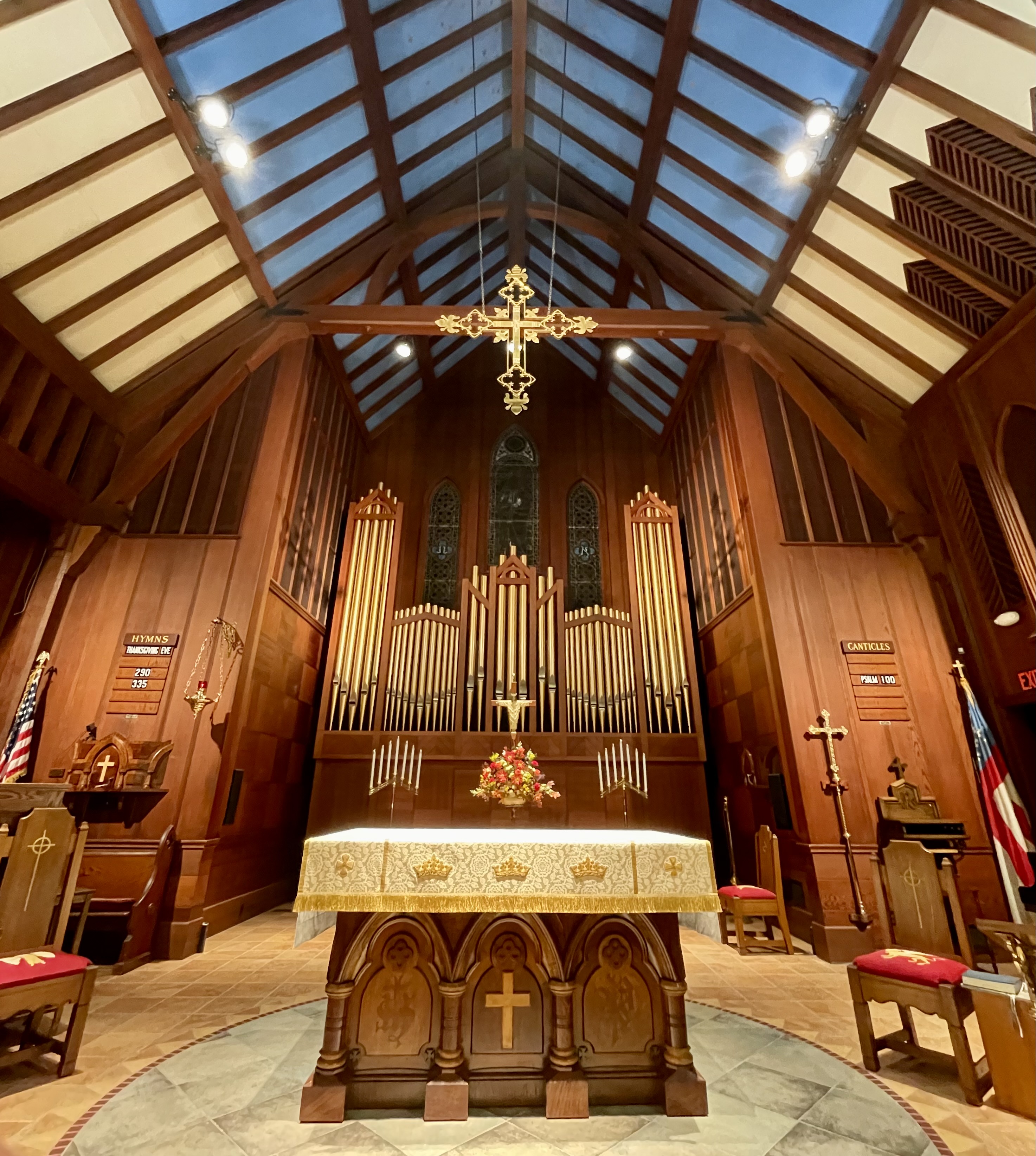
As we prepare to receive the consecrated bread of the Eucharist on this Thanksgiving Eve, may we do so with grateful hearts, with that gift that keeps on giving, with a gratefulness that prizes each and every blessing that God showers upon us, and with a desire to feast on the bread of gratitude, as we join the crowd in today’s Gospel in saying, “Lord, give us this bread always.”

[1] L. William Countryman, The Poetic Imagination: An Anglican Spiritual Tradition (Orbis: New York, 2000), 37.
[2] Thomas Traherne, Centuries of Meditation (ed. 1927), First Century, No. 93 (pp. 68f); Third Century, No. 46 (p. 186). Anglicanism: The Thought and Practice of the Church of England, Illustrated from the Religious Literature of the Seventeenth Century, 518.

 DANIEL DeFOREST LONDON