
Readings for the Feast of All Saints (Year C)
Daniel 7:1-3,15-18
Psalm 149
Ephesians 1:11-23
Luke 6:20-31
This sermon was preached at Christ Episcopal Church in Eureka CA on November 6, 2022.
“O teach me, Lord, that I may teach the precious things thou dost impart; and wing my words, that they may reach the hidden depths of many a heart.” May I speak in the Name of the Father, and of the Son, and of the Holy Spirit. Amen.
The Gospel for this great feast of All Saints includes the opening words of the Sermon on the Plain, a sermon that Jesus preached after staying up all night in prayer. Unlike the Sermon on the Mount in Matthew’s Gospel, where Jesus preaches from on high, Luke describes Jesus descending from a mountain to sit on a level plain. The traditional way that the rabbis taught was by sitting. If we look at the verses that precede our reading, we learn that Jesus went down from the mountain where he had just named and called his twelve disciples and then he sits on a level plain, with a great multitude of people who came from all around the area to be in his powerful and healing presence. And then it says that Jesus “looked up at his disciples” and began to preach.
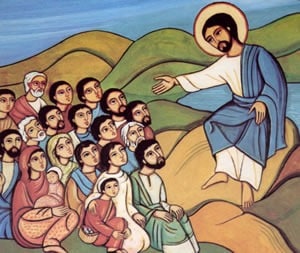
We previously read from the Sermon on the Plain back in February, the second month of the year, and now we return to it on this second to the last month of the year. And the practical question I asked in February was: how in the world did all these people hear Jesus preach if he was sitting down and looking up at his disciples? The suggestion I made is that he and his disciples used a means of communication that is still used sometimes today at rallies and outdoor gatherings called “the human microphone” or “the people’s microphone.” People gather around a person who is designated to speak and then repeat what the speaker says, thus amplifying the speaker’s voice without the need for electronic amplification equipment. Speakers today usually begin by saying, “Mic check” and then the people around the speaker respond, “Mic check!” and sometimes another group of people farther away repeat “Mic check!” The speaker speaks in relatively short and simple phrases, which are then repeated throughout the crowd, sometimes more than once. I shared this idea back in February; but after preaching, I regretted that I didn’t invite us all to try it, but today the glorious saints in light have given me a second chance. So, I’m going to pretend to be Jesus (don’t worry I won’t let it go to my head) and then the people here at the chancel will be the disciples and then you all in the pews will be the great multitude of people from all Judea, Jerusalem, and the coast of Tyre and Sidon. I’m going to say a phrase and then “my disciples” will proclaim it loudly and then you all will repeat after them. And I invite you to let the words wash over you as you hear them and say them.
(Remove microphone)
“Mic check” / Mic check / Mic check
“Blessed are you who are poor” / Blessed are you who are poor / Blessed are you are poor…
“For yours is the kingdom of God/ for yours is the kingdom of God / for yours is the kingdom…
“Woe to you who are rich / Woe to you…
“For you have received your consolation / for you have received…
“I say to you that listen / I say to you…
“Love your enemies / Love your enemies
“Give to everyone who begs from you / Give to everyone…
“If anyone takes away your goods / if anyone takes away your goods
“do not ask for them again / do not ask…
“Do to others as you would have them do to you / Do to others…
Good job! Now, can you imagine doing that throughout an entire sermon? It might take a bit longer, but it calls for much more engaged participation. It requires us to listen carefully and then to repeat what we just heard. When I attended a Baptism at St. Innocent Orthodox Church here in Eureka, I noticed how frequently many of the calls and responses which we say only once were repeated three times. I wonder if their liturgies, which are based on formulas far more ancient than ours, might be rooted in ancient forms of the people’s microphone.
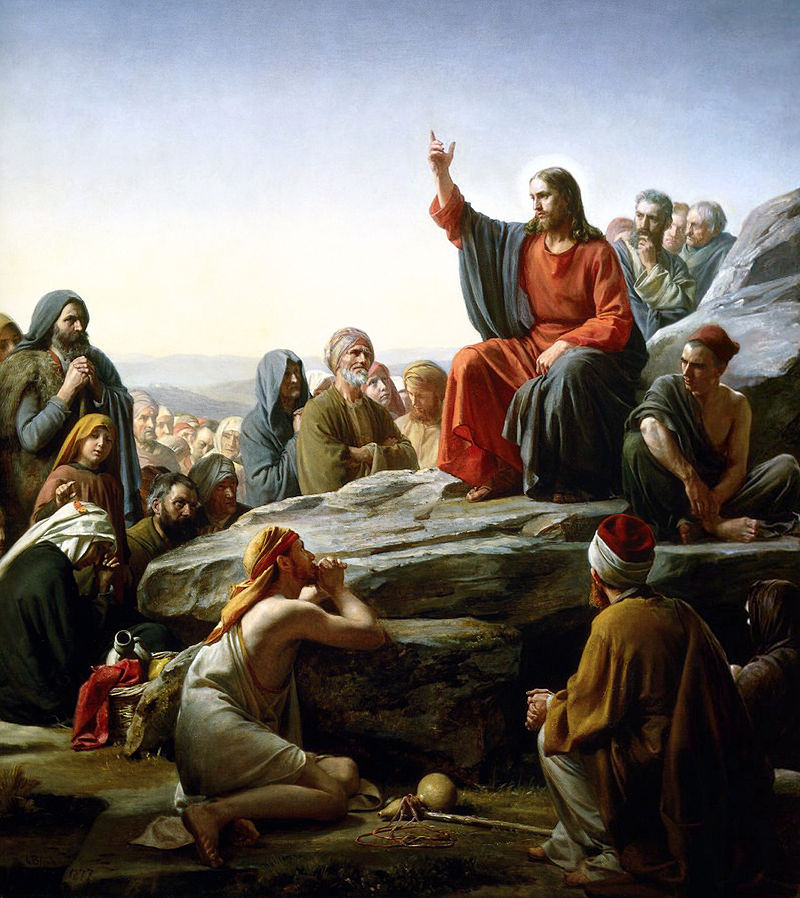
A few verses after today’s Gospel selection, Jesus says something that sums up quite clearly and succinctly his entire message, a message that helps us frame the blessings and the woes. We may be tempted to think that the Gospel of Luke romanticizes the poor and hungry while cursing the rich and well-fed. There may be an element of truth to that, but the deeper purpose, as we saw in the parable of the rich man and Lazarus several weeks ago, is to arouse compassion for the poor and the wealthy, especially the obscenely wealthy who are more spiritually lost than we can imagine. When we hear the woes to the rich and well-fed, we are called to practice compassion to those of us who are bound by our own greed. And that’s how Jesus sums up his message in verse 36. He says [remove microphone], “Be compassionate as your Father is compassionate” / Be compassionate…
Now on this feast of All Saints, I invite you to listen to how these words echo in this building. Listen with the ears of your heart to all the saints and the departed souls who have worshipped here at Christ Church and who have prayed in these pews. Listen to them saying to you, “Be compassionate as your Father is compassionate.”
In Charles Dickens’ A Christmas Carol, the baptized Anglican author described the misery of departed souls who failed to show compassion in this life. He writes, “The misery with them all was, clearly, that they sought to interfere, for good, in human matters, and had lost the power forever.” They wanted to show compassion but had lost the power to do so. Dickens described one old ghost in a white waistcoat “who cried piteously at being unable to assist a [poor] woman with an infant, whom it saw below upon a doorstep,”[1] who wanted to show the woman and her child compassion, but no longer could. If these departed souls of Charles Dickens were to speak to us today, what would they say to us, with urgency? Be compassionate! Give to everyone who begs from you. Do to others as you would have them do to you. This is the message for us today on this All Saints’ Sunday which is also the day of our Pledge In-gathering, when we turn in and bless our pledge cards, which are our contracts with God, our commitments to show compassion, as disciples of Christ. Whatever you give to the church is given to the glory of God so that we can continue to offer public worship for all people here in the beauty of holiness; and a growing percentage of what you give to the church goes directly to meeting the needs of the poor and the hungry here in Humboldt and around the world. Be compassionate as your Father is compassionate.
This last year (on October 23), we lost a saint who served the Episcopal Church in bold and courageous ways, who was on the forefront of prohibiting discrimination in the ordination process based on gender and sexual orientation. He served as the bishop of Rhode Island, and he also served as the interim rector here at Christ Church in 2005 and 2006.[2] Bishop George Hunt was a calm and peaceful presence amidst a time of challenging transition. In one of his addresses to his diocese, he asked, “Can we dare dream that our possessiveness of ‘our things’… be put aside in favor of a wider accountability to the whole mission of Christ’s Church?”[3] Can we put aside our possessiveness of our things in order to embody our Christ’s compassion in this world through worship, discipleship, fellowship, outreach and hospitality?
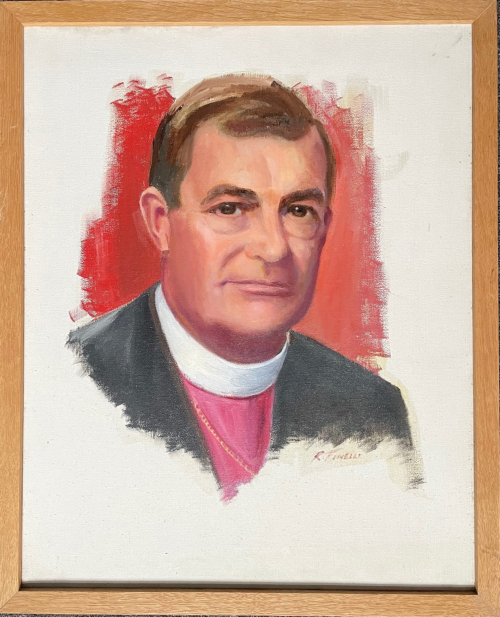
May we listen to the words of Christ’s Sermon on the Plain echo and amplify in this building and beyond through the benevolent presence of all the saints and all the departed souls, including Bishop George Hunt, who urge us, before it’s too late, to be compassionate as our heavenly Father is compassionate. Amen.
[1] https://www.open-bks.com/library/classics/dickens_charles_carol/carol-31-32.html
[2] https://www.episcopalnewsservice.org/2022/10/28/former-rhode-island-bishop-george-hunt-iii-dies-at-90/
[3] https://www.norcalepiscopal.org/wp-content/uploads/2022/10/Requiescat-The-Rt.-Rev.-George-N.-Hunt.pdf

 DANIEL DeFOREST LONDON