
Readings for the Twenty First Sunday after Pentecost (Proper 26 – Year C – Track 1)
Habakkuk 1:1-4; 2:1-4
Psalm 119:137-144
2 Thessalonians 1:1-4, 11-12
Luke 19:1-10
This sermon was preached at Christ Episcopal Church in Eureka CA on October 30, 2022.
“O teach me, Lord, that I may teach the precious things thou dost impart; and wing my words, that they may reach the hidden depths of many a heart.” Amen.
The sermon this morning is about rising above all the noise and clatter of the world by engaging in honest prayer amid the beauty of God’s good earth. Our reading from the Hebrew Scriptures includes the honest prayers and laments of the prophet Habakkuk, who’s probably my favorite of the twelve minor prophets. [1]

Most of the prophets spoke to the people on God’s behalf, but Habakkuk spoke to God on the people’s behalf. At the time, the people of Judah suffered under corrupt leaders who committed disturbing acts of injustice and idolatry, including child sacrifice. However, Habakkuk’s prophetic pronouncements amid such violence and corruption is not to the people but to God. As we read, he asks, “O Lord, how long shall I cry for help and you not listen? Why are you not saving the innocent from the violence of the wicked? Why do you allow justice to be perverted?” This is the honest chutzpah of Habakkuk (whose prayers pack a punch like the persistent widow we learned about a couple weeks ago), who hurls his prayerful questions before God and then waits for a response while he stands at his watch post and stations himself on the rampart. He says, “I will keep watch to see what he will say to me, and what he will answer concerning my complaint.” Habakkuk leaves the din of the crowd below to stand alone on the rampart to listen to God respond to his questions in the silence. And the Lord responds to Habakkuk with powerful invitations and visions. God reminds Habakkuk that the righteous shall live by faith (2:4);[2] and then, in the remaining verses of the three-chapter-long book of Habakkuk (which I highly recommend you read for yourself), God invites the prophet (and us) to feel his presence in the stunning silences of the natural world (2:20), in the beauty of a sunrise (3:4), in the majesty of a mountain (3:6, 9), in the rush of a river (3:8, 9), in the stillness of the moon (3:11), in the power of a horse (3:15), and finally, in the music of a sycamore tree (3:17). After retreating from the suffocating clamor of the world to pray honestly and to listen to God’s response in the silence of the ramparts, Habakkuk’s faith is restored, and his hope refreshed. His final words are a song of praise, “The Sovereign Lord is my strength; he makes my feet like the feet of a deer, he enables me to tread on the heights” (3:19).[3]
The psalm selection this morning is from Psalm 119, the longest psalm, and the longest chapter in the entire Bible. Psalm 119, as you may recall, is an acrostic psalm, which means each stanza revolves around one of the 22 letters of the Hebrew alphabet; and each letter of the Hebrew alphabet has its own personality and mystical power which adds to the meaning of the verses in the stanza. The stanza we read/sang today revolves around the Hebrew letter Tsadeh, which does not have any equivalent (or cognate) letter in the English alphabet. It’s basically the sound that the two “z”s make in the word “pizza.” It’s a T-S sound. In fact, it’s the letter used in the Hebrew word chutzpah. And if we read this stanza in the original Hebrew, we not only see that each verse begins with the letter tsadeh we also see that it’s about a person who is small (tsair) and despised and overwhelmed with trouble and distress (tsok);and yet also finding safety and stability in the righteousness (tsedek) of God. The psalm is the honest prayer of a small, vulnerable person who is despised by others and who is trying to rise above all the trouble and anguish of the world by resting in the righteousness of God.
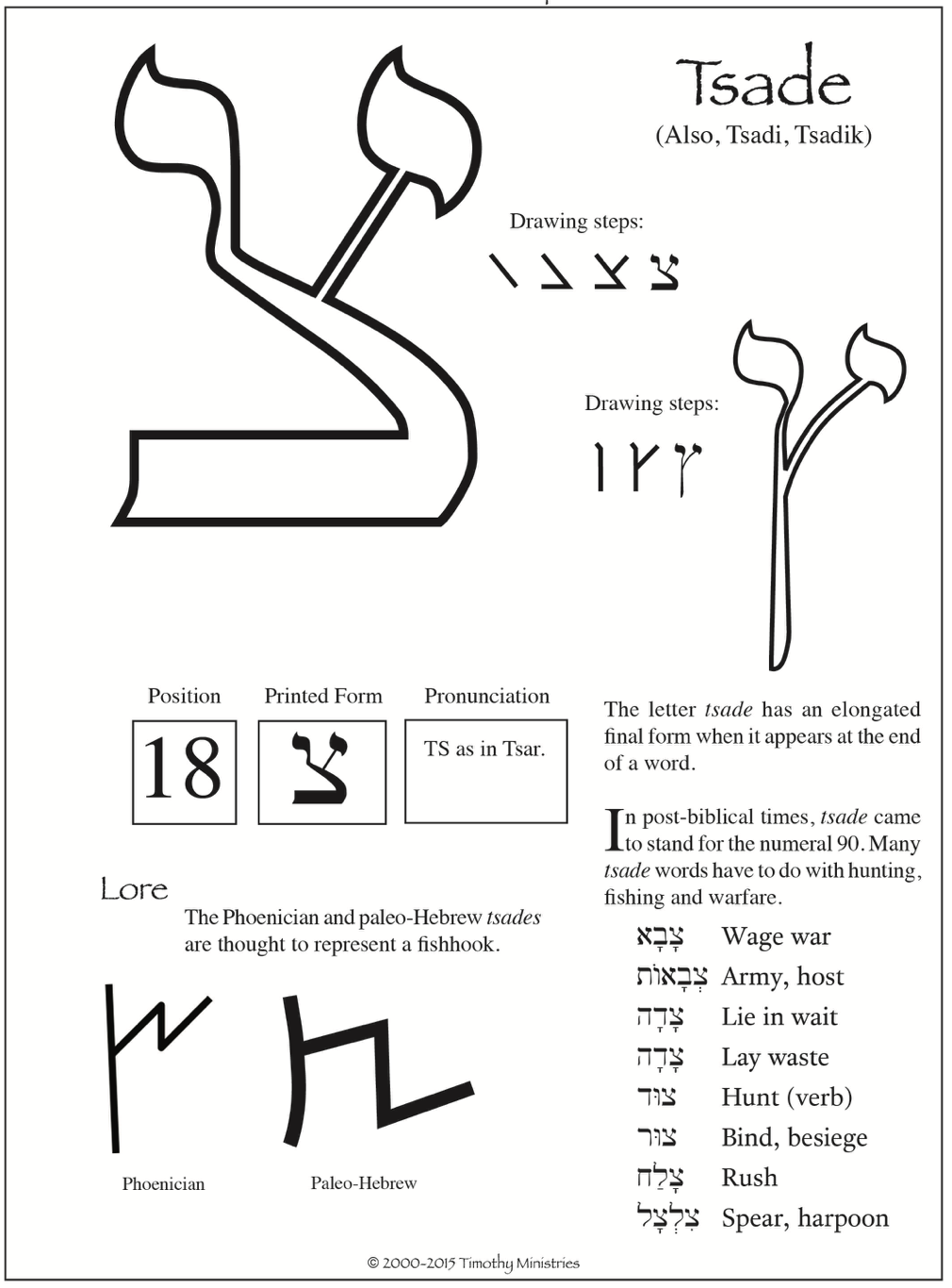
What’s interesting about the letter tsadeh is that it is associated with the tree. The Hebrew word for tree is etz, which ends with the letter tsadeh. It was four years ago (almost exactly) that a synagogue in Pittsburgh was attacked and eleven people killed; and the name of that synagogue is Etz Chaim (Tree of Life). As antisemitism is tragically once again on the rise, may we keep our Jewish siblings in our prayers, especially the people of Etz Chaim synagogue in Pittsburgh.

Some of the rabbis see the shape of the letter tsadeh resembling a tree;[4] and some even see the letter tsadeh representing a tree with a small person sitting on top. Now you see where I might be going with this.
The prophet Habakkuk rises above the chaos to pray on the ramparts, where he receives from God a vision of a sycamore tree. The psalmist uses the Hebrew letter associated with the tree (tsadeh) to pray a prayer that helps him rise above the chaos and rest in God’s righteousness. In Paul’s letter to the Thessalonians, he writes about a steadfast faith that helps one rise above persecutions and afflictions. We are invited to rise above all the noise and clatter of the world by engaging in honest prayer amid the beauty of God’s good earth.
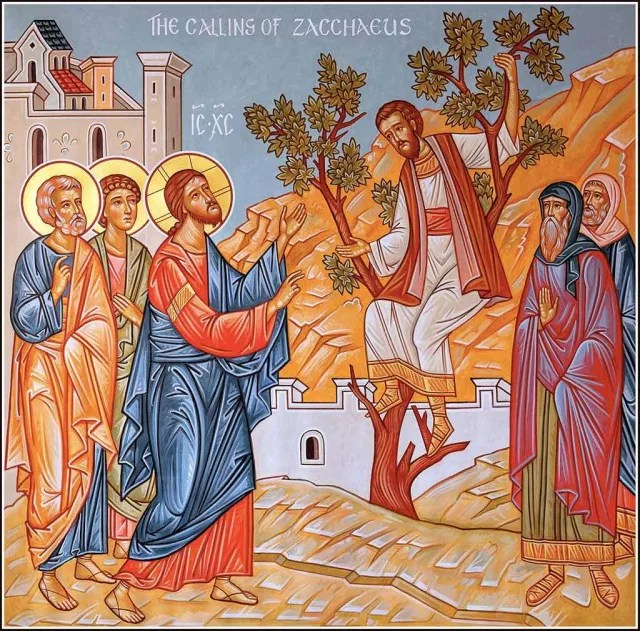
And this is what Zacchaeus does in today’s Gospel. Yes, he climbs the sycamore tree to see Jesus as the children’s song explains: “Zacchaeus was a wee little man and a wee little man was he / He climbed up in a sycamore tree for the Lord he wanted to see.” But when we read this story in light of Habakkuk and the psalm and the letter tsadeh, we can see that Zacchaeus was rising above the suffocating clamor of the crowd to connect with God through the beauty of the earth (through a sycamore tree) as he felt small and vulnerable and, in many ways, despised like the psalmist. Some commentators suggest that Zacchaeus climbed the tree for the sake of his own safety. As a small person who was not very well liked, Zacchaeus could have easily been trampled to death, on accident or on purpose. When I was considering this possibility (which honestly felt a little far-fetched), I learned about the crowd crush that occurred in Seoul South Korea just yesterday, where at least 150 people were trampled to death. Uncontrollable crowds are a danger indeed.

The invitation to rise above all the noise and suffocating clamor of the world is a crucial one for us today, in the aftermath of the tragedy in Seoul and as we enter a fraught midterm election season that has already aroused horrific acts of violence.[5] May we meet God at the ramparts and pray with the chutzpah of Habakkuk, not being afraid to ask, “O LORD, how long shall we cry for help, and you not listen? Or cry to you ‘Violence!’ and you will not save?” And may we carve out time to listen to God’s response in the beauty of the earth and in the music of the sycamore trees. May we find ways to rise above the clatter, including all the noisy thoughts within our own minds, thoughts and worries that can seem to suffocate us. I personally recommend the practice of Centering Prayer as an effective way to rise above all the noise. For you, it might be hiking in the woods of climbing a tree, like Zacchaeus. Whatever it is, cultivate that practice. And then, when our faith is restored and our hope refreshed, may we not be surprised when Christ tells us to come down from the tree and to return to the noisiness and messiness of the world so that we can work together towards justice (tsedek), to repair the breach, and to repent of our own selfishness and greed by extending compassion and generosity to a world that is in such desperate need of God’s saving love in Christ Jesus our Lord. Amen.
[1] A fun Halloween fact about Habakkuk: Renaissance artist Donatello sculpted a famous statue of the prophet, which he referred to lovingly as Lo Zuccone, which is Italian for “pumpkin” or “pumpkin head” (because his bald head resembles a pumpkin). The statue is so realistic that Donatello used to shout at it, saying, “Speak to me! Damn you! Speak to me!” Although Habakkuk never spoke to Donatello, he did indeed speak to God.
[2] This is such a theologically loaded phrase which Paul develops in Romans (1:17) and Galatians (3:11; also, see Hebrews 10:38) in arguing that we are justified by faith and not by works, an argument that Martin Luther amplified in the Protestant Reformation, which began 505 years ago almost exactly. It was on All Hallows’ Eve in 1517 that Martin Luther nailed his 95 theses to the church door in Wittenberg. Many of our Lutheran siblings are celebrating Reformation Sunday today.
[3] This verse inspired the title of the Christian novel Hind’s Feet on High Places by Hannah Hurnard, written in 1955.
[4] I see that especially in the letter’s final form.
[5] I’m referring to the violent attack on Paul Pelosi on October 28, 2022. https://www.cnn.com/2022/11/01/politics/paul-pelosi-attack-what-we-know

 DANIEL DeFOREST LONDON