
Readings for the Seventeenth Sunday after Pentecost (Proper 22 – Year C – Track 1)
Lamentations 1:1-6
Psalm 137
2 Timothy 1:1-14
Luke 17:5-10
This sermon was preached at Christ Episcopal Church in Eureka CA on October 2, 2022.
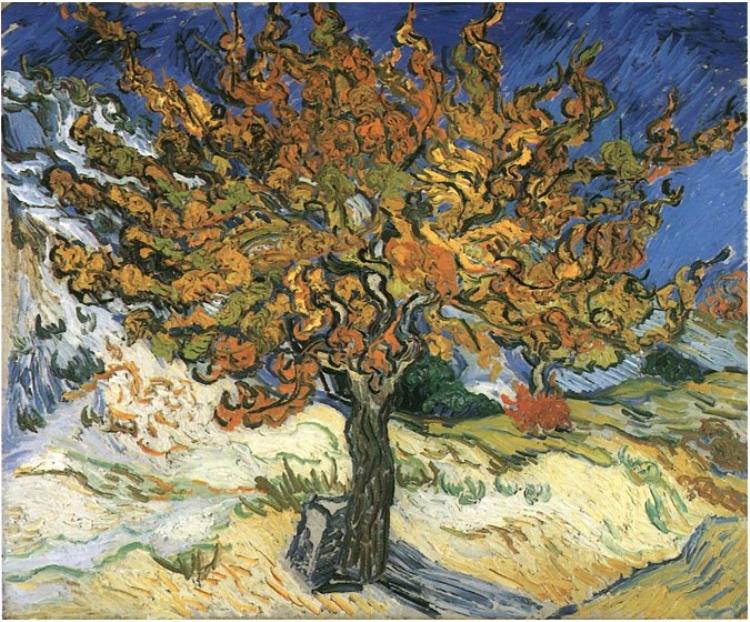
“If you truly love nature, you will find beauty everywhere.”[1] These are the words of a gifted yet troubled man who found beauty and psychological relief in the presence of a tree. This man who had been diagnosed with disease (gonorrhea and likely syphilis) also suffered from severe mental illness and self-destructive behaviors. His previous career as a Christian minister was short-lived and unsuccessful (according to the church at the time) and his vocation as a painter was not financially sustainable at all. He had not yet sold a single painting and would end up selling only one throughout his entire lifetime.[2] He prayed passionately for God to give him increase; and God’s response to his prayers seemed to come to him in the form of a tree, which he saw in early October within the garden of an asylum where he was admitted in southern France, an asylum named after St. Paul. The tree, he said, bursted forth with “a magnificent yellow against a very blue sky and a white, stony, sunlight field behind.”[3] This tree brought him a sense of lucidity and gratitude and humility; and it inspired him to paint what has been called “one of the most powerful images of nature ever painted.”[4] That original painting, which is portrayed on the cover of your bulletin, is located now at the Norton Simon Museum in Pasadena. (I remember being instantly drawn to it and mesmerized by its radiant colors as a seminarian). The artist is, of course, Vincent van Gogh, who died of a self-inflicted gunshot wound less than a year after painting this masterpiece, and who is now known as one of the greatest painters of all time.
I share this story because it offers unique insight into our Scripture readings today. Van Gogh could certainly relate to the deep melancholy dismay expressed in our readings from Lamentations and the Lament Psalm as well as the tears and suffering expressed in the Epistle. This story also sheds light on the Gospel, in which the apostles ask Jesus, “Increase our faith!” not unlike Van Gogh who asked God for increase. Just as God responded to Van Gogh’s prayers by revealing His pacifying beauty in the yellow mulberry tree so too does Jesus respond to his disciples by pointing to a mulberry tree.

He says, “If you had faith the size of a mustard seed, you could say to this mulberry tree, ‘Be uprooted and planted in the sea,’ and it would obey you.” An important word for us here is the word “this” (this mulberry tree – te sukamino taute) which implies that Jesus is not talking about some abstract tree but rather a particular tree that stands right in front of them, which they can see and touch and smell and hear and taste. (Mulberries are apparently a good source of iron and vitamin C).[5] This conversation with Jesus is happening during a sacred saunter, not unlike the one we experienced yesterday in celebration of St. Francis.

Throughout the Gospels, Jesus responds to our anxiety and our depression by pointing us to the natural world. A few chapters earlier in Luke, he says, “Do not be anxious. Look at the birds of the air and the lilies of the field. They don’t worry and yet God takes good care of them” (Luke 12). And here in Luke 17, Jesus responds to an anxious demand from his disciples by inviting them to look at a mulberry tree and to consider the fact that glorious and magnificent trees like this began as tiny seeds. If a tiny seed can grow into a magnificent tree than just imagine what a tiny mustard seed of faith can accomplish! A tiny mustard seed of faith is enough for you to fulfill even your wildest dreams, even dreams that might seem absurd like commanding a tree to be uprooted and planted in the sea. That doesn’t make any sense, but that’s the point: in the wild wonders of God’s creation, Jesus sees an expression of the boundless imagination and creativity of his Father and he invites us to participate in the same wild, creative process. And we don’t need great faith to do it. We don’t need great faith. We just need faith in a great God. It’s not about how much we believe in God, but how much God believes in us.
Van Gogh said, “Great things are done…by a series of small things brought together.”[6] I believe that if we were to see all the ripple effects of our small acts of faith and compassion, we would be floored in amazement. If we were to see all the ripple effects of what we do as a church through our worship, discipleship, fellowship, outreach, and hospitality, it would blow our minds. It would be as mind-blowing as watching a mulberry tree be uprooted and planted in the sea. It would blow our minds almost like the way Van Gogh’s mind would be blown in hearing how much his paintings are worth today—tens of millions of dollars!—and how he’s hailed as one of the greatest artists of all time. It would blow our minds and make us realize not how amazing we are, but how amazing our God is, our God who chooses to manifest his creative love through us in infinite ways. This realization ought not give us big heads, but rather big hearts full of humility. And that’s what Jesus is talking about in his own extreme and slightly disturbing way in the parable of the master and slave. He’s talking about humility. Just as God works his creative power through the beauty of nature that is all around us, so too does God work his creative power through the beauty of nature that is us.
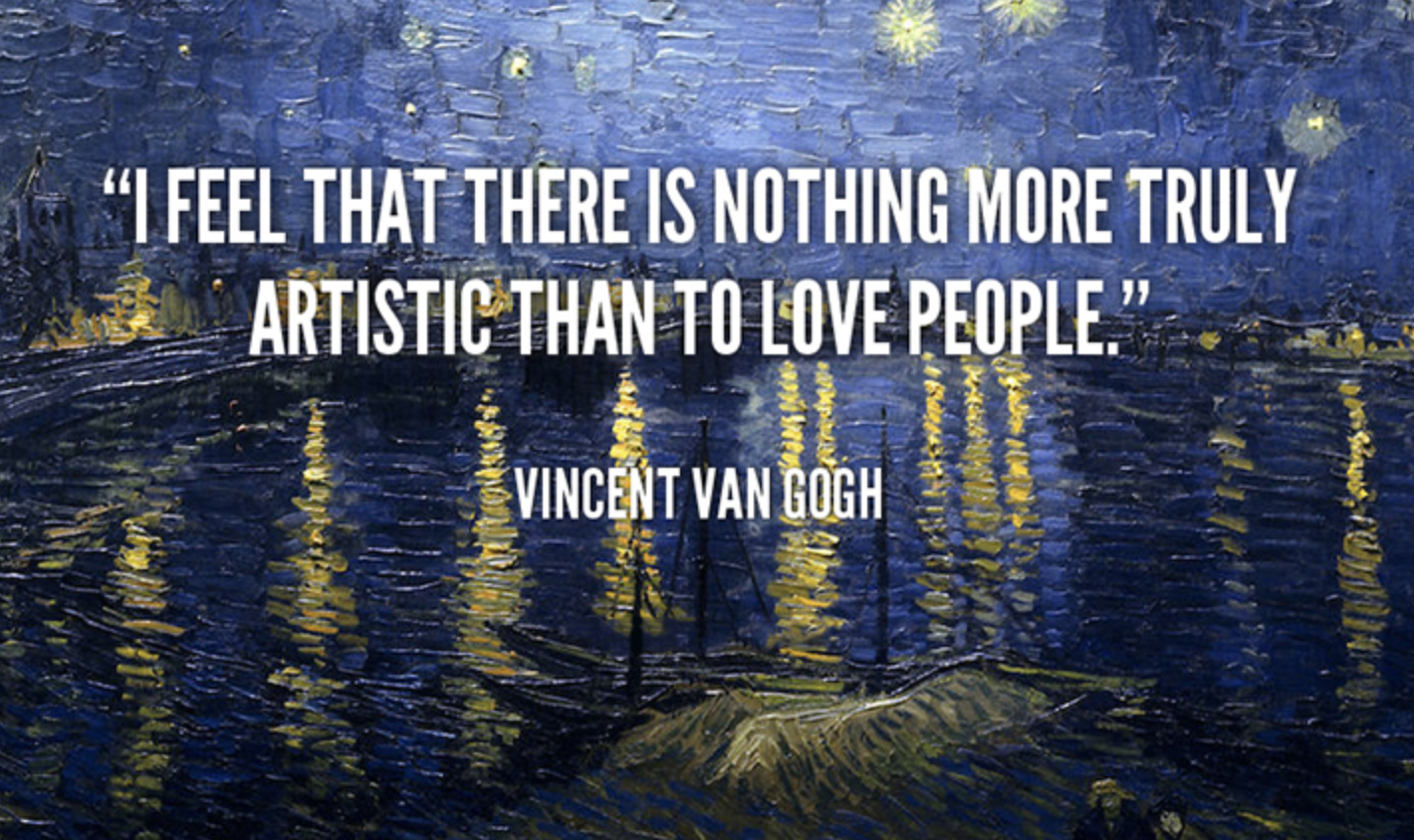
Although he was severely ill and deeply troubled, the great artist Van Gogh, who felt God speak to him through the beautiful mulberry tree, knew what he was talking about when he said, “There is nothing more truly artistic than to love people.”[7] A tiny mustard seed of faith that expresses itself through love reverberates throughout the whole world like a mulberry tree whose roots and branches cover the widest ocean.[8] May God continue to paint his glorious and mind-blowing masterpieces through the small things that we do together here in his Name. Amen.
[1] Vincent van Gogh, Letter 22 to Theo van Gogh , April 30, 1874. https://vangoghletters.org/vg/letters/let022/letter.html
[2] He was financially unprofitable, which is in fact a better translation of the Greek word that the NRSV translates as “worthless” in Luke 17:10. The Greek word achreioi is more accurately translated as “unprofitable”: “we are unprofitable slaves…”
[3] Vincent van Gogh, Letter 827 to Willemien van Gogh. Saint-Rémt-de-Provence, December 9/10, 1889. https://vangoghletters.org/vg/letters/let827/letter.html,
[4] F. Lanier Graham, Vincent van Gogh. Painter. Printmaker. Collector. (Norton Simon Museum, 1990), p. 24. Lanier Graham is the former curator at the Norton Simon Museum in Pasadena.
[5] They also help lower cholesterol, blood sugar, and cancer risk.
[6] “For the great doesn’t happen through impulse alone, and is a succession of little things that are brought together.” Vincent van Gogh, Letter 274 to Theo van Gogh. The Hague, Sunday October 22, 1882, https://vangoghletters.org/vg/letters/let274/letter.html
[7] “You’re kind to painters, and be sure that the more I think about it the more I feel that there’s nothing more genuinely artistic than to love people.” Vincent van Gogh, Letter 682 to Theo van Gogh. Arles, Tuesday Sunday September 18, 1888, https://vangoghletters.org/vg/letters/let682/letter.html
[8] “The only thing that counts is faith expressing itself through love” Galatians 5:6

 DANIEL DeFOREST LONDON