
Readings for the Fourteenth Sunday after Pentecost (Proper 19 – Year C – Track 1)
Jeremiah 4:11-12, 22-28
Psalm 14
1 Timothy 1:12-17
Luke 15:1-10
This sermon was preached at Christ Episcopal Church in Eureka CA on September 11, 2022
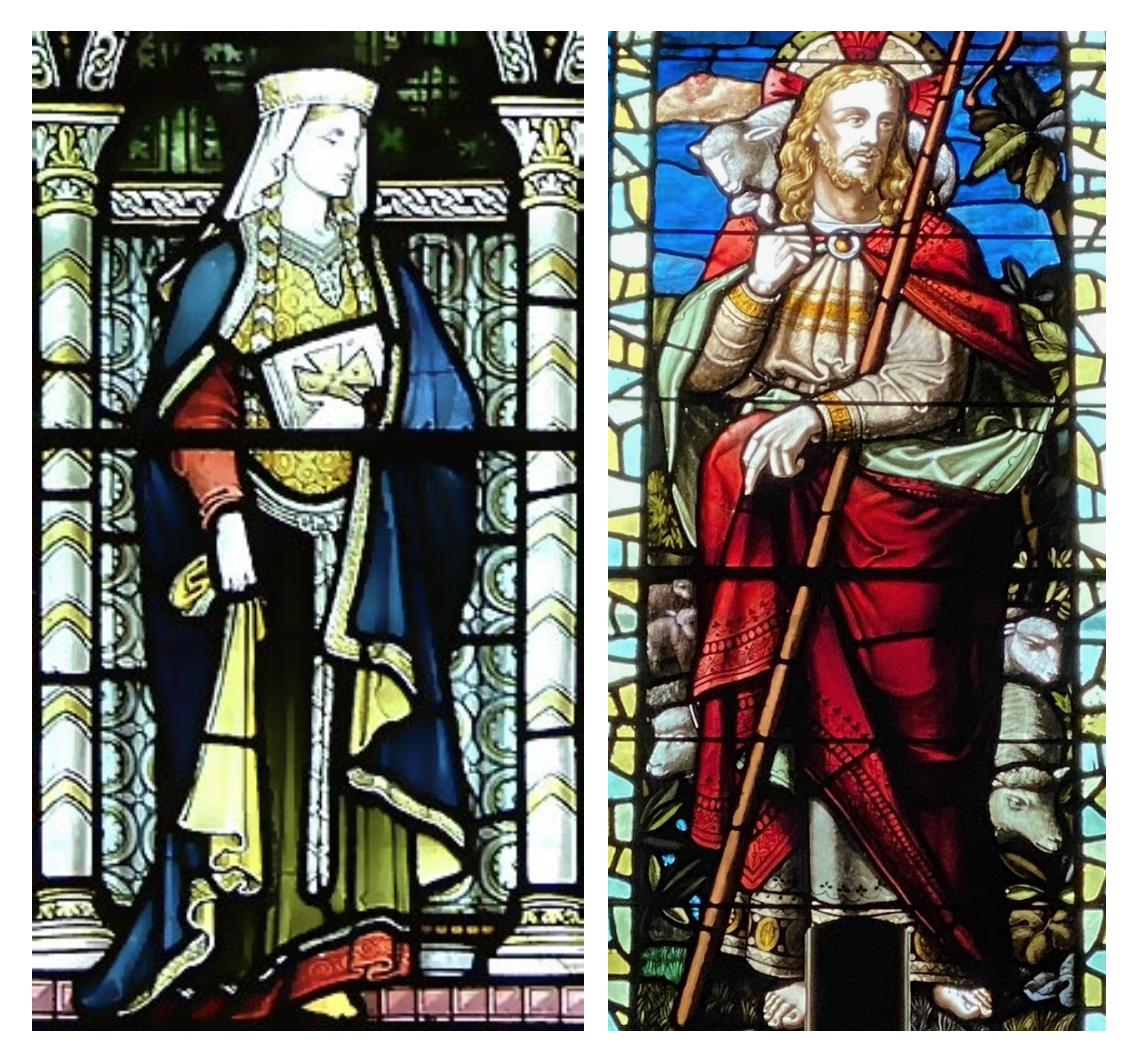
Welcome home on this first Homecoming Sunday since September 2019. It’s good to see you all. Today’s Gospel reading is from Luke chapter 15, which includes the most beloved parables about home coming: the parable of the lost sheep returning home to the flock and the parable of the lost coin returning to its owner both serve as a preamble to the parable of the Prodigal Son returning home to his Father, who welcomes him home with open arms and then throws a party (and a BBQ, which we’ll be offering later today). Today’s parables feature a shepherd and a woman, both significant figures and archetypes in our Christian and Anglican tradition. Some of the earliest portrayals of Jesus in the ancient catacombs represent him as a shepherd carrying a lamb on his shoulder, just like the shepherd in today’s parable.[i] It is this image of Christ that has been predominant for us here at Christ Church Eureka, where our central stained-glass window (designed by John Mallon) portrays Christ as a shepherd carrying a lamb on his shoulder.
Back in the 6th century, when Pope Gregory the Great sent his Benedictine buddy Augustine to the land of the Angles to found the Church of England, the missionary monk arrived carrying a cross and an image of Christ as a shepherd with a lamb on its shoulder.[ii] This image is central to the founding of the Ecclesia Anglicana, the Anglican Christian world of which we Episcopalians are a part.St. Augustine chose to set up his homebase in Kent (in South East England) because there was a woman there, a queen, who had already committed her life to Christ the Good Shepherd; and this woman, Queen Bertha, was instrumental in convincing King Ethelbert (the King of the Angles) to welcome and accommodate and support Augustine in his mission. A shepherd and a woman, key characters in today’s Gospel, were central figures in the founding of our Anglican heritage.

Strong, powerful, and wise women have consistently played key roles in our church’s growth and evolution. Mother Hilda, the abbess of Whitby, helped reconcile and integrate the Celtic and Roman traditions in the church in the seventh century. Julian of Norwich offered theological reflections on her visions in the 14th century which continue to challenge and comfort Christians today. (Her words comforted me 21 years ago in the wake of 9-11). Medieval pilgrim Margery Kempe was the first to write a spiritual autobiography in the English language. And, of course, Queen Elizabeth I brought reconciliation to a deeply divided church and nation and is honored today as the true founder of modern Anglicanism. All these women understood and sought to embody the meaning of today’s parables, which are all about repentance. And what is repentance? Repentance is turning towards the One who is always seeking to bring us home. The Hebrew word for repent is “shuv” which means “to turn.” To repent is to turn to the One who is always seeking us and to allow ourselves to be embraced by the loving Father like the Prodigal Son and to be carried home on the shepherd’s shoulders, like the lost lamb.

The first great Anglican theologian was a bishop named John Jewel who served as the leading spokesman for Queen Elizabeth and the reconciliation of the Elizabethan Settlement. Bishop John Jewel said, “The principal part of the ministerial office [the main job of the priest] is to preach repentance.”[iii] To preach about turning to the One who is always seeking to bring us home. A turning that often involves turning away from a path that is unhealthy and sinful. And often that turning involves saying, “I’m sorry” to those whom we may have hurt or offended. This is important because there seems to be a misunderstanding among some Christians today that apologizing is a sign of weakness. Unless you’re Jesus, it’s hard for me to imagine any authentic Christian going through life without saying, “I’m sorry” because that is so often an essential part of repentance. That is why we say in our Confession that “we are truly sorry and we humbly repent.” We repent for our failure to love God and to love others as ourselves.[iv] The shepherd and the woman in today’s parables and the women who have shepherded our church throughout history invite us to turn to the One who is always seeking to bring us home.
This last week, we lost a strong, powerful, and wise woman who shepherded her country and her church and, in many ways, the entire global community with humility, dignity, compassion and grace. We grieve the loss of Queen Elizabeth II and we pray she rest in peace and rise in glory. The Queen, who devoted her entire life to service, was a spiritual descendent of Queen Bertha who facilitated the arrival of Christianity in England and who welcomed St. Augustine and his image of the Good Shepherd 1500 years ago. Like St. Bertha, Queen Elizabeth II understood the meaning of today’s parables.

Queen Elizabeth II was not blind to the fact, that although we have so much to celebrate when it comes to the glories and achievements of Great Britain, the empire was not always perfect.[v] In her 2011 Christmas Address, she said, “Although we are capable of great acts of kindness, history teaches us that we sometimes need saving from ourselves—from our recklessness or our greed. God sent into the world a unique person—neither a philosopher or a general (important though they are)—but a Savior [a Shepherd], with the power to forgive. Forgiveness lies at the heart of the Christian faith. It can heal broken families, it can restore friendships and it can reconcile divided communities. It is in forgiveness that we feel the power of God’s love.”
On this Welcome Home Sunday, may we honor the legacy of the powerful women who have shepherded the church, especially Queen Elizabeth II, by devoting our lives to service, by refusing to turn a blind eye to our own sin, and by repenting / turning to the Shepherd who is always seeking to forgive us and bring us home. It is in that place of forgiveness, according to her Majesty, that “we [will] feel the power of God’s love.” Amen.

[i] Catacomb of Callixtus in Rome (3rd century), Catacomb of Priscilla in Rome (2nd – 4th century), Catacomb of Domitilla in Rome (2nd century).
[ii] According to the Venerable Bede’s account in The Ecclesiastical History of the English People
“As they drew near to the city, after their manner, with the holy cross, and the image of our sovereign Lord and King, Jesus Christ, they sang in concert this litany: ‘We beseech thee, Lord, for Thy great mercy, that Thy wrath and anger be turned away from this city, and from Thy holy house, for we have sinned. Hallelujah.’” I. XXV. https://ccel.org/ccel/bede/history/history.v.i.xxiv.html Bede describes “the image of our sovereign Lord and King, Jesus Christ,” but does not specify an image of Christ the Good Shepherd. In a mural portraying this event at Grace Cathedral in San Francisco, the image carried represents Christ as the Good Shepherd with the lamb on his shoulder. I must confess that I took some liberty in claiming that this was the image used 1500 years ago even though there is no strong evidence for this. The fact that the Good Shepherd image was so popular from 2nd to 4th century may support my assertion.
[iii] John Jewel, An Apology, or Answer, In Defense of the Church of England, with a brief and plain declaration of the true religion professed and used in the same (1567 English edition) J. Ayres, ed., The Works of John Jewel, Bishop of Salisbury (Cambridge: Cambridge University Press, 1848), Vol III, 55. As cited in John Kater, Ministry in the Anglican Tradition from Henry VIII to 1900 (London: Fortress Academic, 2022), 37 n. 43.
[iv] Remember, Jesus is offering these parables to “sinners,” to people who are not blind to their own sinfulness and their need to repent. If we think we are without sin, then we have no need for Jesus. Earlier in Luke, Jesus said, “It is not the healthy who need a doctor, but the sick” (Luke 5:31). We are all invited to recognize the ways in which we remain sickened by our sin and our foolishness and our stupidity (to use Jeremiah’s harsh language) and then to turn to the physician for healing.
[v] The British empire was not irresponsible for the horrific atrocities of colonialism. Tragically, several peoples and cultures within the British empire were completely wiped out and some communities today remain threatened by annihilation and violence. Many people throughout history and still today believe that the perpetrating violence is actually God’s will, much like the terrorists who attacked the World Trade Center, and much like Paul when he felt called by God to murder Christians. In his letter to Timothy, he repents of this, saying, “I was formerly a man of violence, but I received mercy because [I turned to] Christ Jesus [who] came into the world to save sinners – of whom I am the foremost” (1 Timothy 1:15). Queen Elizabeth II was not blind to the violence within and even perpetrated by the empire over which she presided.

 DANIEL DeFOREST LONDON