
Readings for the Eleventh Sunday after Pentecost (Proper 16 – Year C – Track 1)
Jeremiah 1:4-10
Psalm 71:1-6
Hebrews 12:18-29
Luke 13:10-17
This sermon was preached at Christ Episcopal Church in Eureka CA on August 21, 2022.
“Advice from a Tree” written by Ilan Shamir (whose name literally means “protector of trees”)
Dear Friend,
– Stand Tall and Proud
– Sink your roots deeply into the Earth
– Reflect the light of a greater source
– Think long term
– Go out on a limb
– Remember your place among all living beings
– Embrace with joy the changing seasons for each yields its own abundance: the Energy and Birth of Spring, the Growth and Contentment of Summer, the Wisdom to let go of leaves in the Fall, the Rest and Quiet Renewal of Winter
– Feel the wind and the sun and delight in their presence
– Look up at the moon that shines down upon you and the mystery of the stars at night.
– Seek nourishment from the good things in life. Simple pleasures: earth, fresh air, light.
– Be content with your natural beauty
– Drink plenty of water
– Let your limbs sway and dance in the breezes
– Be flexible
– Remember your roots
– Enjoy the view![1]

Last Sunday, Deacon Anne spoke about the Lambeth Conference in England, the gathering of over 650 Anglican and Episcopal bishops from 165-plus countries. They gathered to pray, worship, study Scripture and engage in conversations that are meant to guide the Anglican Communion in the coming decade. After one day of particularly challenging conversations about human sexuality, the bishops traveled from the University of Kent (where most of the conference took place) to the Lambeth Gardens in London, where they blessed and planted a tree and launched the Anglican Communion Forest Initiative, which is a global initiative comprising local activities of forest protection, tree growing and eco-system restoration undertaken by provinces, dioceses, and individual churches across the communion to safeguard creation.[2]
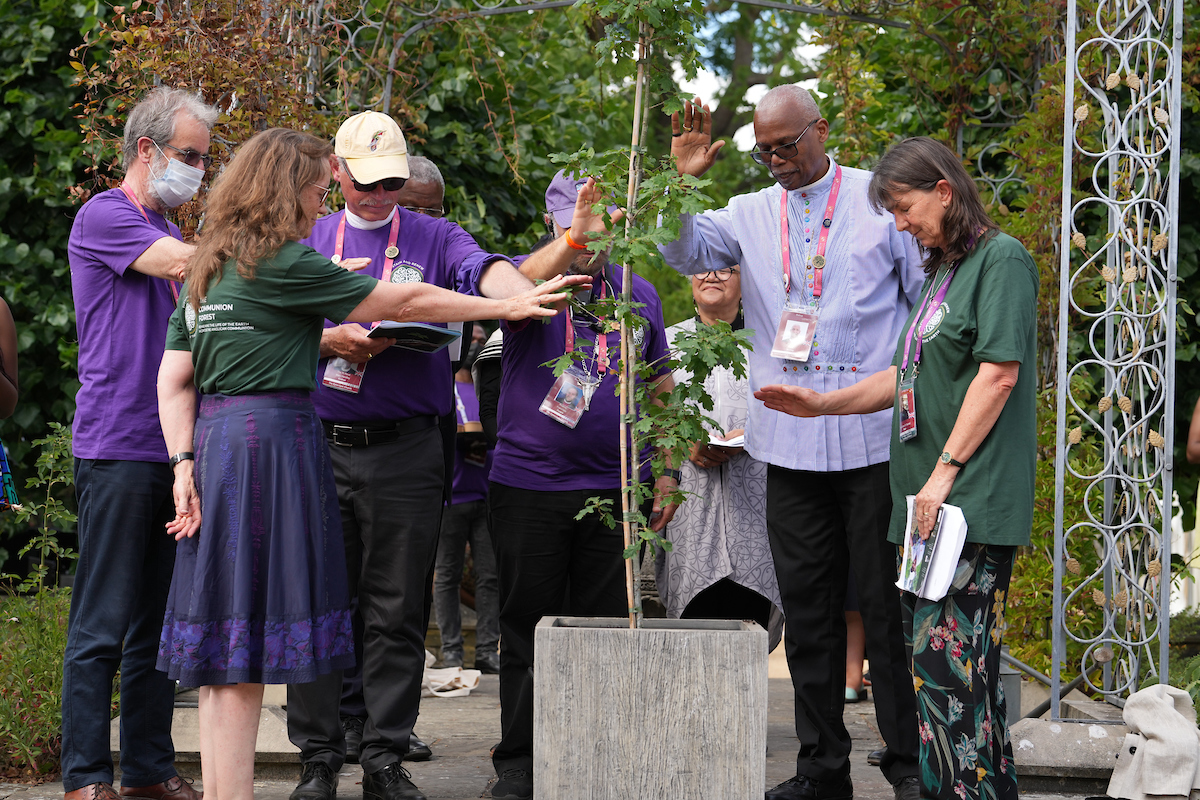
The Archbishop of Canterbury Justin Welby described climate change as “an absolutely enormous emergency for literally billions of the world’s population, [especially for] the poorest who represent the vast majority of Anglicans in the world.”[3] We here in California cannot deny the reality of climate emergency as destructive wildfires tear through our state each year, a reality that perhaps makes the language today from Scripture about fire feel more disturbing than consoling. Last Sunday, Jesus said, “I came to bring fire to the earth and how I wish it were already ablaze” (Luke 12:49). In today’s reading from Hebrews, the author describes God as a “consuming fire” (Hebrews 12:18, 29). And the prophet Jeremiah, who was appointed as a prophet before he was born, is told by God, “I am putting my words in your mouth as a fire; the people are tinder and it will consume them” (Jeremiah 5:14). In the face of climate emergency, what can we in California learn about this “fire” described in our Scriptures? And how might forests and trees, in their ancient wisdom, offer us advice, as vulnerable individuals, as a parish, as a diocese, and even as a global communion?
At the Lambeth Garden, the Bishop of Wyoming (Paul-Gordon Chandler) talked about the importance of looking to our “Native American sisters and brothers, [who uphold creation care as] an inherent part of their spirituality.”[4] The Native Americans, who have been listening deeply to trees for centuries, understand intimately that fire can be both deadly and destructive on one hand, but also awe-inspiring and life-giving on the other. For centuries, Native Americans have practiced what is called “cultural burning” which is the “intentional lighting of controlled fires to [promote] the health of vegetation and animals that provide food [and] clothing.”[5] This Native American practice has been emulated by fire experts who apply a controlled fire under specified conditions in order to restore health to forest environments and other eco-systems. This careful use of fire reduces excessive amounts of brush and shrubs and other clutter and encourages new growth of native vegetation. This prescribed burning, also called “the controlled burn,” has proven to be one of the most effective tools in reducing the disastrous destruction of wildfires. Is the prophetic fire of God like the wildfires that burn out of control in apparent anger and destructive wrath, as some fire-and-brimstone preachers often insist? Or is God’s fire more like a controlled burn of love, always working towards renewal?[6]
As we begin to approach the Fall season and witness the trees letting go of their leaves, do we hear their invitation to let go of what we need to relinquish? Do we hear an invitation to burn away the potentially dangerous clutter that accumulates around us? An invitation to undergo God’s “controlled burn” of love?
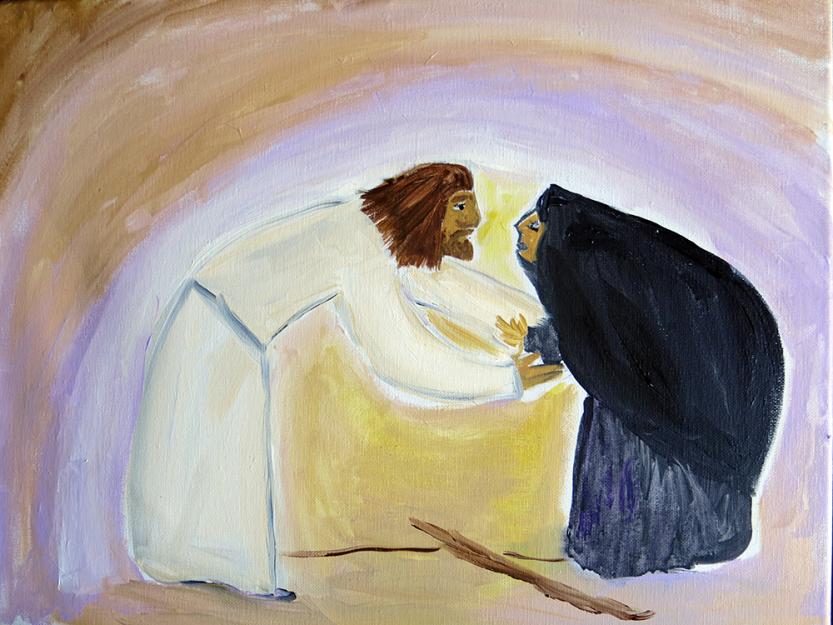
In the Gospel today, Jesus brings fire to a worship service and into the life of a woman who has been crippled for eighteen years. Whatever was making the woman hunched over was incinerated by the controlled burn of Jesus’s voice and touch. Jesus said to her, “You are set free. Let go of whatever burden you are carrying in your body. You are now liberated.” And when he laid his hands on her, immediately she stood up straight and began praising God.
Advice from a Tree: Stand tall and proud. Reflect the light of a greater source. Be content with your natural beauty. Enjoy the view!
Jesus continued his controlled burn by clearing away all the religious clutter that had accumulated around the sacred act of keeping the Sabbath. His fire convicted his religious opponents of their hypocrisy, but their sense of conviction was ultimately life-giving because it was inviting them to participate in liberation and renewal.
So what clutter is weighing you down? What prevents you from heeding the advice of trees and standing up tall and proud, like the woman in the Gospel? What clutter are you being called to relinquish and burn away? Judgment? Anger? Bitterness? Boredom? Denial? Self-pity? Self-loathing? Whatever it might be, let the controlled burn of God’s love move through you and liberate you and empower you to praise Him and serve Him by safeguarding the integrity of creation (the forests and the trees), and sustaining and renewing the life of the Earth and our life together.[7] Amen.
[1] https://www.awakin.org/v2/read/view.php?tid=2237, accessed August 20, 2022.
[2] For more on the Communion Forest initiative, see https://www.communionforest.org/ and Lynette Wilson, “At Lambeth Palace, bishops and spouses celebrate launch of Anglican Communion forest initiative” (Episcopal News Service, Aug 3, 2022): https://www.episcopalnewsservice.org/2022/08/03/at-lambeth-palace-bishops-and-spouses-celebrate-launch-of-anglican-communion-forest-initiative/
[3] Welby said, “If we stand united, we can, as the global Anglican Communion, make a transformative difference around the world. There is a real sense of unity on this, and [this] is a sign of great hope for the poorest who represent the vast majority of Anglicans in the world.” https://www.episcopalnewsservice.org/2022/08/03/at-lambeth-palace-bishops-and-spouses-celebrate-launch-of-anglican-communion-forest-initiative/. There’s an disturbing irony in the fact that the 650 bishops left a considerably large carbon footprint by travelling from all around the world to gather at Lambeth, but alas…
[4] https://www.episcopalnewsservice.org/2022/08/03/at-lambeth-palace-bishops-and-spouses-celebrate-launch-of-anglican-communion-forest-initiative/
[5] See, https://people.smu.edu/croos/2022/07/22/indigenous-burning-is-not-easily-replaced-or-imitated/ Christopher I. Roos, 2021.
[6] Much of the description of the “controlled burn” and the subsequent questions about God’s fire were culled from a sermon titled “The Unforgettable Fire,” preached by the Rev. Jon Dephouse at All Saints Episcopal Church in Pasadena CA on Sunday August 18, 2013. https://www.youtube.com/watch?v=ChJ0Wd-e_LQ
[7] The Fifth of the Anglican Communion’s Five Marks of Mission is to strive to safeguard the integrity of creation, and sustain and renew the life of the earth. The other four marks are the following: 1) to proclaim the Good News of the Kingdom 2) to teach, baptize, and nurture new believers 3) to respond to human need by loving service 4) to transform unjust structures of society, to challenge violence of every kind and pursue and peace and reconciliation.

 DANIEL DeFOREST LONDON