
A brief introduction to The Church in the Province of the West Indies for the Anglican Cycle of Prayer
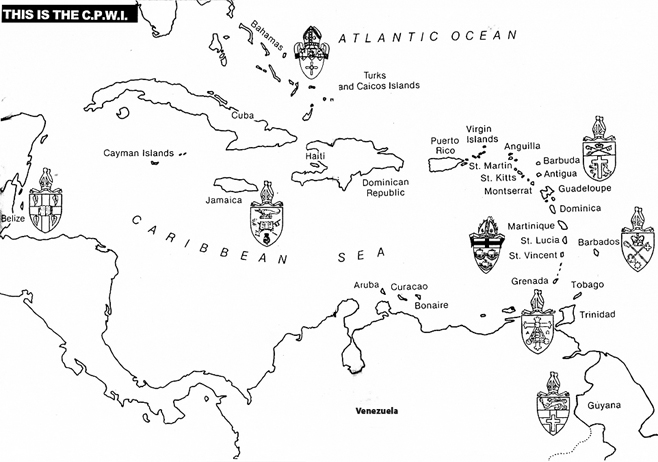
In the Anglican Cycle of Prayer, we pray for the Church in the Province of the West Indies which is comprised of eight dioceses spread out across Aruba, Jamaica, Barbados, Bahama, Trinidad and Tobago, Belize, Guyana, the North-Eastern Caribbean, and the Windward Islands.
Christianity first arrived in the West Indies with Christopher Columbus in October of 1492.[1] Though Columbus was driven by a desire for gold and glory, he also saw himself as a missionary, hoping to find a shorter route to the East in order to hasten the evangelization of the world and thus the Second Coming of Christ.
After the Spanish and the French brought Catholicism to the West Indies, the Dutch brought Protestantism; and in the seventeenth century, the Church of England brought religious conflict between Protestantism and Catholicism.[2] According to Noel Titus, the Church of England “had a shaky start in the West Indies.”[3]
In the late seventeenth century, the Bishop of London began to license clergy to serve in the region; however, there was no oversight or accountability, so clergy of poor character would often behave immorally with impunity. In the eighteenth century, the bishops of London appointed commissaries as episcopal representatives, but they often locked horns with local governors and legislators whenever they tried to set up ecclesiastical courts.
The parishes in the West Indies were governed by vestries, which consisted of wealthy landowners and slave owners who were not even required to be members of the church. Vestries had the power to “hire and fire” clergy and to withhold clergy stipends if the priests ever challenged or criticized their blatantly immoral behavior.[4]
Chattel slavery was the dominant social issue in the West Indies during the seventeenth and eighteenth centuries. For the most part, the church failed to instruct slaves in the basic tenets of the Christian faith, but this was mostly because the vestry members did not want their slaves educated and they exercised considerable control over the clergy.

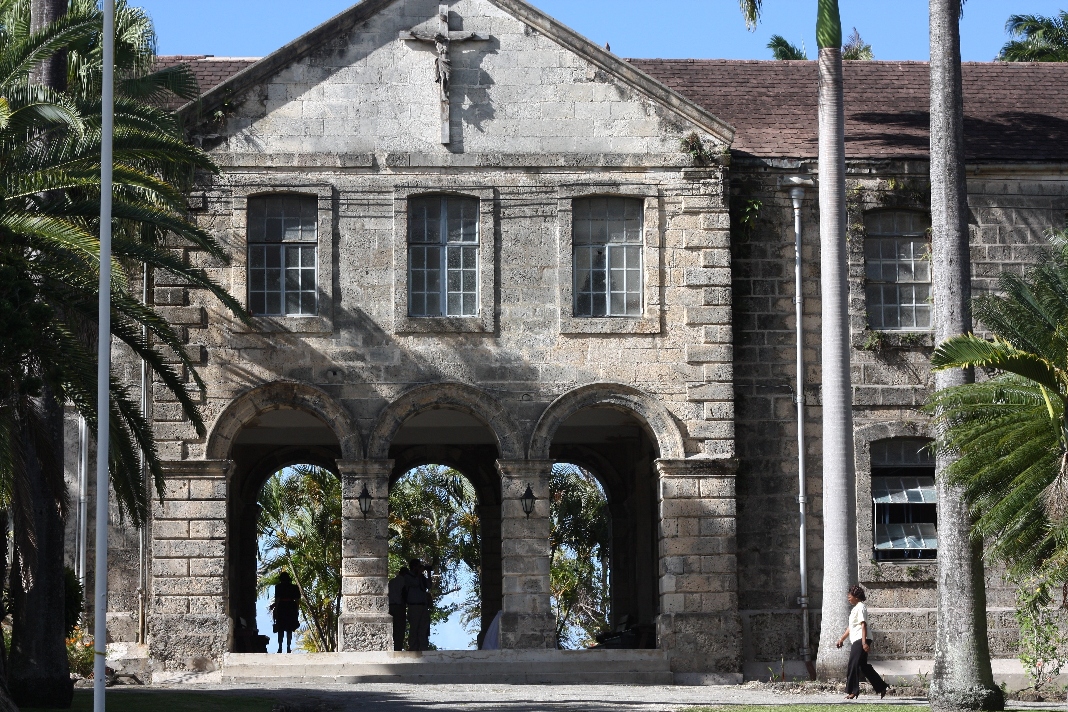
In the late eighteenth century, Bishop Beilby Porteus became involved in the selection and formation of clergy in the region and began to focus on the conversion and religious instruction of West Indian slaves, especially in the Leeward Islands and Jamaica. Also in the early eighteenth century, a sugar plantation owner named Christopher Codrington donated land to the SPG (Society for the Propagation of the Gospel in Foreign Parts) to establish a religious college in Barbados. Codrington College was the Anglican Communion’s first theological college and still exists today as one of the oldest theological schools in the Americas. Unfortunately, Codrington’s will demanded that slaves continue to work on the property which made the SPG a slave-owning organization, a situation that aroused significant criticism from Evangelicals and abolitionists.[5] Moreover, when the SPG took ownership of the Codrington plantation, slaves had the word “society” branded on their backs with a red-hot iron.[6]

Theological education and education in general were vital to the implementation of what has been called the “gradual abolition” of slavery in the West Indies, which was spurred by Anglican evangelists in the late 1700s and early 1800s.[7] In 1824, two bishops were finally appointed: Bishop Coleridge in Barbados and Bishop Lipscomb in Jamaica, who both helped liberate the church from the clutches of the plantocracy, as slavery was finally abolished in the 1830s.
Former principal of Codrington College Noel Titus writes, “The implanting of the church began in an atmosphere of conflict, with the struggle of Englishmen for certain rights against a determined monarch. In 1823, the West Indies was caught up in a struggle for basic human rights by and for the majority of the population. The difference was that, whereas the fight in England was against a single monarch, in the West Indies the prevailing social and economic system produced many monarchs.”[8]
Although white Anglican clergy in the West Indies were slow in raising up clergy of color, the Rev. Percival William Gibson was elected as the province’s first black diocesan bishop of Kingston in Jamaica in 1955 and the province’s first Archbishop of color G. C. M. Woodroffe was elected in 1980. The province participated in the formation of the Caribbean Conference of Churches and engages in ecumenical and interfaith dialogue while continuing to invest in education through schools like United Theological College of the West Indies and Codrington College.
May we keep all this in mind as we hold the Church in the Province of the West Indies in our hearts.

[1] Columbus set sail for the “Indies” 530 years ago, on August 3, 1492.
[2] The conflict from 1642 to 1651 was between the Roundheads (Parliamentarians) and the Cavaliers (Royalists). The Cavaliers adopted “Loyalty and Piety” as their slogan with loyalty being expressed through submission to the monarch and piety being expressed in the use of the Book of Common Prayer. England’s first exploits in the Caribbean back in the late 16th century as Sir Walter Raleigh (1552 – 1618) tried converting Indian rulers to the Protestant faith and forming an alliance with them against Catholic Spain. “Protestant England,” Kevin Ward writes, “had no more concern for the souls of the indigenous populations, the Carib and Arawak, than had the Spanish. Indeed, less so: there was no Anglican theologian of the stature of the Dominican Fra Bartolomé de las Casas to defend the native Americans as fully human, though the Elizabethan clergyman Richard Hakluyt, who publicized English exploits across the globe, made use of las Casas in his attack on Spain’s treatment of the American Indians.” Kevin Ward, A History of Global Anglicanism, 83.
[3] Noel Titus, “The Church in the Province of the West Indies” in The Wiley-Blackwell Companion to the Anglican Communion, 517.
[4] “The island legislatures and the parish vestries had considerable powers, not least because they financed the upkeep of the church fabric and paid the stiped of the minister. Priests were sometimes paid in sugar. They themselves became sugar planters and slave owners. While originating from Britain themselves, they came to reflect the mores and attitudes of the plantocracy.” Ward, History, 85. Also, see A. C. Dayfoot, The Shaping of the West Indian Church 1492 – 1962 (Kingston: University of the West Indies, 1999), 85 – 90.
[5] One Evangelical abolitionist wrote, “What a frightful mockery is this! A Society holding the Bible in one hand and the cart-whip clotted with blood of the African in the other, with one eye fixed in pious veneration on the Cross, the other on the drooping slave degraded down to the lower animals.” Regulations of 1819, quoted by Leroy Errol Brooks, ‘The Church and the Abolition Movement in the British Caribbean,’ unpublished M. Th. dissertation, Columbia Theological Seminary, 1986, p, 62, as quoted by Ward, History, 87.
[6] http://news.bbc.co.uk/2/hi/uk_news/4694896.stm
[7] The Rev. James Ramsay (1733 – 1789), a Scot from Aberdeenshire who served as a parish priest in St. Kitts, was a vocal abolitionist who became a major influence on William Wilberforce.
[8] Noel Titus, “The Church in the Province of the West Indies” in The Wiley-Blackwell Companion to the Anglican Communion, 519. “In the Caribbean itself, Quakers and Moravians, Baptists and Methodists, were more critical of slavery. They were not so bound up in the slave economy of the British Caribbean islands as the Church of England (though the Methodist missionary Thomas Coke, in his concern to reach planters as well as black slaves, was reluctant to make too much of an issue of it).” Ward, History, 87.


 DANIEL DeFOREST LONDON