
Readings for the Sixth Sunday after Pentecost (Proper 11 – Year C – Track 1)
This sermon was preached at Christ Episcopal Church in Eureka CA on July 17, 2022.
Three years ago (in 2019), I preached on this morning’s Scripture readings at our parochial mission church in Trinidad on the day we celebrated the mission’s matronal feast day, the feast of their matron saints Martha and Mary of Bethany. The community had come a long way since its last matronal feast day in 2018 when they were struggling in the wake of the abrupt departure of previous leadership. In order for the Sts. Martha and Mary mission church to continue, new leaders needed to step up and they did. Leaders such as David Tschoepe and Connie Butler, who embodied the active service of St. Martha and the prayerful devotion of St. Mary. Although we eventually needed to let go of that relationship and our parochial mission closed soon before COVID (in December 2019), I’m grateful for those who worshipped and served faithfully at Sts. Martha and Mary from 2006 to 2019 and who have now returned to Christ Church.
Yesterday, we had a mini reunion of the Sts. M & M community as we celebrated the life of one of the mission’s founding members Connie Marguerite Butler, a prolific sculptor and gifted artist who designed the image of Martha and Mary on the cover of your bulletin, which served as the logo for the mission church. Traditionally, Martha and Mary have been understood as representing two poles on the spectrum of the spiritual life: active service (Martha) and contemplative prayer (Mary). In this image, Connie presents Mary and Martha as integrated, as sisters of the same family, sharing a common cup, both embraced by arms of love. Their faces form a yin and yang, suggesting that there’s always a little bit of Martha in Mary and Mary in Martha; and that they need each other in order to be whole. One of the most ancient Christian theologians was Origen of Alexandria (d. 185), who said, “We may reasonably take Martha to stand for action and Mary for contemplation. However, the mystery of love [embraces both.] There is no [authentic] action without contemplation, or contemplation without action.”[1] They are two sides of the same coin. If all I do is sit and pray all day and cut myself off from active engagement with others, then my prayer becomes inauthentic. At the same time, if all I’m doing is running around serving others without taking the time to rest in God’s presence, then my service becomes inauthentic. “Inauthentic” because true contemplation leads us to action and true action is fueled and empowered by contemplation.

In today’s Gospel, Jesus rebukes Martha and his rebuke has led many Christian theologians to believe that Jesus upholds contemplation as superior to action. The anonymous English author of The Cloud of Unknowing focuses on today’s Gospel passage of Martha and Mary more than any other biblical passage and he seems to see contemplation as superior to action. In chapter 8 of the distilled version of the Cloud, he writes, “Some people are primarily called to the active life, which means striving for peace and justice and caring for the weak, poor, and vulnerable. Other people are primarily called to the contemplative life. Many are called to a combination of the two: the ‘mixed life.’ My friend, right now, I am inviting you to consider a call to the contemplative life. And in this life, only one thing is needed: to sit peacefully before the God you love, like Mary of Bethany. Let go of all those distracting thoughts and anxious voices that keep saying, ‘You’re not doing enough!’” (12).
There are seasons for action and there are seasons for contemplation. For instance, the woman who perhaps best embodies the active life of Martha here in Eureka is our friend Betty Chinn, who right now is on a prayer retreat, practicing contemplation.
When Jesus chastises Martha, it’s very important to understand that he is not rebuking her active service. “Please understand,” the Cloud author says, “that Martha’s work is good and holy and necessary. And thank God for Martha! She is truly a saint” (23). What Jesus is rebuking in Martha is not her good work but her anxiety and distraction and preoccupation with her sister’s behavior. It is Martha’s anxiety that prevents her from being her authentic active self and it’s Martha’s anxiety that seeks to obstruct Mary from being her authentic contemplative self. Jesus urges her to let go and to do the one thing that is needed: to trust in Christ, to rest in his arms of love, even during the hustle and bustle of active service. The “better part” is not contemplation. The “better part” is trusting in Christ during both action and contemplation.
This message is reiterated in the other famous passage of Martha and Mary which we read yesterday from the Gospel of John (at Connie’s service), in which both sisters express their anxiety to Jesus regarding the death of their brother Lazarus. Jesus responds to both of them with a sympathetic and non-anxious presence, inviting them both to remember the “better part,” inviting them both to trust in Him even in the face of death, inviting them both to rest in his arms of love.
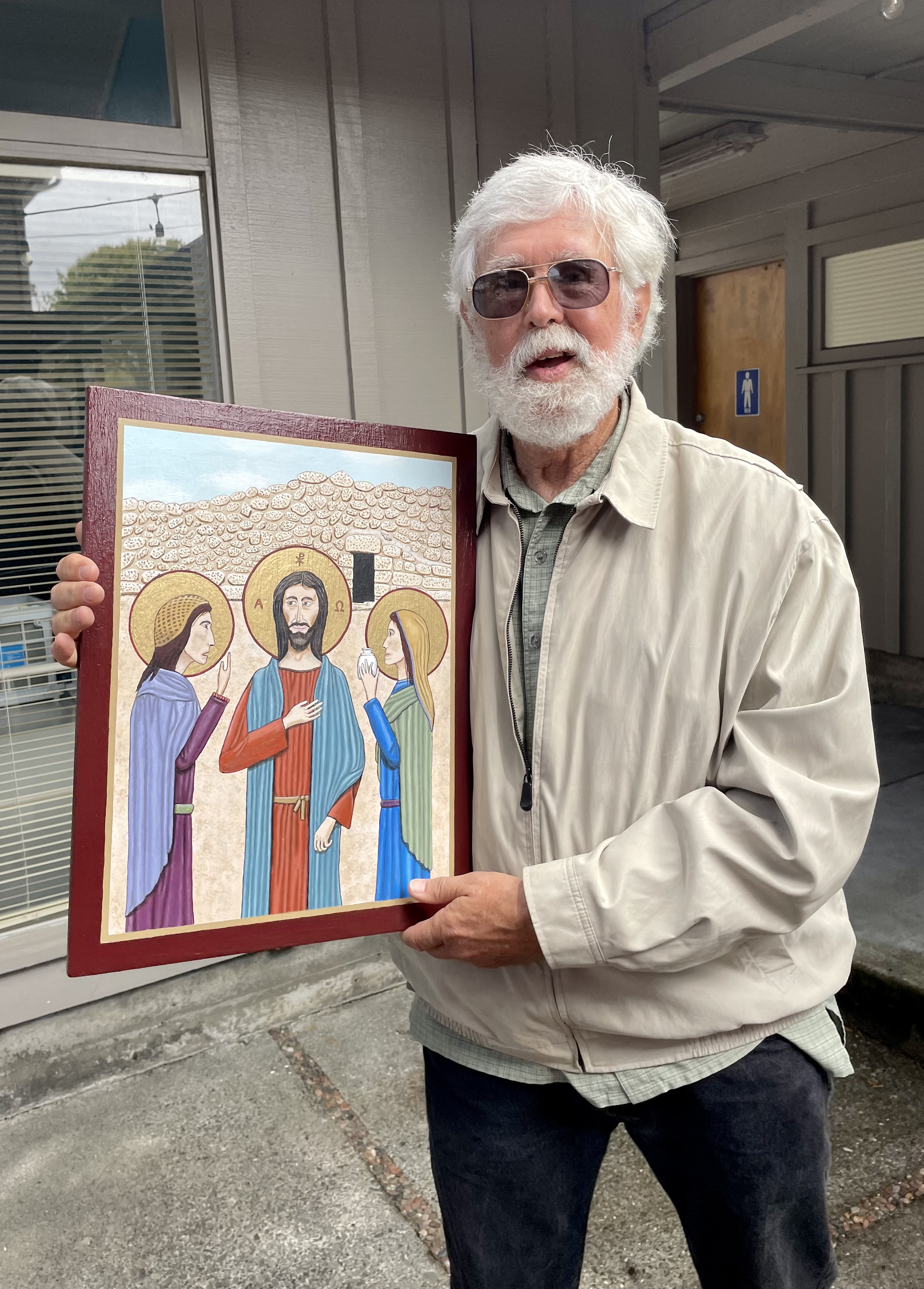
Yesterday, as Connie’s family and friends gathered around the chapel courtyard to take pictures by her sculpture, we talked about the need to let go in order to embrace and be embraced, to let go of our anxiety in order to rest more fully in God’s arms. During these conversations, David Tschoepe told me that he had recently finished the icon of Sts Martha and Mary which the vestry commissioned him to make for the chapel courtyard several months ago. He told me that the icon represents the passage from John’s Gospel which we had just read at Connie’s service.
So Connie’s family and friends were among the first to see David’s icon which portrays Jesus as exuding a sympathetic and non-anxious presence to Martha and Mary in the midst of their grief and loss, inviting them to remember the “better part,” inviting them to trust that he is the Resurrection and the Life and the Messiah (the Christos), inviting them both to rest in his arms of love as vital and essential members of God’s family.
In a couple weeks, we are going to formally reintegrate the Sts. Martha and Mary community back into the embrace of the Christ Church family by blessing the chapel courtyard as the “Sts. Martha and Mary courtyard,” a courtyard now adorned by Connie’s sculpture and soon to be adorned by David’s icon. Since their feast day is July 29th, we are planning to do this in the chapel Sunday July 31st at 12:30 PM and you are all invited. As the Sts. Martha and Mary community becomes formally enfolded back into the Christ Church family, may we all learn to let go of our anxieties and distractions and resentments and preoccupations in order to be enfolded into the warm embrace of Christ our Merciful Saviour. Amen.
[1] Origen, Fragments on the Gospel of Luke 171; trans. Joseph T. Lienhard.

 DANIEL DeFOREST LONDON