
Readings for Connie Butler’s Celebration of Life
- Isaiah 61:1-3
- Revelation 7:9-17
- John 11:21-27
This homily was preached at Christ Episcopal Church in Eureka CA on July 16, 2022. Worship Bulletin
Jesus said to Martha, “I am the resurrection and the life…everyone who believes in me will never die” (John 11:25-26)
We gather this morning to do three things: to give thanks for the gift of Connie Buter; to grieve her passing; and to discover hope and joy in the promise of the resurrection through the power of the One who comforted Martha of Bethany and who told her that he is the Resurrection.
We gather to celebrate and give thanks for Connie’s life. I personally treasure all my interactions with Connie, who had so much depth and wisdom and creativity as well as levity and humor and playfulness. She was a powerful channel for God’s playful creativity and light; and when I look at her art, I see that light continue to shine brightly, especially in sculptures of colorful personalities and archetypes, like “Loki” and “Gaia” and “Dreaming Horus.” Because of her deep work in studying her own dreams and depth psychology and Carl Jung, these archetypes were not just ornamental for Connie; they were integrated. On page 17 of your bulletin, you can see her bronze sculpture of Loki as well as a sculpture that I wish I could talk to her about today titled “Peanut Butter Cookie Demon.” Clearly, God’s playful light continues to emanate and radiate through Connie’s art.

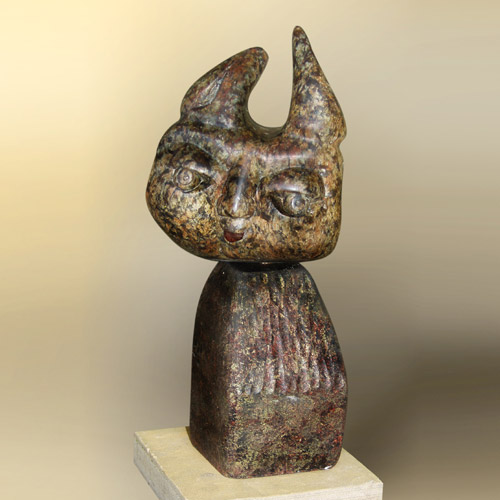
I remember running into Connie at Costco many years ago and talking with her for quite some time about her hopes and joys and concerns about the church in Trinidad and about her own life. And I remember her saying how much hope she had for the future of our country and our church and our planet because of young people, especially Millennials, and more specifically her grandchildren, who are with us today: William, Ashley, Erika, and Claire (and her great grandchildren Alana and Abigail). She beamed with light when she talked about you guys. That conversation gave me hope and, like all my interactions with Connie, it was a gift. I invite you now to take a moment to simply give thanks for the gift that Connie was in your life and the gift she will continue to be through your memories of her and through her art.
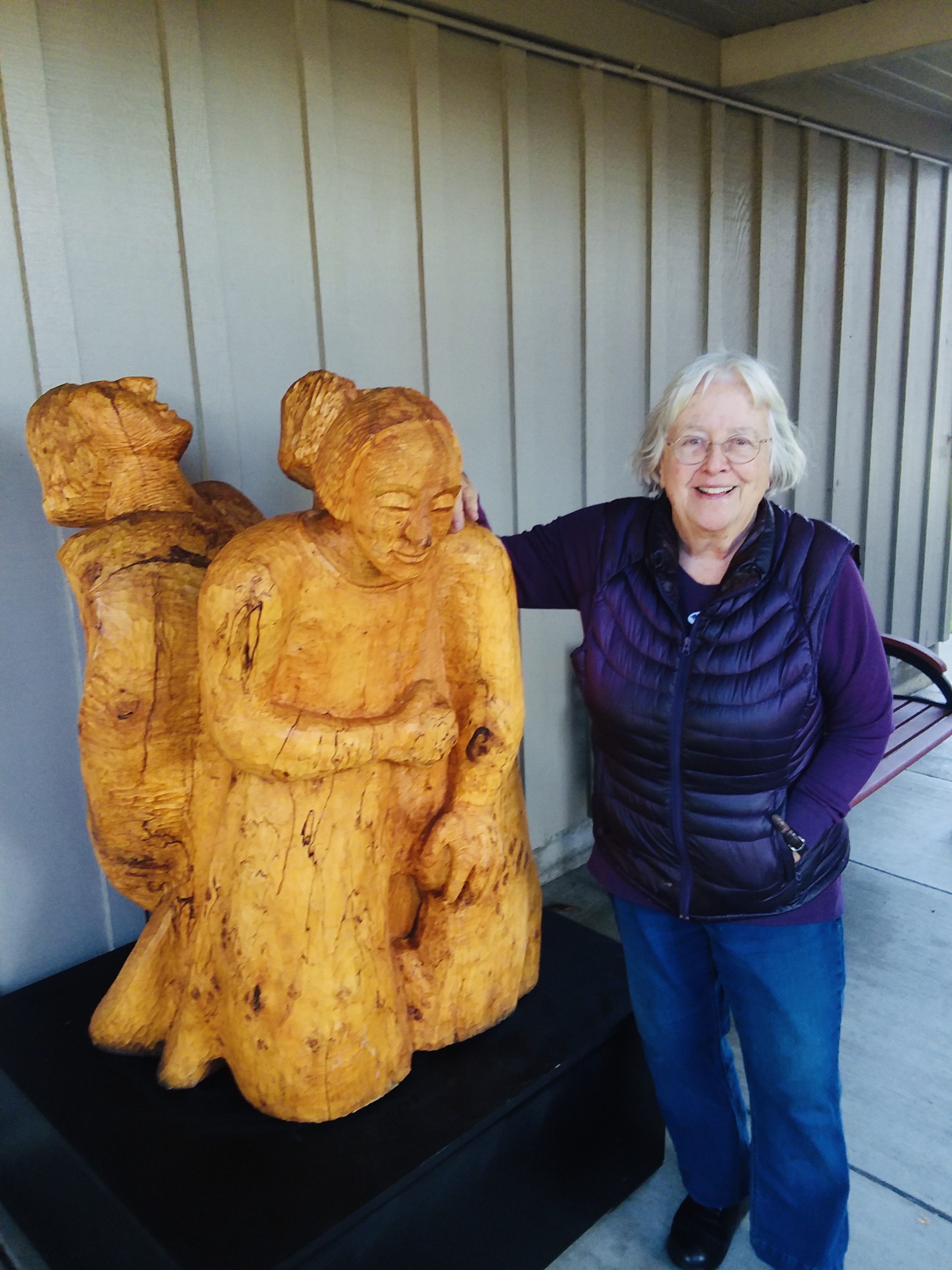
Today we also grieve. Connie was a founding member and pillar of our parochial mission church in Trinidad Sts. Martha and Mary. And I had the privilege to worship with her there several times, especially on the church’s matronal feast day, the feast of the church’s matron saints (Martha and Mary) which is July 29th (12 days from today). And this year, in honor of their feast day, we are going to bless our chapel courtyard as the Sts. Martha and Mary courtyard on Sunday July 31st at 12:30 and you’re all invited to be part of that. That courtyard is now the home of “Our Good Angels,” a wooden sculpture that previously decorated the church in Trinidad and which was sculpted by Connie. I encourage you to visit it after the service today.
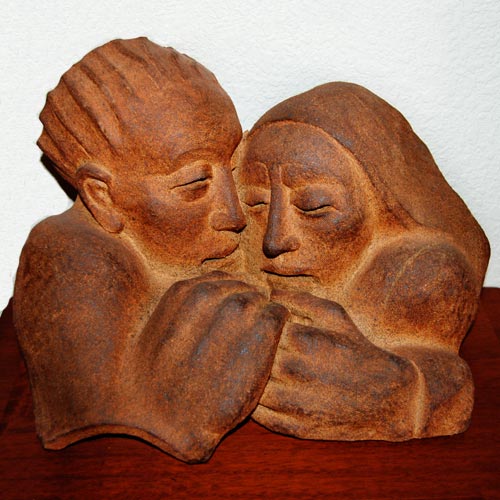
Martha and Mary were close friends of Jesus and the most popular story about these two sisters comes from the Gospel of Luke, which portrays Martha as worried and distracted by many tasks while Mary sits calmly at the feet of Jesus. (This happens to be the Gospel reading for tomorrow morning). These two sisters represent two poles on the spectrum of the spiritual life, with Martha representing action and service while Mary represents contemplation and prayer. The invitation is for us to see these two as integrated, as sisters of the same family, and to integrate their qualities into our own lives. And my favorite image of Martha and Mary is one created by Connie Butler, on page 9 of your bulletin. Their faces form a yin and yang, suggesting that there’s always a little bit of Martha in Mary and vice versa. They share a common cup, both embraced by arms of love. Are these the arms of Martha? Or Mary? Or Christ? Or an Angel? I imagine Connie would invite you the viewer to decide whose arms they are, but what’s clear is that they are both held lovingly by these arms.

And that is a motif I notice throughout Connie’s art: the embrace of tender and almighty arms of love. You see this motif expressed on page 16 in her Wood Block Print “Benedicta Veritas II” and in a clay sculpture titled “Loss,” in which two people, who are grieving, lean into each other’s warm presence and embrace and receive comfort as a result. Connie knew the depths of grief and loss, including the tremendous grief of losing her son Grant; and Connie knew what it felt like to be held.
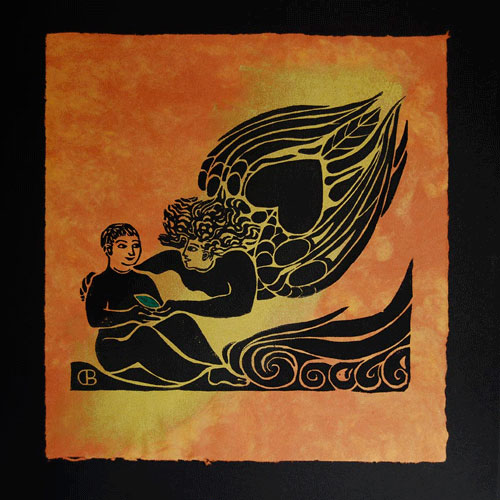
In our Gospel for today, we hear John’s account of Mary and Martha, who are both overwhelmed with grief, telling Jesus, “If you had been here, our brother Lazarus would not have died.” After the conversation between Martha and Jesus, in which Jesus reveals himself as the Resurrection and the Life, Mary approaches Jesus and she begins to weep. Jesus responds to Mary’s tears by weeping himself (John 11:35). The shortest verse of the entire Bible (“Jesus wept”) packs a powerful emotional and theological punch, revealing God as One who enters fully into our sorrow and grief. I imagine Jesus putting his arms around Mary and holding her; and the two of them leaning into each other like the two figures in Connie’s clay sculpture.
Our prayer book references this Gospel when it says, “The very love we have for each other in Christ brings deep sorrow when we are parted by death. Jesus himself wept at the grave of his friend. So, while we rejoice that one we love has entered into the nearer presence of our Lord, we sorrow in sympathy with those who mourn.” Grief is appropriate and we grieve for as much and for as long as we need. Even Jesus, who knew that resurrection was only moments away for his friend Lazarus, still wept for him. When we grieve, we open ourselves up to receiving the comfort and embrace of the God, who according to our reading from Revelation, wipes away every tear from our eyes (Romans 7:17). I love that this reading from Revelation 7 also mentions angels (7:11), heavenly creatures whom Connie portrayed frequently in her artwork, including within a plaster sculpture titled “Carry Me Home,” which might be my favorite piece by her. You can see it on page 15: someone with Connie’s haircut is tucked snugly between the bosom and armpit of a mighty angel, with her head resting on the angel’s cheek, covered by the shadow of its wings. This sculpture invites us to be held and comforted by the God who sees our tears as prayers and who, according to the Psalms, collects our tears in his bottle (Ps. 56:8).
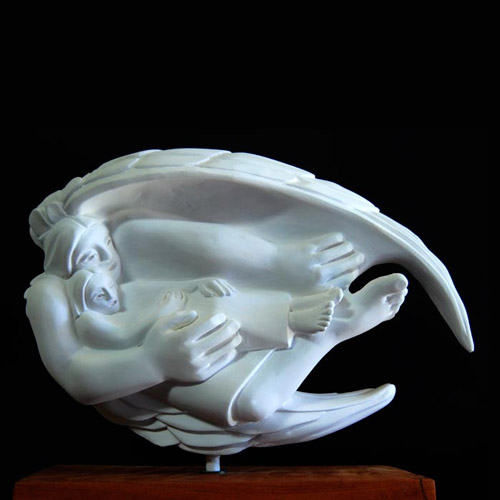
Finally, may we find joy in the promise of the resurrection. Connie personally knew and trusted in the One who is the Resurrection and the Life. She leaned into him and curled up into his embrace. And those who trust in him will never fully die. I like to imagine that Connie is now teaching and learning and laughing and playing with the angels, who were her muse in this life and whom she portrayed as comforting and embracing and carrying people home. These images and the light of Connie that shines through them invite us to find our comfort and hope and joy in knowing that she is now not only at rest but also experiencing new depths of peace, refreshment, and creativity with our good angels, under the shadow of their wings, as they carry her home, ever deeper into the heart of God. Amen.


 DANIEL DeFOREST LONDON