
Readings for the Second Sunday after Pentecost (Proper 7 – Year C – Track 1)
This sermon was preached at Christ Episcopal Church in Eureka CA on Juneteenth, June 19, 2022.
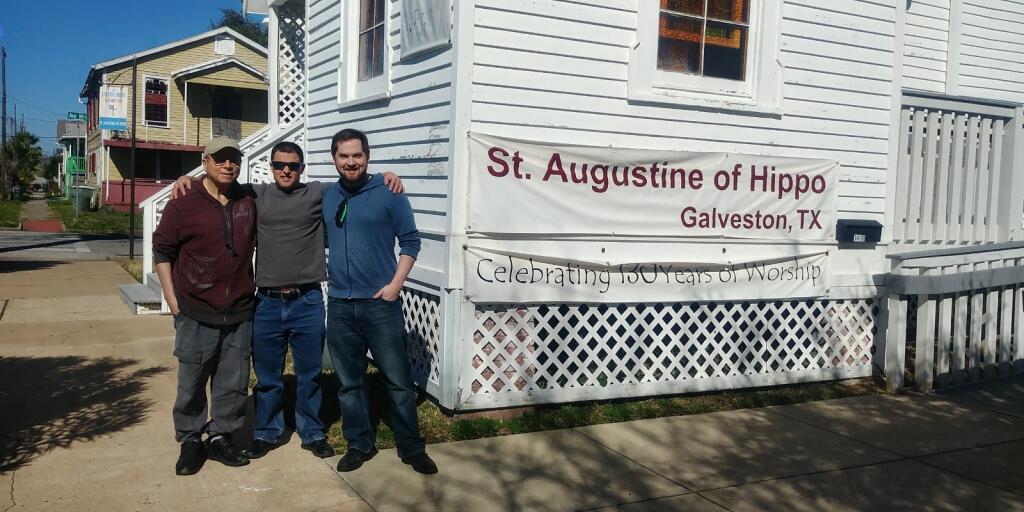
The last day trip that I took with my father was to Galveston TX, which seemed kind of random at the time, but now seems destined, since today we celebrate Father’s Day and Juneteenth, a new federal holiday that commemorates the proclamation of liberty to slaves in Galveston back in 1865.[1] It was my father who first told me about the historical significance of Galveston during our visit from Houston and, at the time (January 2019), I thought it was just another bit of historical trivia, about which my father seemed to have a surplus of knowledge. Since then, I’ve come to realize and appreciate the national and spiritual significance of Galveston, where Black Independence Day began and where it has been celebrated for over 155 years. I was hoping to return to Galveston with my father after he had been liberated from his leukemia and although that trip never took place and my father is no longer with us, I find comfort in knowing that he is now ultimately free from his disease.
And that is what this day is all about: freedom. And that’s also what our faith is about: freedom from our bondage to sin, which can so easily entangle and enslave us (Hebrews 12:1). Through Christ, we are made free and yet it may take us a lifetime to live into the fulness of that freedom. To use theological terms, we are justified in Christ, but we are not fully sanctified. Justification means we are declared free from sin while sanctification is the process of growing into the fullness of that freedom. The 250,000 slaves in Galveston had already been emancipated two years prior to Juneteenth through the Emancipation Proclamation, issued by President Lincoln in January of 1863. However, due to the greed and “grave sins” of slave owners who delayed the liberating news, the African Americans in TX were not yet able to start living into that freedom. When the news of emancipation finally arrived with the authoritative power of Union Major General Gordon Granger and his troops, the truth set the people free and they were free indeed, whether the slave owners liked it or not (and most of them did not like it).[2] Our bishop described Juneteenth as “a day of remembrance that is long overdue, not unlike the original date that freed the slaves. It is a reminder that justice delayed is justice denied. We are still in the process of fully living into that freedom. I thank God that his mercy and lovingkindness fall upon each of us, especially those of us with extra privilege, in our imperfect walk toward justice. May the God who frees us from sin in Christ Jesus, empower us by the Holy Spirit to do those things we have left undone: generous listening and courageous action.”
Juneteenth reminds us of our country’s commitment to liberty and justice for all, which are core and foundational values that we Americans share with the youngest country in the world, the country for which we pray today in our Anglican Cycle of Prayer: the country of South Sudan, which gained independence in 2011 and whose motto is “Prosperity, Justice, and Liberty.” South Sudan gained independence and liberation from the Republic of Sudan, where the fundamentalist Islamic government had imposed severe limitations on the people’s freedom, particularly the freedom of Christians to worship. Sudanese Christians have been considered by many to be the most persecuted people in the world, battered by violence, poverty, displacement, disease, and devastating civil wars. Between 1983 and 2005, two and a half million Sudanese people were killed, most of whom were Christian; and several more million were internally displaced or scattered in the Sudanese Diaspora. Today, thanks to the newly gained independence, the majority of the population in South Sudan are Christian and most of the Christians are Anglican. In fact, there are over 3.5 million Anglicans in the Episcopal Church of South Sudan, which is well more than twice the number of Episcopalians in the US. (And their numbers are growing while ours are shrinking, even though they have faced enormous persecution). The Anglicans of South Sudan celebrate their freedom from an oppressive government, and we celebrate with them and yet we also pray for them because the South Sudanese have continued to have tremendous difficulty living into the fullness of their freedom, still facing extreme poverty and civil war and violence, which have touched the lives of every family in the country.
Like our Anglican siblings in South Sudan and like the 19th century slaves in Galveston, we have experienced freedom in our own lives. We have been made free in Christ and yet it takes time (even a lifetime) to live into the fullness of that freedom. We are justified, but not yet fully sanctified; and as we strive to live into the fullness of our freedom, may we also trust and take courage in knowing that help is always on the way, like it was for Elijah (in the wilderness under that solitary broom tree) and like it was for the demon-possessed man in the Gerasenes. Help and fuller freedom are on the way, even when we don’t know it, even when our souls feel heavy and weighed down and even tormented by all kinds of oppression, even when we feel devastated and undone by yet another shooting (this time in an Episcopal Church in Alabama), even when greedy people capitalize on our bondage like the slave owners of Galveston and the people of the Gerasenes and the violent oppressors in Sudan, even then, help and liberation are on the way, sometimes arriving as an army general or an angel or a still, small voice, or as Christ himself crossing the Sea of Galilee to liberate us and bring us home, where we are no longer imprisoned or subject to any taskmaster, but where we are free, as free as any beloved child of God, who is our Heavenly Father. Amen.
[1] Galveston TX was never really on my radar. On the way, we listened to Glen Campbell’s hit song “Galveston.”
[2] General Gordon Granger read the following to the people of Texas: “The people of Texas are informed that in accordance with a Proclamation from the Executive of the United States, all slaves are free. This involves an absolute equality of rights and rights of property between former masters and slaves, and the connection therefore existing between them becomes that between employer and hired laborer.”

 DANIEL DeFOREST LONDON