
Readings for the Sixth Sunday of Easter Sunday (Year C)
This sermon was preached at Christ Episcopal Church in Eureka CA on Sunday May 22, 2022.
At yesterday’s Sacred Saunter, we celebrated the feast day of St. Lydia of Thyatira, the first European convert to Christianity – the matron saint of European Christianity. And we read a slightly shorter version of this morning’s reading from Acts which describes Lydia sitting at a place of prayer by a river before getting baptized in that river by Paul. We read this passage while standing beside the running waters of the Glatt Street fountain at Sequoia Park. I talked about the health benefits of simply being in the presence of flowing water, which releases negative ions that not only purify the air, but when they reach our bloodstream, actually increase our levels of serotonin, thus relieving stress and anxiety and increasing energy. The ancient Hebrews understood the spiritual and salubrious effects of listening to water, which is why their word for heaven (shemayim) is a combination of two words: mayim, which means “water” and shema which means “listen.” When we first arrived at the fountain as it was splish-splashing, one of the saunterers who had heard this Hebrew lesson before pointed at it, and said, “Look! It’s heaven!” She was right. It was the heaven of listening to water.
And as I was reflecting on Lydia and listening at Sequoia Park, I realized that just like the image of the tree, water imagery shows up as central at the beginning and the middle and the end of our Scriptures. In Genesis, the Spirit of God hovered over the face of the waters (Genesis 1:2). The first psalm describes a tree planted by streams of water (Psalm 1:3), a metaphor for those who walk in the way of the Lord. And then water shows up again as central in the last chapter of the last book of the Bible, Revelation, which we just read this morning: “Then the angel showed me the river of the water of life, bright as crystal, flowing from the throne of God” (Rev 22:1). Our Scriptures underscore the healing power of water, simply being in its presence and listening to its soothing music. God’s healing energy dwells within and hovers above water.
In this morning’s Gospel, we have perhaps the most fascinating description of the mysterious healing power of water. In fact, it’s so fascinating that most translations today leave it out! The Gospel’s creative description of the spiritual potency of water is so intense that it has been removed from the text.
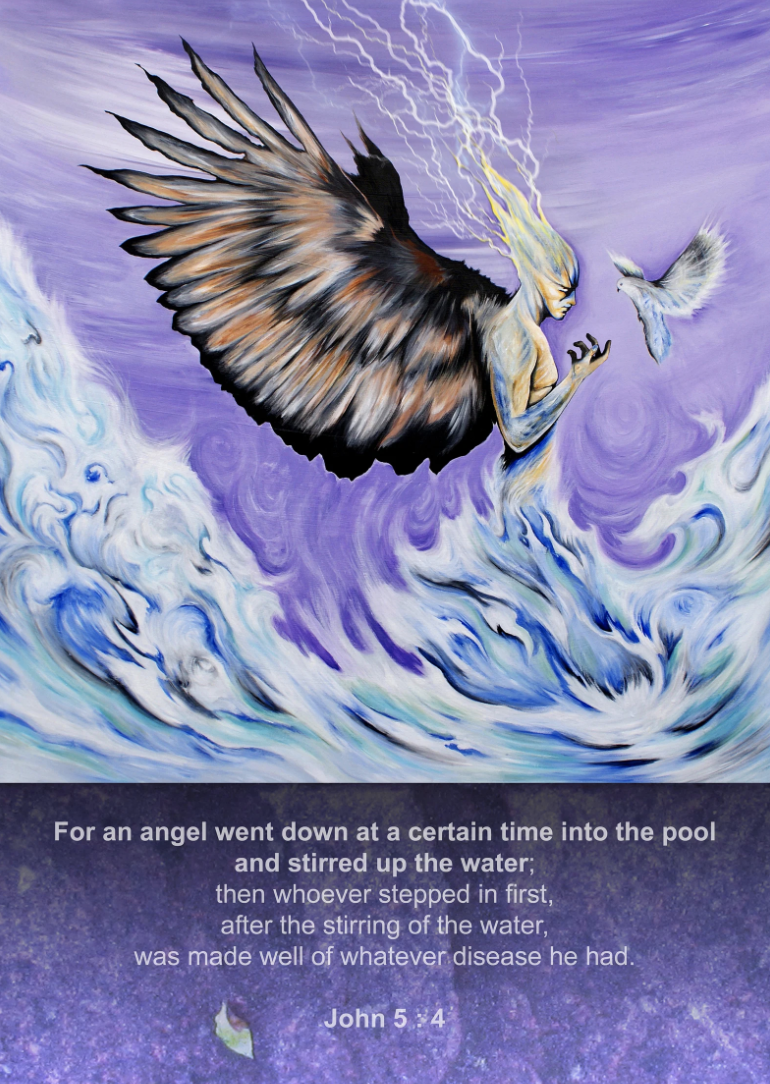
Open your Bibles to John chapter 5, which is on page 970 in your pew Bibles. And let’s try to read together verse 4. [Read verses 1 – 3 and then ask, “Where is verse 4?”] Verse 4 has been extracted. If we put verse 4 back in, the story is told this way, starting back at verse 3: “In these [five porticoes] lay many invalids – blind, lame, and paralyzed, [they were] waiting for the stirring of the water; for an angel of the Lord went down at certain seasons into the pool, and stirred up the water; whoever stepped in first after the stirring of the water was made well from whatever disease that person had.” These are the words that have been extracted from your Bible. Fortunately, the NRSV includes them in a footnote at the bottom of the page, but their removed from the main text.

Now the primary reason for this omission is because our most ancient manuscripts of John’s Gospel do not include these words, so most scholars agree that they were likely not written by the original author but were rather added later to explain why the man complains about not having anyone help him get into the pool when the water is stirred.[1] However, as your footnote says, there are still a lot of “ancient authorities” (ancient manuscripts) that do include these words and they’ve been included in the Bible throughout most of church history, which is why you’ll often see angels in portrayals of this miracle, like in the William Hogarth painting on the cover of your bulletin.
Another reason it’s taken out of the main text is because it sounds a little too pagan, too much like those magical wells of the pre-Christian Celtic world that I love so much. I personally find it more effective to keep those verses in the main text, not only because they explain what was likely a colorful, local legend about an angelic water sprite who occasionally sprinkled and stirred its healing angel dust into the pool, but also because the words end up highlighting the power of the One from whom all creation, including water and angels, derive their healing qualities.
Jesus approaches the man at the pool of Bethesda and asks one of my favorite questions in the entire Bible: “Do you want to be made well?” We might think that the answer is obviously “yes” since the man has been ill for 38 years and he’s trying to be healed by this magical pool. However, the man responds to the question by not saying yes. Instead, he complains that nobody helps him, and other people just keep pushing him out of the way. Now of course we want to be sympathetic towards this person, but his answer reminds me of times when we actually seem to prefer our sickness to health, whether that sickness be addiction, mental illness, depression, anxiety, emotional paralysis, or whatever. Kurt Cobain of the band Nirvana sang, “I miss the comfort of being sad.” Some of us find comfort in our sickness, especially in our addictions and we might not want to be made well because wellness often requires something of us. As someone who is addicted nicotine, I know what it’s like to prefer something that kills me over something that gives me life. Although I’ve been abstinent from nicotine for seven years now, it still took me a long time to respond with a yes to the question “Do you want to be made well?” I had to first want to want to be made well. Wellness requires something of us. It calls us to stop feeling sorry for ourselves. It calls us to stand up, to take up our mat, and walk, which is exactly what this man does after Jesus cuts through his excuses and empowers him to embrace the healing that is right in front of him. After 38 years of sickness (which was likely some toxic blend of mental, emotional, and physical disease), this man is healed not from the pool, not from the water, not from the angel, but from the One through whom all these things derive their power, the One to whom the angels bow down and worship, the One who fully embodied the Spirit that hovered over the waters at the beginning of creation, the One who fully embodied the Spirit that courses through river of the water of life, bright as crystal, the One who nourishes us like a stream nourishing roots, empowering us to get up and walk in the Way of the Lord, which is the Way of Love.
Water, trees, angels, healing pools and water sprites are only valuable insofar as they are vehicles for Christ and his life-giving power and glory. The Gospel of John makes this very clear. A medicinal pool that is stirred up by an angel sounds amazing, but even the angels would think you’re crazy if you chose that over the One who embodies the life-giving Spirit who hovered over the waters at the beginning of creation. What the Gospels also make clear is that water remains one of Christ’s preferred vehicles for his healing power and glory, along with bread and wine and oil. So, I invite you to spend some quality time this week beside some flowing waters. You will receive the health benefits of negative ions, but may you also receive eternal benefits of which negative ions are a mere shadow. May you also receive from the water the refreshing and rejuvenating presence of the Christ who heals you, nourishes you, strengthens and empowers you to get up and walk in the way of his self-giving love.

[1] John 5:4 is missing in a variety of manuscripts, including P66, P75, B, C*, D, and more. It is marked by asterisks or obeli, indicating that it is an addition in a number of Greek witnesses. It contains a number of terms otherwise missing from John or the entire New Testament (kata kairon, embaino, ekdexomai, katexomai, kinesis, tarache, depote, and nesome.) It is generally recognized as a secondary addition explaining the man’s excuse. Marianne Meye Thompson, John: A Commentary (Louisville KY: Westminster John Knox Press, 2015), 120.

 DANIEL DeFOREST LONDON