
A brief introduction to the Church of the Province of South East Asia for the Anglican Prayer Cycle
In the Anglican Cycle of Prayer, we pray for the Church of the Province of South East Asia, one of the youngest provinces within the Anglican Communion.[1] Although Christianity first reached South East Asia in the seventh century through a group of Christians called Nestorians, Anglicanism was not introduced until a millennium later through the chaplains of the British East India Company.[2] The first Anglican missionary to South East Asia was Dr. Francis Thomas McDougall who later became the first Anglican bishop of Labuan and Sarawak in 1855. In 1948, Trinity Theological College in Singapore was established to train local men and women for leadership in the church. On February 2, 1996, the Archbishop of Canterbury, the Most Rev. Dr. George Carey formed the Province of South East Asia, which is composed of four dioceses: Kuching, Sabah, West Malaysia, and Singapore, which also has responsibility for the mission work of deaneries in Indonesia, Vietnam, Nepal, Laos, Thailand, and Cambodia, giving the province a wide geographical reach.
Although the province exists under the restriction of a Muslim government, this context has seemed to galvanize Christian communities, compelling different denominations to work together as partners rather than rivals.[3] This context has also helped forge partnerships across faith traditions, such as the Malaysian Consultative Council for Buddhism, Christianity, Hinduism, Sikhism, and Taosim (MCCBCHST). Out of an estimated population of 360 million, there are approximately 200,000 Anglicans within the province;[4] and the church continues to experience growth as it focuses on training local leaders, teaching the Word of God, ministering to youth, and remaining open to the diverse gifts of the Holy Spirit, especially the gift of charismatic renewal.[5] May we keep all this in mind as we hold the Church of the Province of South East Asia in our hearts and prayers.
Fun facts:
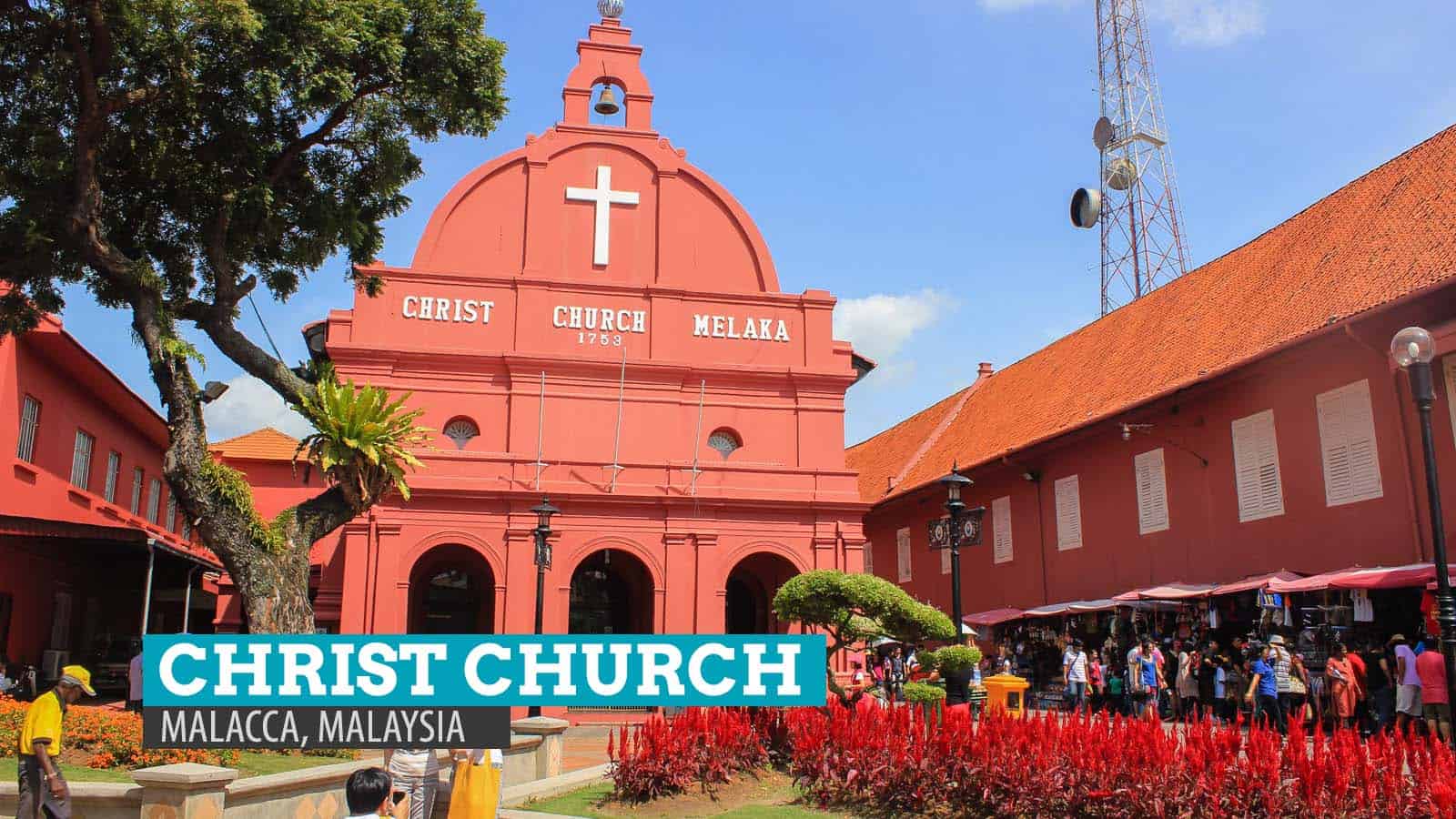
- The oldest functioning Protestant church in Malaysia is called Christ Church. Located in the city of Melaka (Malacca), it was originally a Dutch Reformed Church (founded in 1753), but was converted to Anglican use as Christ Church in 1838.
- Many of the Anglicans and Christians in South East Asia are Chinese and Tamil.
[1] The Anglican Communion is composed of 41 provinces, including The Episcopal Church.
[2] Nestorius was an Archbishop of Constantinople from 428 – 431. According to Eddie Ong, Nestorian ecclesiastical texts refer to Patriarch Ishoyab III’s episcopal jurisdiction (AD 650 – 660) as stretching from ‘India…to the country called Kalah’ in West Malaysia.” Ong contrasts the peaceful Nestorians with the violent Reconquista Catholics (1511 – 1641). He encourages the Anglican Church in Malaysia to reflect on the Nestorians, who were “peaceful, quiet but zealous.” Eddie Ong, “Anglicanism in West Malaysia” 172 – 178 from Anglicanism: A Global Communion, ed. Andrew Wingate, Kevin Ward, Carrie Pemberton, WIlison Sitshebo (New York: Church Publishing, 1998), 177.
[3] Christians have difficulty procuring land to build churches or burial grounds. It is illegal to evangelize to Muslims; and non-Muslims are not permitted to use certain words like God (Allah), gospel (injil), and revelation (wahyu). Bishop Stephen Neil said, “If there is any place in the world where there is a case for a united church, if it can be obtained without sacrifice of principle, it would seem to be Malaya [West Malaysia].” Justyn Terry, “The Church of the Province of South East Asia” Justyn Terry, “The Church of the Province of South East Asia” 344 – 353 in The Wiley-Blackwell Companion to the Anglican Communion, ed. Ian S. Markham, J. Barney Hawkins IV, Justyn Terry and Leslie Nuñez Steffenson (Malden MA: Wiley-Blackwell, 2013), 350 – 351.
[4] These numbers come from Anglican Communion News 2000, as cited by Justyn Terry, 347. Kevin Ward says there are 168,000 Anglicans in the province.
[5] Bishop Joshua Chiu Ban It (the first indigenous bishop of Singapore) read Dennis Bennett’s Nine O’clock in the Morning, and prayed for the Holy Spirit to fill his life. He wrote afterwards, “When I woke up, I was conscious of a great difference within me. God was suddenly very close. My heart was filled with life, joy, and peace instead of anger, despair, and gloom. I burst out with praise and thanked God through Jesus Christ.” This, according to Justyn Terry, led to a major renewal in his ministry. WBCAC, 352. According to Eddie Ong, “most of the Anglican parishes that are growing rapidly are led by charismatic-renewed priests and parishioners.” AGC, 175.


 DANIEL DeFOREST LONDON