
Readings for the Fourth Sunday of Easter Sunday (Year C)
This sermon was preached at Christ Episcopal Church in Eureka CA on Good Shepherd Sunday May 8, 2022.
In March of 1983, the Irish Rock band U2 released their third album, which is titled “War”; and the opening track of the album is called “Sunday Bloody Sunday” which describes the horrors of the decades-long conflict in Northern Ireland known as “The Troubles,” a conflict between Irish nationalists (who were mostly Roman Catholic) and Irish unionists (who were mostly Anglican).[1] Although the song “Sunday Bloody Sunday” is one of the band’s most overtly political songs, they’re non-partisan in their lyrics. The lead singer Bono (whose mother was an Irish Anglican) does not choose a side, except the side of peace and non-violence.[2] The song’s lyrics still speak to us today amid the division and death that continue to plague us, amid the recent news from the World Health Organization that 15 million people have died from COVID.
“I can’t believe the news today / I can’t close my eyes and make it go away.” And then Bono sings the song’s two-word refrain, which is also a refrain all throughout the Bible, the classic words of biblical lament, the biblical mourner’s mantra, the way the Bible asks the age-old question of suffering: “How long? How long must we sing this song? How long? How long?” The psalmists ask, “How long, O Lord, will you hide your face from me?” (Ps 13:1) “How long will the wicked be jubilant?” (Ps 94:3). U2 return to the “How long?” refrain in the last track of the album titled “40” which is based on Psalm 40, from the Bible’s treasure trove of honest prayer and lament. The prophet Habakkuk asks, “How long shall I cry out and you not hear me?” (Hab 1:2). In Revelation, the souls of the martyrs cry out, “How long will it be, Sovereign Lord, before you execute justice and avenge us?” (Rev 6:10).
The question (“How long?”) assumes that God wants to save his people and that God has the power to do so, but for some inexplicable reason, He tarries. God generally does not respond to the question by providing a detailed timeline for his plan of salvation nor does he offer a theological defense. And God generally does not respond by removing all danger and suffering in two shakes of a lamb’s tail. However, God does still respond to the question. And part of what I love so much about studying Scripture is the opportunity to see and unravel and interpret God’s response to the question of suffering; God’s response to the ancient human lament, “How long?”
All our readings this morning can be seen as divine responses to the question of suffering. Our reading from Revelation chapter 7 is part of God’s response to that question asked by the martyrs in Revelation 6, “How long until you execute justice?” (Rev 6:10). The beautiful and beloved Psalm 23 follows right after one of the most desperate lament psalms in the psalter: Psalm 22, the opening line of which Jesus himself prays on the cross: “My God, my God, why have you forsaken me?” And the Gospel reading this morning recounts Jesus’s response to a question asked by the Judeans, a question that begins with the words, “How long….?” The rest of their question is translated as “How long will you keep us in suspense?” However, literally in the Greek, the question they ask is, “How long will you take away our breath?”, an especially poignant question as COVID steals away the breath of millions. In the Gospel, we can see that the Judeans are reiterating a question asked by the disciples at the beginning of this two-chapter long passage in John, which begins in chapter 9, when the disciples ask the question of suffering when they see suffering in a man born blind and ask Jesus, “Who is responsible for this?”
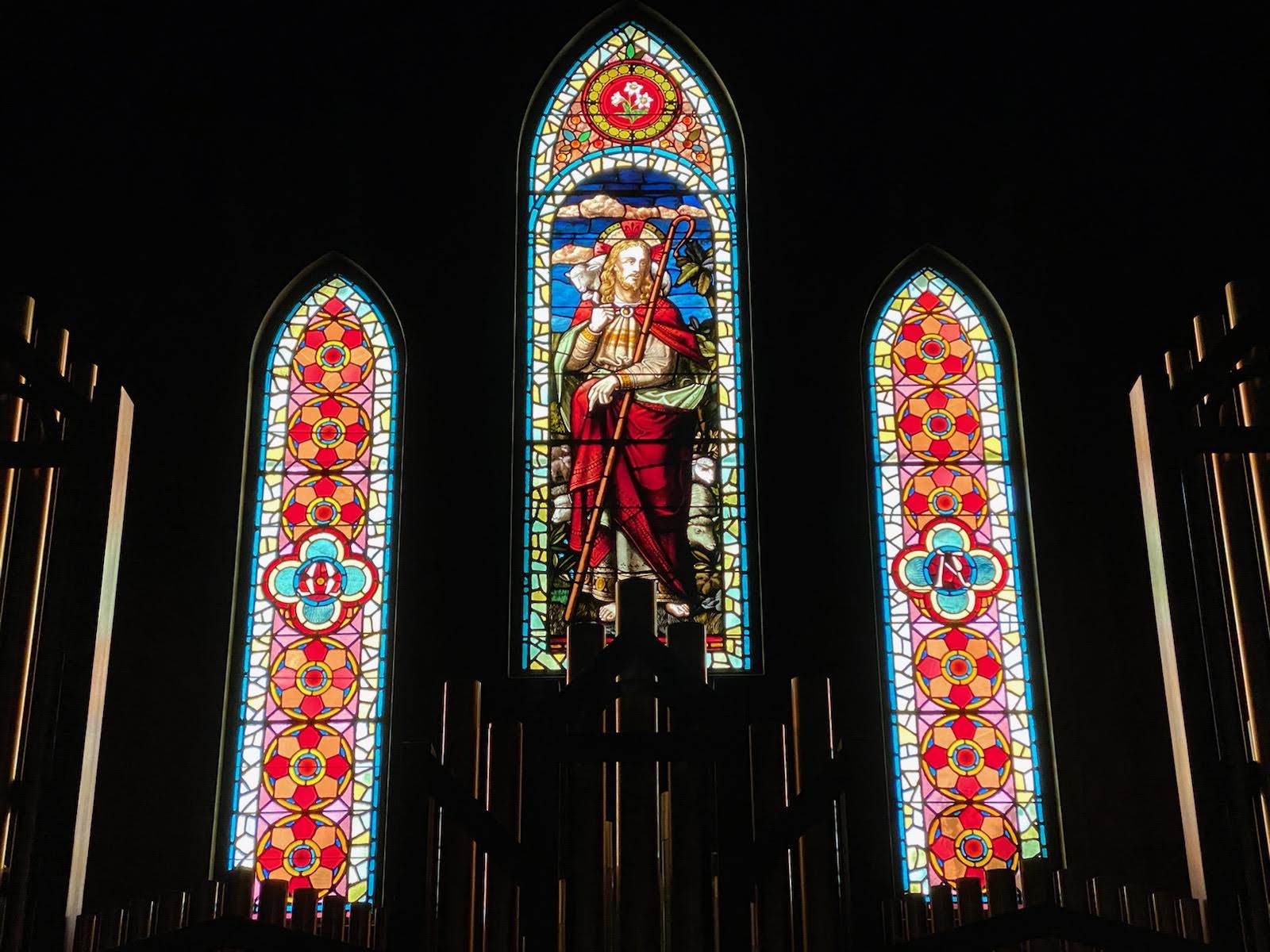
All these divine responses to the question of suffering share one thing in common. The Psalm, the passage from Revelation, and the passage from John all present us with the image of God as a Shepherd. God responds to our laments, our questions, and our confusions around suffering with an invitation to see him as a Good Shepherd, who holds us lovingly in all our bewilderment, resentment, fear, and vulnerability. This profound and pastoral image of the divine Good Shepherd invites us to recognize our vulnerability and to trust in the God who promises to protect and guide us as a shepherd protects and guides his sheep, whom he knows by name.
I remember preaching on these readings six years ago, just four weeks after 70 Christians (mostly women and children – children with their mothers) who were celebrating Easter in a park were tragically killed by the vicious wolf of violent terrorism in Lahore, Pakistan. This tragedy along with the still rising death toll of COVID drive us to join the authors of Scripture in crying out, “How long?” and to sing the closing lines of U2’s song: “And it’s true we [think] are immune / When fact is fiction and TV reality / And today the millions cry / We eat and drink while tomorrow they die / The real battle just begun / To claim the victory Jesus won / On Sunday, Bloody Sunday.”
Jesus won the victory on Easter Sunday as the Lamb who is also the Shepherd, as our reading from Revelation reveals. Jesus responds to us in our desperation as a Good Shepherd who lays down his life as a Lamb. The former Episcopal bishop of South Carolina FitzSimons Allison explains, “[Jesus] takes our resentment in his torn hands, our bitterness in his nailed feet, our hatred in his pierced side and buries them. Yet it is not as a scapegoat that Christ takes our anger but as a lamb. The all-important difference between a scapegoat and a lamb is that the Lamb makes us responsible. Scapegoats for our anger are projections that feed our self-righteousness. We always attempt to justify ourselves with scapegoats. The Lamb of God puts the responsibility back in our laps where we are no longer able to justify ourselves.”
God’s response to our question “How long?” is again not a timeline nor a t defense but rather an invitation to both be held by the Good Shepherd and to behold the Lamb; to bring our questions to God, questions that might be laced with confusion and rage, and to allow ourselves to be transformed and disarmed by the Lamb whose forgiveness takes away the sin of the world, and grants us peace. And we are invited this morning to bring our own questions, confusions, fears, and frustrations to the altar and to experience the divine response as we celebrate together what the book of Revelation calls the Supper of the Lamb; the Supper in which we are nourished, like a child at its mother’s breast, in the process of beholding the Lamb and being held by the Shepherd. Amen.
[1] Remember that our parish founder Thomas Walsh was an Irish Anglican, a member of the Anglican province known as the Church of Ireland, a province composed of about 375,000 members (mostly located in Northern Ireland, although several are also in the Republic of Ireland).
[2] “Bloody Sunday” refers to the Bogside massacre in Londonderry, Northern Ireland in 1972, when 15 Roman Catholic (Irish nationalist/republican) civilians were shot and killed during a protest march. Perhaps the most powerful live performance of the song was performed on the day of the Enniskillen bombing, when twelve civilians (likely Anglicans) were killed during a Remembrance Sunday ceremony, remembering British soldiers who died.

 DANIEL DeFOREST LONDON