
Readings for the Third Sunday of Easter Sunday (Year C)
This sermon was preached at Christ Episcopal Church in Eureka CA on Sunday May 1, 2022.
After casting their net to the starboard side of the boat for a tremendous catch, the disciples realize that the man on the shore who told them to do so is the Risen Christ himself. When Peter learns this, he girds himself and jumps into the sea, leaving his friends to beach the boat.
Now the Gospel here emphasizes Peter girding himself with clothes before jumping into the water, which initially baffles us a bit, doesn’t it? We can understand why he would be stripped down while fishing, but why would he put his clothes on right before jumping into the water? Perhaps he wants to be more appropriately dressed when greeting the Lord, even though his clothing will be sufficiently soaked. Or some suggest that perhaps Peter, after seeing the Risen Lord on the shore, feels inspired to try walking on water again (Matthew 14:28-30). So, he puts on his clothes as a demonstration of his faith, steps off the boat, and takes a swim instead of a walk, which I think is pretty hilarious and which is fairly consistent with Peter’s character. Peter is impetuous and we love that about Peter, but we see that there is some room for growth.
The next verse seems to imply some of the others disciples’ frustration with Peter. It says, “The other disciples came in the boat, dragging the net full of fish, for they were not far from the land, only about a hundred yards off.” In other words, “Peter, we love your enthusiasm, but we’re really not all that far from the shore and we have a lot of fish to carry, and we could really use your help, especially since it was your idea to go fishing in the first place!”
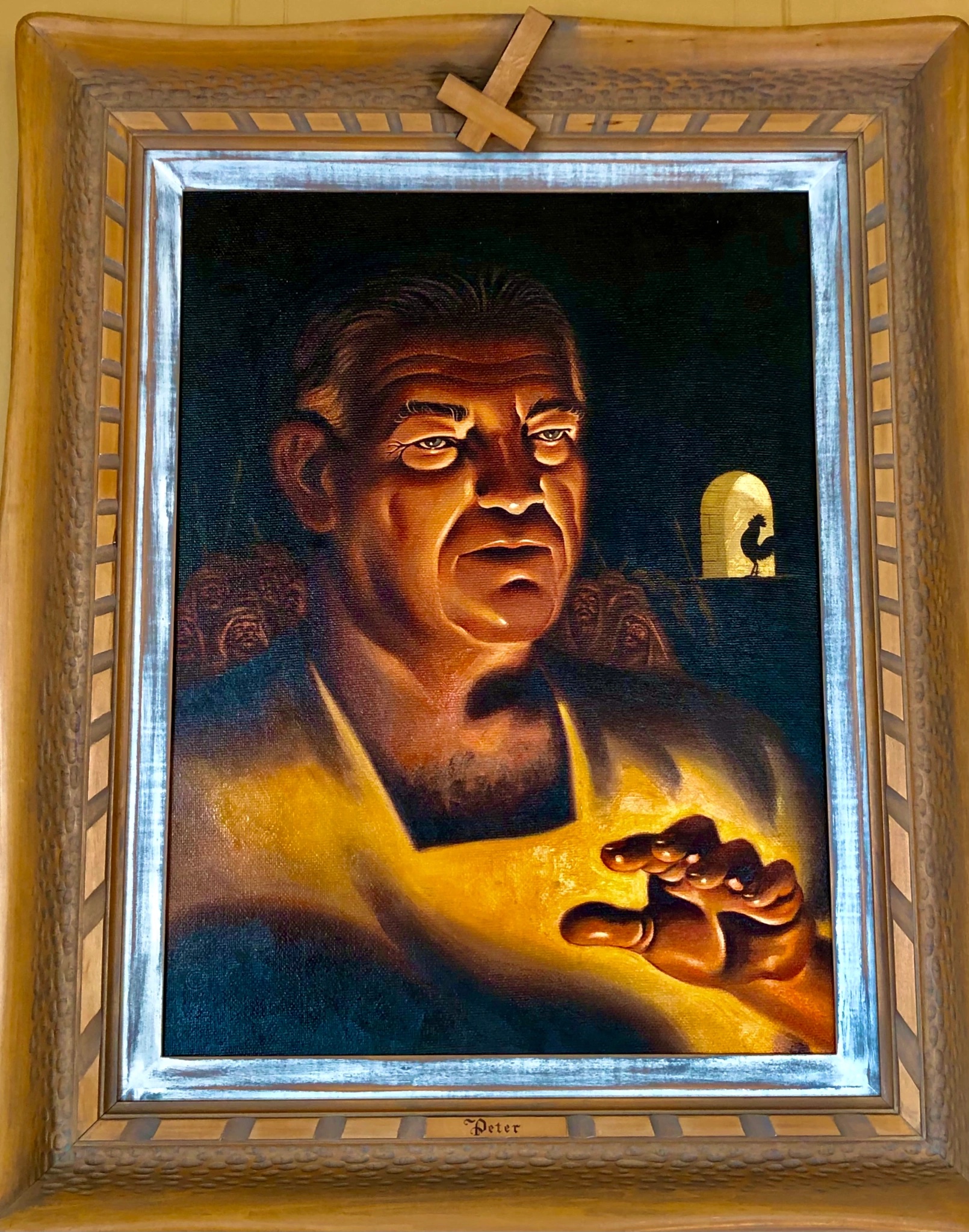
When Peter arrives on the shore in his drenched clothes, he sees Jesus sitting beside a charcoal fire. Now the Greek word for this charcoal fire (anthrakia) only appears twice in the entire New Testament and the other time it appears is also in John’s Gospel (John 18) and it’s when Peter is warming himself in the courtyard of Caiaphas right after denying Jesus the first time and soon before denying him two more times. [In Fr. Shag’s portrayal, we see the reflection of the fire on Peter and we see him warming his hand by the anthrakia]. So, the author is clearly making a connection here and we can imagine that the smell of the charcoal fire probably triggers this shameful memory within Peter, who then decides to help his friends haul the net ashore.
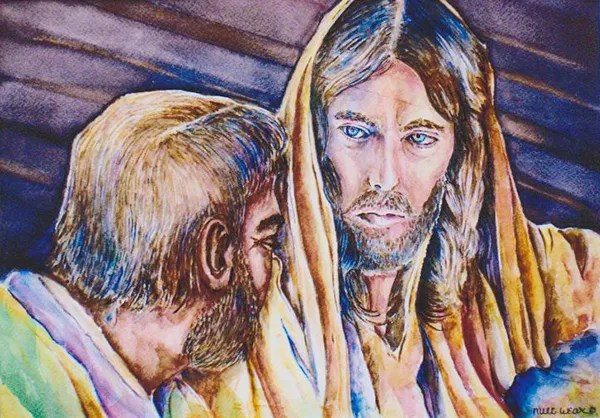
They all enjoy a delicious fish-fry breakfast together. Think Gill’s by the Bay with Jesus. And the fried fish is prepared from among the 153 fish caught. At the time, it was thought that there were 153 species of fish, so this number suggests that all people from every tribe and nation will ultimately be saved and held by the untorn net of God’s love. During this third appearance of the Risen Christ to the disciples (on this Third Sunday of Easter), Jesus asks Peter three times, “Do you love me?” thus paralleling and absolving Peter’s previous three denials.
That’s what Jesus does in response to denial and betrayal and violence, he asks questions: “Do you love me?” “Saul, Saul, why do you persecute me?” Even today, he asks you that question, “Do you love me?”
When Peter responds in the affirmative, Jesus urges him to demonstrate his love by feeding and tending God’s flock, which will require of him significant self-sacrifice. The independent and impetuous Peter who previously girded himself as he impulsively leapt from one activity to another will eventually be girded by someone else while being led along the Way of the Cross, the Way of Self-sacrificial love.
In John’s Gospel, the Risen Christ continues to tell his followers that the way to love and to be close to him now involves commitment to the beloved community. In the previous chapter in John, he told Mary Magdalene to go to his brothers because that is where she will now be able to touch the Risen Christ, in the assembled body of believers, the Body of Christ. Here he tells Peter to show love for Christ by tending his flock and feeding his sheep, which will involve helping them carry their loads rather than leaving them to shoulder the burden on their own as he girds himself and leaps off to the next activity.
We know that during the reign of emperor Nero, Peter was crucified upside down because he did not consider himself worthy to be crucified in the same way as his Lord. This is why the cross of St. Peter is an upside-down cross, which Fr. Shag carved into the frame of Peter’s portrait; and this is what Jesus is referencing when he says, “You who have previously girded yourself as you leap from one activity to another will eventually be girded by someone else while being led where you do not wish to go, along the Way of the Cross.”
Before making his final sacrifice in martyrdom, Peter exhorted church leaders to gird themselves in humility as they cared for God’s flock and awaited the Chief Shepherd who will award them with the crown of glory that never fades away (1 Peter 5:2-5), for it is by caring (not caring) for the beloved community (the church) and by bearing each other’s burdens (or not bearing each other’s burdens) that we demonstrate our answer to the question Jesus asks of each us every day, “Do you love me?”

 DANIEL DeFOREST LONDON