
“Before I Formed You in the Womb…”
Readings for the Fourth Sunday after Epiphany (Year C)
This sermon was preached at Christ Episcopal Church Eureka on Sunday January 30, 2022.
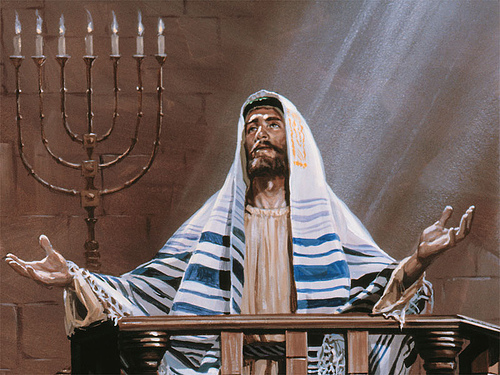
One of my friends and colleagues the Rev. Chris Yaw wrote a book titled “Jesus was an Episcopalian (and You Can Be One Too!).” Although this title is obviously meant to be tongue- in-cheek, the Gospel this morning seems to support the idea that Jesus had some Episcopal leanings, especially when it came to preaching. He seemed to understand the importance of short, pithy sermons that really packed a punch. His first sermon in his hometown was one line long, but it’s very powerful when we look at the context. First, he preaches on a passage of Isaiah (chapter 61), which we read last Sunday, but in the reading, he adds a line about giving sight to the blind and omits a line about God’s vengeance. And then he says that this reading about the Messiah (the Anointed One) bringing the great year of Jubilee is being fulfilled today.
Then all the congregation spoke well of him and were amazed at the gracious words that came from his mouth. But perhaps Jesus should have quit while he was ahead, because when he opens his mouth again to expand upon his brief homily, the congregation becomes furious. They drive him out of the synagogue and try to throw him over a cliff. It would be kind of like an Episcopal priest preaching a sermon for more than 30 minutes. They’d be driven out! You guys wouldn’t do that, but some Episcopalians might.
Now why does Jesus expand on his brief homily? Because he obviously hears the people asking a question that is almost as loaded as the words of his sermon, when we understand the context. They ask, “Is not this Joseph’s son?” This question is loaded because it concerns Jesus’s birth, which we know (from the Gospel of Luke and the other Gospels) was a source of a lot of suspicion and potential scandal. Not everyone believes in the Virgin Birth today and not everyone believed in the Virgin Birth back then. Even Joseph didn’t believe it at first. There’s evidence in the Gospels that people contested the identity of Jesus’s biological father. In the Gospel of John, some suggest that Jesus was an illegitimate child (John 8:41), which means he would be what they called a “mamzer,” a child born out of wedlock or as the result of certain forbidden relationships. “Mamzer” carries similar negative connotations as our word “bastard.” There’s even a story (from at least the third century) that Jesus’s biological father was a Roman soldier named Pandera. Just imagine how difficult that would be for a young boy’s sense of self, growing up, to be called a mamzer. So, when the people ask, “Is not this Joseph’s son?” they’re asking, “Is not this that weird kid who was conceived out of wedlock (that mamzer!), who Joseph graciously took under his wing? People are praising him and saying he’s full of the Holy Spirit and a healer and now here he is claiming to be Anointed by God, but why isn’t he showing his miraculous power to us, who raised him and tolerated him when he was an awkward kid playing with clay pigeons? Shouldn’t we be getting credit for this young guy’s reputation?”
This is why Jesus responds harshly: “Doubtless you will quote to me this proverb, ‘Doctor, cure yourself!’ ‘Do here also in your hometown the things that we have heard you did at Capernaum.’” And then after saying that “No prophet is accepted in the prophet’s hometown,” he starts comparing himself to the great prophets Elijah and Elisha. The people must have thought: What arrogance and audacity for this young man to say such things! This guy who still lives with his mother, who isn’t married yet, who has no children, and not much life experience is saying that he’s like Elijah and that we, who helped raise him, are like the people who failed to embrace and receive the miraculous powers of Elijah and Elisha! What gall! What insolence and ingratitude! We’ve given him so much. If it weren’t for Joseph and us, he would be nothing. So, they were filled with rage, even murderous rage. How dare he say such blasphemy in our synagogue! Get him out of here! And then that mob mentality grows and swells until they’re ready to throw him off a cliff. And ironically, Jesus ends up displaying his miraculous power in Nazareth by nonviolently escaping the clutches of a mob hellbent on his death. The Gospel says, “He passed through the midst of them and went on his way” (Luke 4:30). Somehow a mob obsessed with killing one man loses track of that one man, who walks right through them and continues along his way. I love this image of Jesus walking on his way in the midst of a storm of anger and violence. This is the “Way” that we uphold in our vision statement: a community of companions walking together in the Way of Christ’s love for all. This is the “Way” in which Jesus walked his whole life, even as a young kid, growing in wisdom and strength, as the Gospel of Luke says (Luke 2:40), as a young boy being bombarded by voices of insult and accusation, voices that questioned the legitimacy of his birth.
Jesus is indeed the fully divine Son of God and yet Jesus is also the fully human son of Mary who had some growing to do. I imagine a crucial part of that growth involved counteracting all those voices that accused him of being an illegitimate and unloved mamzer. I imagine him counteracting those voices with some of the very same words of Scripture that we heard read this morning, verses that his mother may have shared with him and read to him when she tucked him into bed at night, verses from the prophet Jeremiah in which God says, “Before I formed you in the womb I knew you, and before you were born I consecrated you.” (Jeremiah 1:4). Perhaps Jesus responded in the same way Jeremiah did, saying, “I am only a boy, some say a ‘mamzer.’ I do not how to speak.” And God says, “Do not say, ‘I am only a boy’; for you shall speak for me. Do not be afraid for I am with you. My love is stronger than your fear.” And Jesus knew the verses from the Psalms in which the psalmist says to God, “I have been sustained by you ever since I was born; from my mother’s womb you have been my strength; my praise shall be always of you” (Psalm 71:6).
Young Jesus immersed himself in the truth of these Scriptures so much that he felt absolutely rooted in his identity, not as a mamzer, not even as the son of Mary and Joseph, but as the Son of God, the child of the God who knew him and loved him even before forming him in the womb. Jesus embraced and embodied this truth perfectly not just with his head but with his heart; and he invites us to embrace and embody this same truth of our belovedness as well. Although Jesus is the only begotten Son of God who is divine by nature, we through our baptism also become anointed (“Christ”ed) so that we can enjoy the same relationship that Christ had with his Father. So, all those biblical truths that Christ adopted for himself now apply to each of us: Before God formed you in the womb, he knew you, and before you were born, he consecrated you…God has sustained you ever since you were born and from your mother’s womb, God has been your strength.
Now you have heard me preach about this divine voice of love often, but the invitation is for us to receive that voice not so much with our head, but with our heart. That’s what the author of The Cloud of Unknowing keeps insisting. When it comes to the love of God, our minds can only take us so far. We Episcopalians are not anti-intellectual. We don’t ask people to leave their brains at the door. We celebrate intellectual achievement, and we pay attention to facts and science, which is exactly why we are encouraging vaccinations and following CDC guidelines (and requiring vaccinations for those who choose to worship with us in person). Episcopalians are people of logic and reason; and we also know what Blaise Pascal knew: that “the heart has reasons which reason knows nothing of.” We know what Socrates, the Father of Western Philosophy, meant when he said, “Wisdom is knowing what you don’t know.” Wisdom is knowing the limitations of the mind. Wisdom is knowing that God is not an intellectual idea to be grasped by the mind, but a presence to be experienced and received by the heart. And that is the wisdom offered in this morning’s glorious passage from Paul’s first letter to the Corinthians, a passage that might be the spiritual pinnacle of Paul’s entire corpus, if not the spiritual pinnacle of the entire Bible.
A few weekends ago, when I was leading a retreat at the Bishop’s Ranch, a New Testament professor asked me if I thought that the entire Christian life might be sufficiently summed up in the words 1 Corinthians 13, which we just read. I said, “Absolutely.” This is what it’s all about. The Christian life is all about experiencing God’s love in our heart and sharing that love with the world. I can read and preach about God’s love in Hebrew and Greek and Spanish and a hundred other different languages, but if God’s love is not in my heart, I’m a noisy gong, an annoying cowbell. I can have the highest IQ in the world, but if God’s love is not in my heart, then I’m nothing.
The reason why this church exists is so that you might feel the love of God in your heart now and share that love with others. The love that is patient and kind. The love that does not envy or boast, that is not self-seeking or irritable or resentful. The love that bears all things and hopes all things and endures all things. The love that never ends. That’s why we believe in eternal life because the love we receive in our hearts is a love that never ends. Receive that love now, not just in your head, but in your heart. And when you receive Christ in the bread and wine made holy, let that love fill your heart and body. If it brings tears or laughter, let it be. If it brings energy or peace, let it be. Let that kind and patient love that bears all things, that knew you and formed you in the womb, that has sustained you ever since you were born, fill your heart now so that you, like that love, may last forever. Amen.

 DANIEL DeFOREST LONDON