
A reflection on St. Thomas the Apostle inspired by the oil painting of Fr. George Leonard Shultz (1896 – 1971). This same reflection was published in the Times-Standard on Saturday January 8, 2022 as “St. Thomas: the doubter or the believer?“
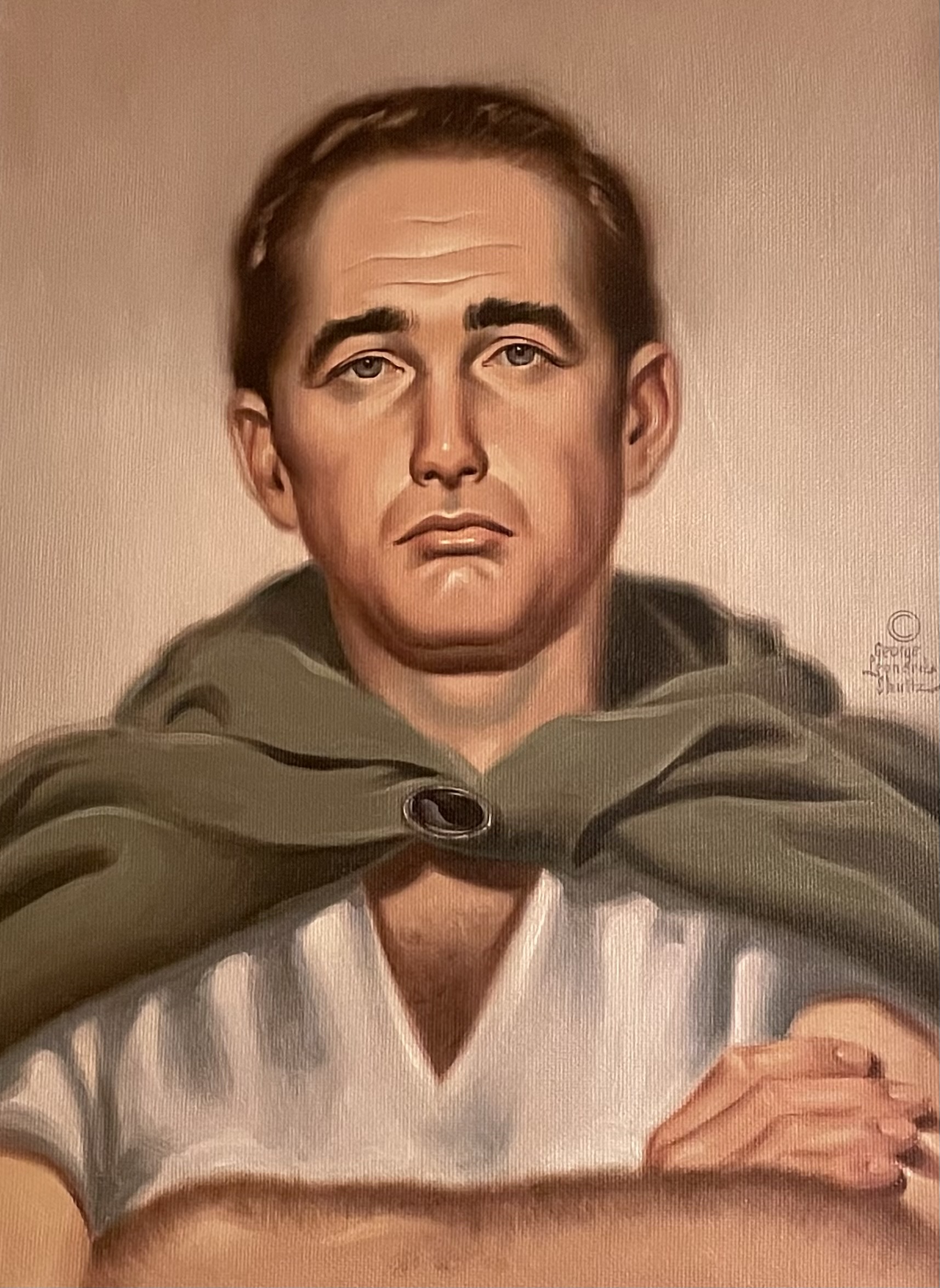
At first glance, Fr. George Shultz’s portrayal of St. Thomas seems to reinforce the popular understanding of the apostle as the doubting skeptic, with arms crossed, appearing to say, “I won’t believe it until I see it.” This understanding of Thomas has been underscored not only by the unfair misnomer “Doubting Thomas,” but also by the fact that his feast day falls on Dec. 21, which is usually the winter solstice and therefore the darkest day of the year, a day that was apparently chosen because Thomas remained “in the dark” while the rest of the apostles enjoyed faith in the light of the Resurrection.
On St. Thomas Day in England, children used to sing, “St. Thomas Gray, St. Thomas Gray, the longest night and shortest day.” When I look again at the painting with these words echoing in my head, I can’t help but imagine Thomas’ face and posture expressing his own tired response to the many ways that he’s been demeaned over the centuries. The artist may have felt the same way since the book that informed his paintings on the apostles (Herbert Lockyer’s “All the Apostles of the Bible”) describes Thomas as “The Apostle Most Maligned.”
The Gospel of John presents Thomas as a bold disciple who asks his rabbi difficult questions (John 14:5). When the disciples tell Thomas that they have seen the Risen Christ, Thomas honestly expresses his doubt to his friends likely because he understands that doubt and faith are opposite sides of the same coin. As Herman Hesse said, “One who never doubts will never truly believe.”
As a result of his honesty, Thomas receives a personal visit from the Risen Christ, who is more than willing to meet Thomas’s criteria for belief. Thomas then becomes the first disciple to recognize the divinity of Christ, exclaiming, “My Lord and my God!” (John 20:28). Thus, Thomas becomes the model disciple, arriving at the very conclusion at which the author of John’s Gospel wants the reader to arrive (John 20:31). Jesus then responds to Thomas’ exemplary faith with a Beatitude: “Blessed are those who have not seen and yet have come to believe” (John 20:29).
Although this might sound like an admonishment against Thomas’ doubt, I do not hear reprimand, but commission. Whenever the Risen Christ appears to someone, he gives a commission to go and share what has been witnessed, and with these words, Thomas receives his own personal commission from Christ along with the promise that many who have not seen will come to believe because Thomas will tell them! And according to tradition, Thomas evangelized what is now Iran and Turkmenistan, and then he traveled further east to evangelize southern India, where churches today still boast the name “St. Thomas Christians.”
For all these reasons, the Eastern Orthodox Church refers to him as “St. Thomas the Believer.” So now when I look at the expression on the apostle’s face in the painting, I imagine him saying to me, “Go ahead and call me ‘Doubting Thomas.’ I dare you.”

 DANIEL DeFOREST LONDON