
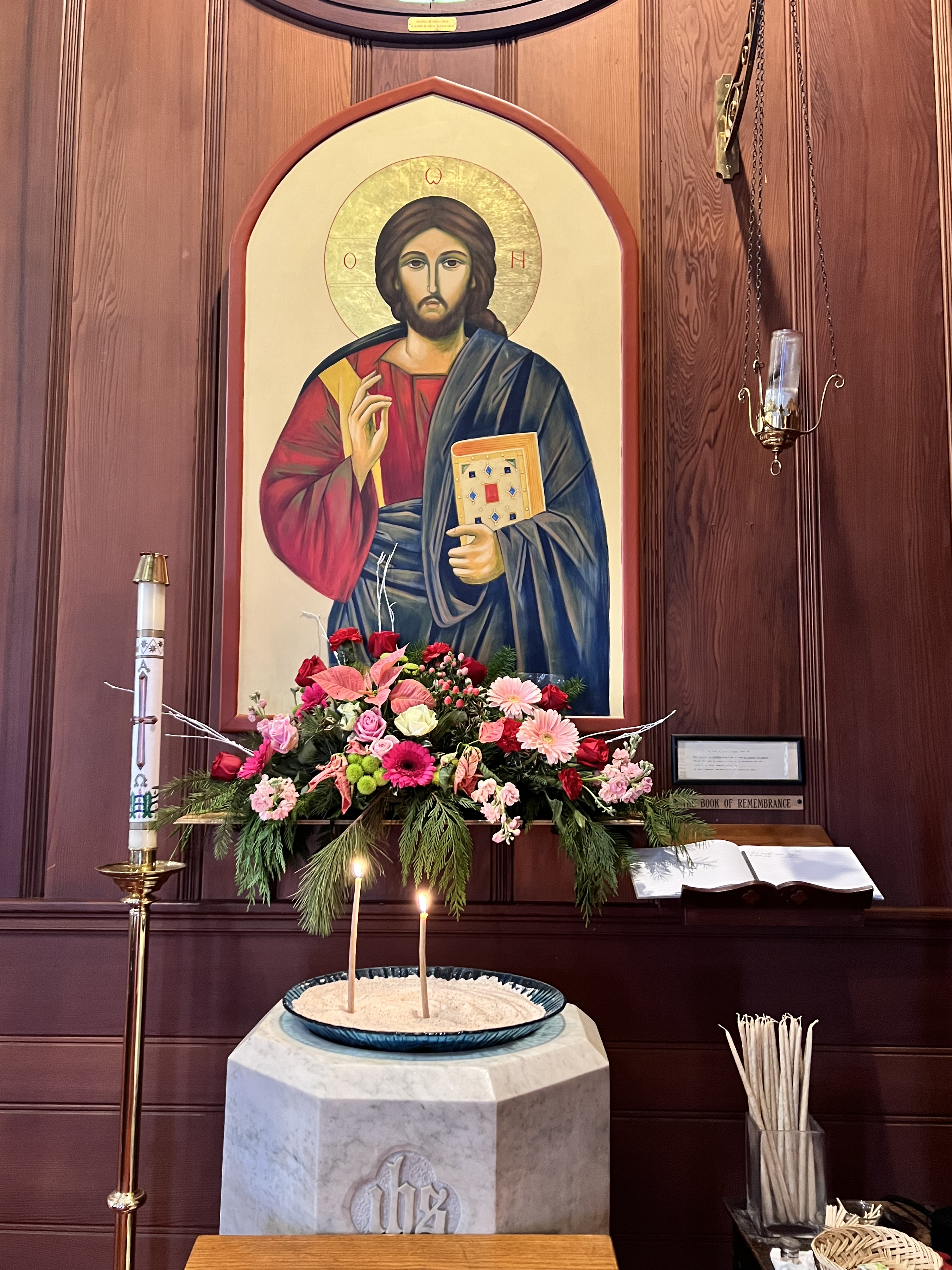
Readings for the Feast of the Christ Mass (Selection III)
This sermon was preached at Christ Episcopal Church Eureka on Saturday December 25, 2021.
“Break forth together into singing, you ruins of Jerusalem” (Isaiah 52:9). Isn’t it wonderful to be able to break forth together into singing these beloved Christmas hymns and carols? After a long period of abstaining from singing together, let us never again take this for granted…
Out of all the Gospel readings assigned for the Christmas feast, my favorite has got to be the prologue to the Gospel of John, which we just heard. Although some people think it is fairly abstract and philosophical, that is not why I appreciate it. In fact, I appreciate it for almost the opposite reason: because it is so affirming of the flesh, because it clearly rejects all those early Christian heresies that denied the full-body reality of Jesus Christ. The Word, John says, became flesh. The Word did not just appear to be flesh, it became flesh and dwelt among us. Former Archbishop of Canterbury and theologian William Temple said “The Word made flesh” is the most important phrase in all of Christianity.[1] He then explained, “Christianity is the most materialistic of all great religions…. [‘materialistic’ not in the economic sense but ‘materialistic’ in its affirmation of matter]. Based as it is on the Incarnation, [Christianity] regards matter as destined to be the vehicle and instrument of spirit, and spirit as fully actual so far as it controls and directs matter.”[2] In John’s Prologue, it becomes clear that God loves physical matter. He made it, he became it, and he wants us to experience him through it. As Richard Rohr says, “Matter matters.”
Dr. Alexander John Shaia, who preached here last year, also recognizes this affirmation of the flesh in John and believes that the Gospel invites its readers to appreciate the beauty and wonder of the matter that is all around us and the matter that is us. He says the Gospel invites us to notice the “buzzing of the bees and the rustling of the wind through the leaves…[to] become aware of the remarkable artistry in the veining of every leaf and bird feather…[to] sense the musculature beneath our own thin skin that miraculously holds us at 98.6 degrees in both snow and blistering sun…[to] wiggle our toes and stretch our arms and enjoy the sun or perhaps the taste of a raindrop on our tongue. This,” he says, “is God’s gift of sensuality awakening—becoming more sensitive and appreciative.”[3]
On this Christmas day as we celebrate the mystery of the Incarnation (the Word made flesh), John’s Gospel invite us to receive this gift of sensuality awakening, to practice appreciation of our bodies and to experience our flesh (and the earth!) as sacred vessels for divine life and expression. So, what would receiving this gift of sensuality awakening look like for you today and during this twelve-day-long season of Christmas?
One practical way that the Gospel of John invites us to celebrate the Incarnation is by being present to our bodies through our five senses. In John, Jesus invites us to listen to the wind with Nicodemus (John 3), to quench our deepest thirst with the Samaritan woman (John 4), to see God at work in the messy muddiness of our lives with the man born blind (John 9), to smell the aroma of grief laced with joy with Mary, Martha, and Lazarus (John 11), and to touch the feet of Christ with the disciples and the Body of Christ with Mary Magdalene and Thomas, to experience the Body of Christ that is made manifest in the beloved community (John 20) and made present to us in the consecrated bread and wine, which we bring into our own fleshy bodies (John 6). Throughout the Fourth Gospel, the Word Made Flesh invites us to be refreshed by the gift of our own flesh, our own temples of the Holy Spirit (1 Cor 6:19), specifically by appreciating and attending to our five senses.
These invitations from the Gospel of John are what led me to pursue the Japanese medicinal practice of shinrin-yoku, forest bathing, which is all about being present to the forest through our senses, a practice that has been proven to reduce cortisol levels, temper inflammation, improve cognition, enhance sleep, relieve anxiety and depression, lower high blood pressure, and even boost empathy. The Gospel of John’s invitations led me to the Association of Nature and Forest Therapy, where I’m currently being trained to become a Forest Therapy Guide. So, as a Forest Therapy Guide-in-training and as a student of John’s Gospel and as a priest, I invite us on this Christmas Day to do something that Jesus urged his disciples to do at the center of the Gospel, in chapter 15: to rest and to abide in him (15:4,7). There’s a Spanish proverb that one of my Forest Therapy trainers shared with me: “How beautiful it is do nothing, and then rest afterward.” The traditional author of John’s Gospel is, of course, St. John who is identified as the “Beloved Disciple.” This beloved disciple embodies this resting and abiding in Christ as he reclines next to Jesus during their last evening together. St. John rests upon the bosom of Jesus and, according to the Celtic Christians, he was listening to the heartbeat of Christ. So, I invite us to receive the gift of sensuality awakening by resting and abiding and listening to the heartbeat of Christ in our own flesh this Christmas season so that we, in the poetic words of Thomas Merton, might “make ready for the Christ, whose smile, like lightning, sets free the song of everlasting glory that now sleeps, in [our] paper flesh, like dynamite.”
[1] “[Christianity’s] own most central saying is: ‘The Word was made flesh,’ where the last term was, no doubt, chosen because if its specially materialistic associations” from Nature, Man and God: Gifford Lectures, Lecture XIX: ‘The Sacramental Universe” (London: Macmillan), p. 478 as cited in Christ In All Things: William Temple and His Writings, ed. Stephen Spencer (Norwich: Canterbury Press, 2015), 130.
[2] William Temple, Readings in St. John’s Gospel (London: Macmillan, 1945), xx-xxi. Also in Lecture XIX of the Gifford Lectures, he says, “[Christianity] is the most avowedly materialist of all the great religions” as cited in Christ In All Things: William Temple and His Writings, ed. Stephen Spencer (Norwich: Canterbury Press, 2015), 130.
[3] Alexander John Shaia, Heart and Mind: The Four-Gospel Journey for Radical Transformation (Preston Australia: Mosaic Press, 2013), 218.

 DANIEL DeFOREST LONDON