

“Jesus Wept”: Sermon for the Feast of All Saints and All Souls
Readings for the Feast of All Saints (Year B)
Wisdom of Solomon 3:1-9
Psalm 24
Revelation 21:1-6a
John 11:32-44
This sermon was preached at Christ Episcopal Church in Eureka CA on November 7, 2021.
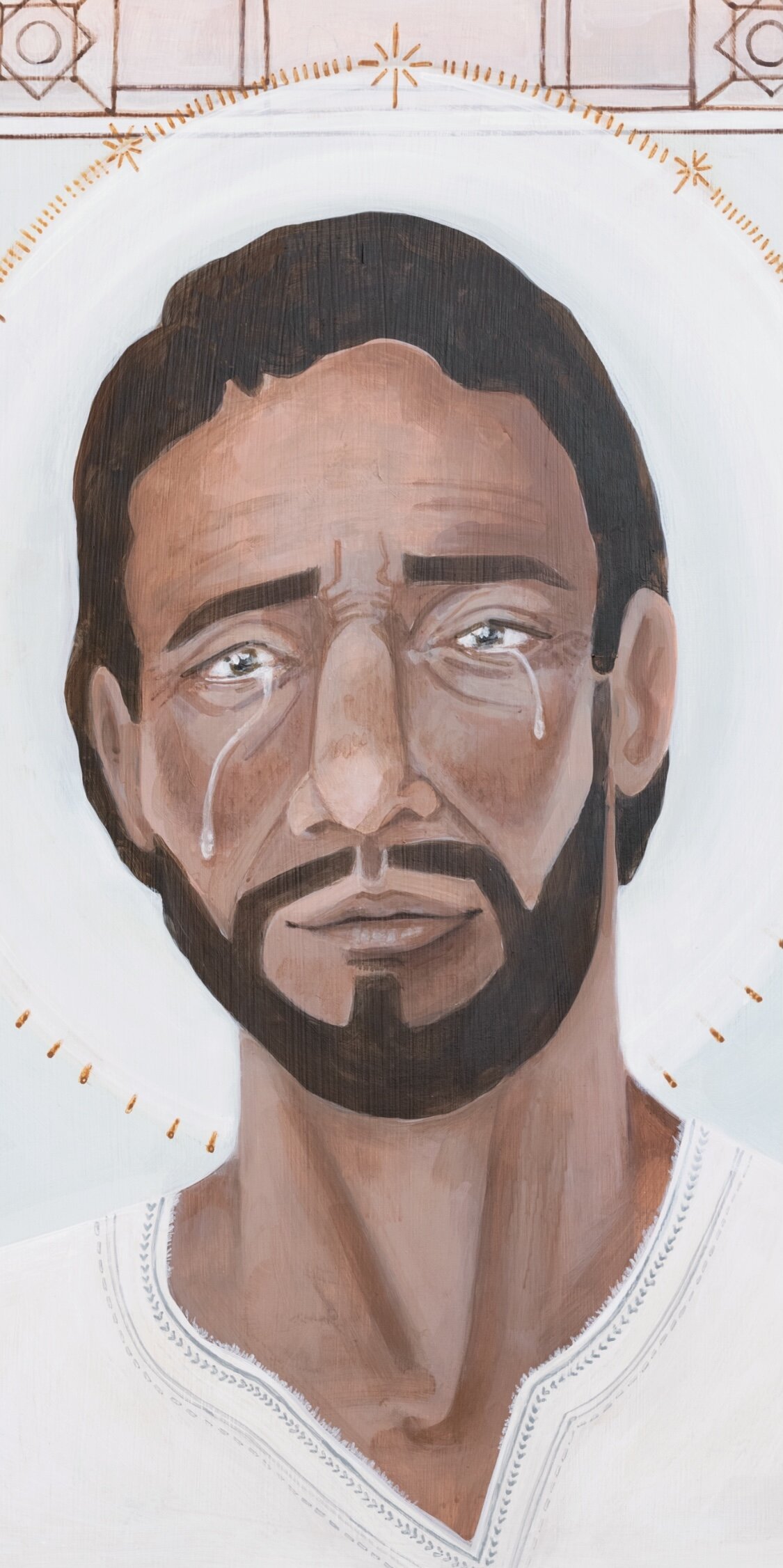
Growing up in Bible churches, I often participated in Sunday School programs and Vacation Bible Schools that encouraged Bible verse memorization. I continued this practice even up to my college days when I memorized the three chapters in Matthew’s Gospel that comprise the Sermon on the Mount. Although we Episcopalians don’t tend to stress Bible verse memorization very much, I still recommend it as a spiritual discipline; and a great place to start is with a verse from this morning’s Gospel, which is considered the shortest verse in the Bible: John 11:35: “Jesus began to weep” or as other translations put it, simply: “Jesus wept.” I always kind of thought it was a joke when peers would boast about the fact that they had memorized this verse (and I’m sure it was), but this short Bible verse really does pack a punch and I want to reflect on it with you for a bit this morning, on this feast of All Saints and All Souls. Jesus wept.
Now Jesus seemed to know beforehand that he was going to raise his friend Lazarus from the dead. When Jesus first learned that Lazarus was ill, he did not rush to heal him but rather remained where he was for a couple days because, according to the church fathers (Peter Chrysologus, Sermon 63:1-2), it was more important for Christ to conquer death than to cure disease. Instead of offering a remedy for his illness, Christ offered Lazarus the glory of rising from the dead. So, if Jesus already knew that he was going to raise Lazarus, why does he weep?
And he doesn’t just weep. The Gospel says he was deeply troubled and disturbed (etaraxen – only used once in NT). Later on, in verse 38, it says he was “deeply moved.” The Greek word used is embrimomenos which is used in other ancient texts to describe a horse snorting. This is Jesus groaning and sobbing with his whole body. [People often describe Jesus in John as a detached “god who seems to glide over the face of the earth,” but here he is weeping, sobbing, and snorting like an animal!]. But why? Why is we weeping when he knows he will soon bring his friend back to life?
The answer is one that I’ve shared at almost every memorial service that I’ve officiated, and it’s found in our prayer book on page 507. And I invite you to turn there with me now. It’s a brief note about the Burial Service. It says, “The liturgy of the dead is an Easter liturgy. It finds all its meaning in the resurrection. Because Jesus was raised from the dead, we, too, shall be raised. The liturgy, therefore, is characterized by joy, in the certainty that ‘neither death, nor life, nor angels, nor principalities, nor things present, nor things to come, nor powers, nor height, nor depth, nor anything else in all creation, will be able to separate us from the love of God in Christ Jesus our Lord.’ (Romans 8:38-39).
“This joy, however, does not make human grief unchristian. The very love we have for each other in Christ brings deep sorrow when we are parted by death. Jesus himself wept at the grave of his friend. So, while we rejoice that [those whom] we love [have] entered into the nearer presence of our Lord, we sorrow in sympathy with those who mourn [and we grieve].”
Now I don’t think Jesus was weeping just to make a point, just to teach us that it’s ok to cry. The Gospel insists that he was experiencing profound grief and sorrow. And that’s because he was fully human, and he loved someone who had died. The indigenous translation of the New Testament refers to Jesus as the “True Human Being,” a translation of the term “Son of Man.” The True Human Being feels grief and allows that grief to be expressed authentically and naturally in the body through tears and groans and sobs and sighs and perhaps even screams. [Jesus also shouts in this morning’s Gospel.] The True Human Being feels grief and allows that grief to be expressed in the body. “Grief is not a sign of weakness nor a lack of faith. It is the price of love.” [Bob Rex shared this wisdom with me after his beloved Judy died in December of 2020. We’re still waiting to hold a memorial service for her].
Some say that grief is love. It’s all the love you want to give but cannot. All of that unspent love gathers up in the corners of your eyes, the lump in your throat, and in that hollow part of your chest. Grief is…love with no place to go.” That’s why when people saw Jesus weeping they said, “See how he loved him!” Grief is an expression of love.
Jesus knew he was going to see his friend Lazarus again [in a matter of moments!] and we know that we will see our loved ones again too. Relative to eternity, we will see them again in the twinkling of an eye. But that doesn’t change the fact that they are not physically with us right here, right now. And that physical absence can so easily rip us apart inside as it did to Jesus who sobbed and shouted at death.
I continue to grieve all my beloved friends whose bodies previously warmed these pews and who are no longer physically with us. Yes, they are here with us in spirit (thank God!) and we will see them again in our heavenly bodies, but they’re not here now and that is heartbreaking. And it’s so ok to cry. It’s really healthy. I love how Jesus doesn’t do what we so often do when we cry in public and that is apologize and say, “I’m sorry. I’m sorry. I promised I wouldn’t cry. I gotta keep it together.” Jesus lets it all out. He holds nothing back. It is Christlike to mourn and wail and sob for those we love.
On this Feast of All Saints and All Souls we remember and grieve for those whom we have loved and lost. And this is also a time for us to remember and grieve for all that we’ve lost over these last 20 months. I remember on Good Friday in April of 2020, we were feeling the weight of 18,000 people worldwide who had died of COVID. Today, over 775,000 people have died of COVID in the United States; and over 5 million have died worldwide. How can we not grieve? How can we not shed tears?
This weekend, delegates from the diocese gathered online for Diocesan Convention. We were initially hoping to gather in person in Redding to worship together and sing together after a long exile, but because of the rising COVID cases, we had to meet online. Again. There were many highlights of convention, but everyone would agree that the biggest highlight was arranged by our very own Paul Gossard who worked with Alan Rellaford (Missioner for Communications and Convention Manager) and Philip Traquair to bring Presiding Bishop Michael Curry to our convention. Bishop Curry recorded a message specifically for spouses of clergy in our diocese, but fortunately, we all got a chance to hear his message in which he describes the grief and strain that we’ve all experienced during these last 20 months. He said it’s been “as though we’ve all been living with a kind of low-grade fever, a tiredness that comes from having been separate from each other. The tiredness of having to fear or be on guard against the virus and somehow working not to be afraid of each other. That’s internal stress.
“It is sometimes helpful,” he said, “just to admit it. We’re all tired. I like to say we’re all a little wacky right now. And the good thing is we all are. Nobody’s exempt. Sometimes just acknowledging that is helpful. It’s also helpful,” he said, “to grieve. To grieve those who have died and suffered and struggled. To remember to name them in our prayers. Those who we know who have died and those who have died during this time. It’s helpful to grieve, to get it out.” That was the invitation of Bishop Curry and that’s the invitation of our Gospel this morning: to grieve, like Jesus, like the True Human Being.
“It’s helpful to grieve, to get it out, and to do it together.”
More than anything else, Bishop Curry emphasized the fact that we need each other. He concluded his message with a saying from the Antebellum South: “Walk together, children, and don’t you get weary cuz there’s a great camp meeting in the Promised Land.” He said, “I may get weary, but you hold me up. And other times, you may get weary and I’ll hold you up. But walk together, children, and we won’t get weary cuz there really is a great camp meeting in the Promised Land.” So my friends, let us walk together in the way of Christ’s love for all [as a community of compassionate companions], holding each other up when we’re weary and letting ourselves be held up and encouraged by all the compassionate souls that fill this place and by the very hand of God (described in the Wisdom of Solomon) in which the souls of the righteous are preserved and cherished. Amen.

 DANIEL DeFOREST LONDON