
This article was written for the November 2021 Chronicle newsletter for Christ Church Eureka and then republished in the Episcopal Diocese of Northern California Commission for Intercultural Ministries Becoming Beloved Community December 2021 Newsletter
I have started taking a six-month-long course to become a certified Forest Therapy Guide through the Association of Nature and Forest Therapy. I plan to share with you some of the wisdom and insights that I learn along the way. One of the practices of the Forest Therapy Guide is to begin a Forest Therapy walk by acknowledging the land managers and traditional land keepers. “It is good,” according to the Forest Therapy Guide Handbook, “to acknowledge both the contemporary and the traditional peoples who have walked and tended the land before.”
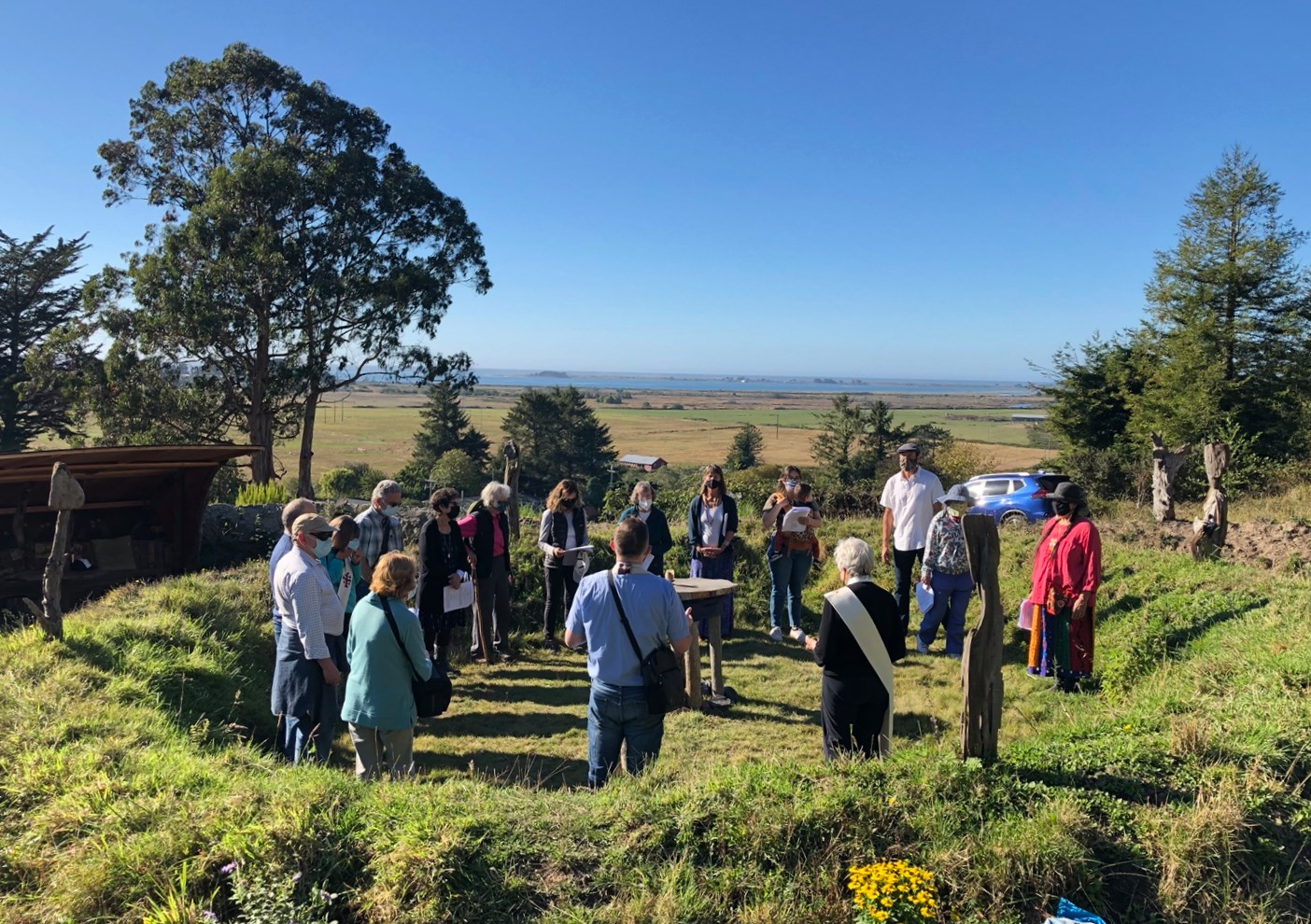
During a house blessing in September, I began our worship with a land acknowledgement that expressed gratitude to the Wiyot people who cared for the land long before Europeans arrived. One of the participants at the house blessing expressed appreciation for this acknowledgement and informed me that several other Episcopal churches that he has visited online during COVID include Land Acknowledgements in their Sunday worship bulletins. Inspired by this conversation, I looked at the Land Acknowledgement page on the website for St. Mark’s Episcopal Cathedral in Seattle (https://saintmarks.org/land-acknowledgment/), which defined a land acknowledgement as “a statement [that] formally recognize[s] the fact that a building, or gathering, or event is on land that originally belonged to Indigenous people who lived in the area long before European colonization. It is offered to pay tribute to the first inhabitants whose land – whose home – in many cases was captured, stolen, or otherwise unethically taken from them.” The webpage also explains that a land acknowledgement ought to be created with the guidance and approval of representatives from the Indigenous tribe or nation local to the area.
So, I crafted a land acknowledgement to be used in our Sunday bulletin as well as a slightly longer one to be used on special occasions. I then shared them both with Ted Hernandez the Cultural Director of the Wiyot Tribe who gave me some helpful feedback and said, “Thank you for the acknowledgement of Wiyot Lands and the Wiyot people.” His gratitude for our acknowledgement underscored the reason for including the statement in the first place, which is not some attempt at grandstanding or virtue-signaling, but rather to express gratitude for those who have been stewards and tenders of the beautiful land in which we now live. The first Sunday that we included the Land Acknowledgment in the worship bulletin was October 10th, the day before “Indigenous Peoples’ Day”; and we have continued to include the statement at the top of our worship bulletin every Sunday since.
I find it especially appropriate to highlight this new expression of gratitude for the Wiyot people and land this month when we celebrate the holiday of Thanksgiving. If you haven’t already noticed, I invite you to read the Land Acknowledgement in our worship bulletin each Sunday this month and offer up a prayer of thanksgiving for the Wiyot people and land.
The Land Acknowledgement used in our Sunday bulletins:
Christ Episcopal Church acknowledges that we gather on the traditional land of the Wiyot people, who are still here, and we honor with gratitude the land itself and the life of the Wiyot Tribe.
The extended Land Acknowledgement to be used during special occasions:
We would like to acknowledge that we are standing on the ancestral territory of the Wiyot people and pay respect to elders both past and present. Long before Christ Episcopal Church was established, and before our many homes were built, and even before the Episcopal Church had a presence in California, this area was home to the Wiyot, who still have a presence today throughout Humboldt Bay. We grieve for the hundreds of Wiyot elders, women, and children who were massacred on February 26, 1860 when they were in the middle of celebrating their world renewal ceremony. Let us observe a moment of silence in respect and reverence for the Wiyot people, who have stewarded this land throughout the generations, while also not forgetting the violence and colonization of this land.


 DANIEL DeFOREST LONDON