
Listening to the Hopes and Desires of Our Heart with St. Simon, St. Jude, and Bartimaeus
Readings for the Twenty Second Sunday after Pentecost (Proper 25– Year B – Track 2)
Jeremiah 31:7-9
Psalm 126
Hebrews 7:23-28
Mark 10:46-52
This sermon was preached at Christ Episcopal Church in Eureka CA on October 24, 2021.
Last Sunday I preached about James and John who asked Jesus if they could be part of his inner ring by sitting at his right and left hand in glory. Jesus responded by explaining the difference to them between the inner rings of violence in the world and the divine circle of love. The inner rings of violence, as C.S. Lewis described, are built on exclusivity and tyranny while the divine circle of love looks outward, always welcoming and serving and including others into the dance. In this morning’s Gospel, we see Jesus showing us what the divine circle of love looks like in action as he listens to the cry of a blind beggar on the side of the road and grants him the desire of his heart. This story is about listening and inviting others to listen to the hopes and desires of the heart.
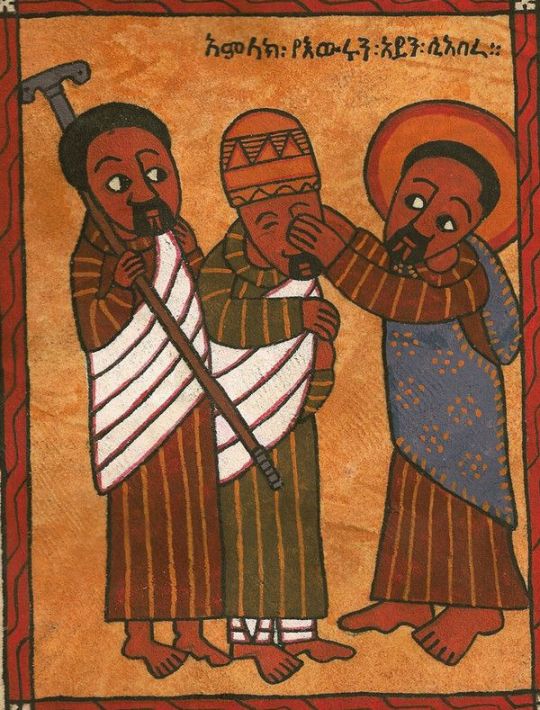
Bartimaeus is blind but he knows how to listen. Often when someone struggles with vision impairment their other senses are enhanced, such as their ability to hear. Bartimaeus was sitting by the roadside when he heard that Jesus of Nazareth was passing by. He wanted to make sure that Jesus could hear his voice over the din of the crowd, so he cried out, “Jesus, Son of David, have mercy on me!” and he cried out even more loudly when others sternly ordered him to be quiet.
Jesus then stood still. Sometimes the most effective way to really listen to the cries of those in need involves practicing some stillness. And even when we do hear the cries of others, stillness can remain a healthy posture rather than quickly leaping to action and making assumptions as if we know exactly what the other person wants and needs. Jesus says to his disciples, “Call him here” and the disciples say to Bartimaeus, “Take heart, get up, he is calling you.” Tharsei, egeire, phonei se. (Θάρσει, ἔγειρε, φωνεῖ σε.)
I like to imagine that the disciples who said these encouraging words to Bartimaeus were the two disciples whose feast day is this Thursday, October 28th. They are two of the more obscure and lesser-known apostles and they function almost like foils to James and John. They are St. Simon and St. Jude and they’re represented here on my stole with the symbols of a boat (for Jude) and a fish and book (for Simon). Together they represent what this story of Bartimaeus is all about: listening and inviting others to listen to the hopes and desires of the heart.
The name Simon comes from the Hebrew “Shimon” which means “the one who listens.” And the Gospels don’t explicitly record a single word spoken by Simon (even though I like to think he said these words to Bartimaeus) and that’s because he was so busy listening, unlike the other Simon in the crew who spoke so much and put in his foot in his mouth so often that Jesus decided to change his name entirely to “Peter.” Simon, on the other hand, listened and encouraged others to listen as well.
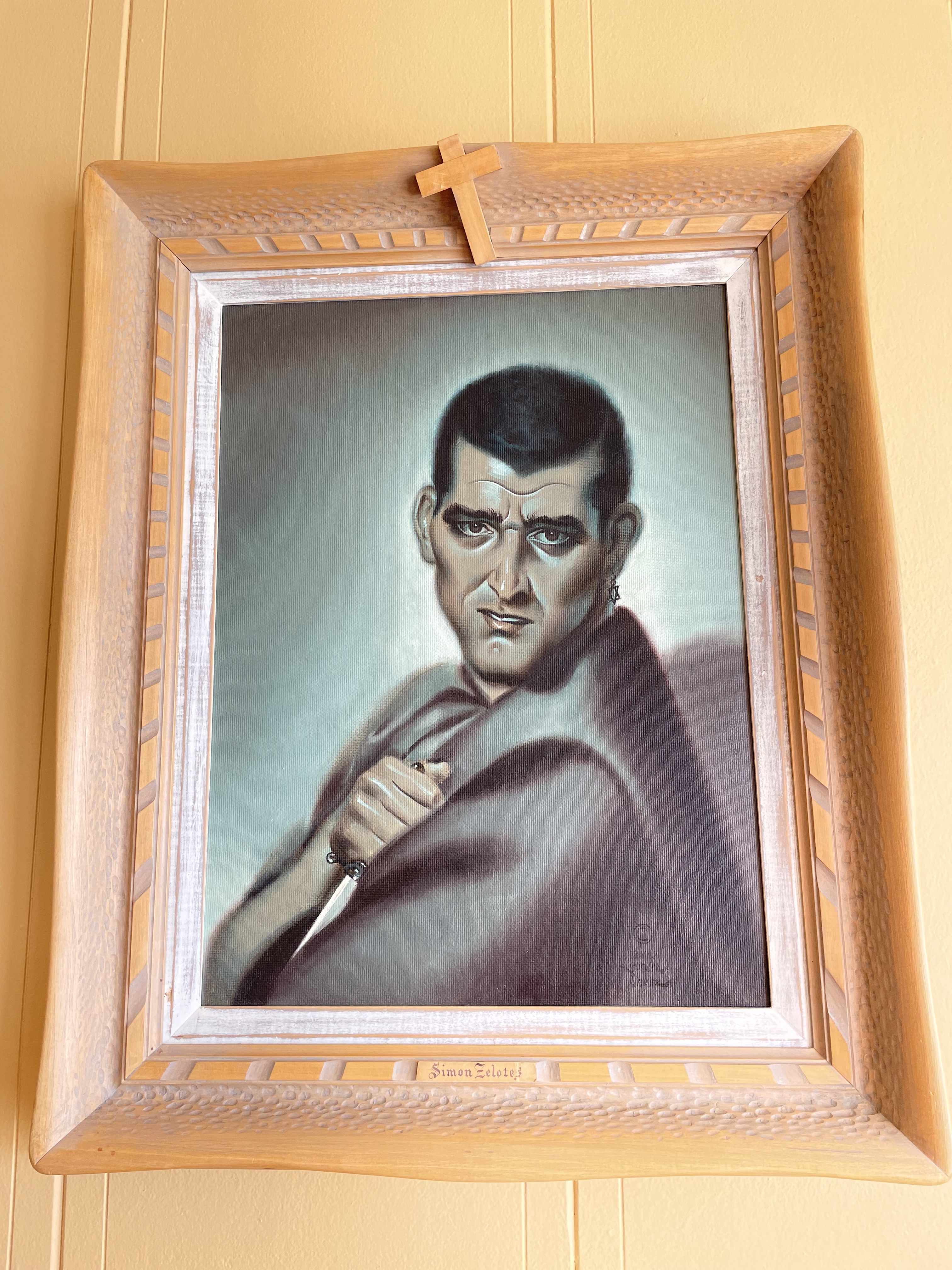
He was also known as Simon the Zealot, which likely meant that he was originally part of a group of violent revolutionaries who sought to overthrow the Roman empire. If you look at Fr. Shag’s portrayal of him in Lewis Hall, you’ll see that he is holding a knife in his right hand (almost hidden behind his cloak) and he’s wearing an earring of the Star of David on his left ear to represent his passionate patriotism for the kingdom of Judea. Although this is very creative of Fr. Shag, it’s highly anachronistic since the Star of David was not a common symbol for Judea at the time (it was usually the menorah or candelabra) and no faithful Jew would ever pierce his or her body since the Torah strictly forbids piercings (or tattoos for that matter) (Leviticus 19:28). But I still really like Fr. Shag’s portrayal of St. Simon. To me, he looks kind of like a member of one of the street gangs in Westside Story, which is appropriate if he was indeed a Zealot.
[I think it’s worth acknowledging the fact that among Jesus’s inner circle of friends there was one disciple who worked for the Roman empire as a tax collector (Matthew) and another disciple who wanted to violently overthrow the Roman empire (Simon). These two were on completely opposite ends of the political spectrum, but they both shared a desire to listen to Jesus and follow him.]
Simon the Zealot hoped that Jesus would inaugurate the kingdom of God on earth by overthrowing the Roman empire, but after listening to Jesus for years, he began to realize that his hope for the arrival of the kingdom would be fulfilled not through violence but through the non-violent way of the Cross, the way of Christ’s love for all. So he put down his dagger, took courage and followed where Christ was calling him; and according to legend, he was called by Christ to bring the Gospel to Egypt and Spain and Persia and those islands on the outermost edge of the Roman Empire known today as the British Isles. There is ample evidence that suggests St. Simon was the apostle who brought Christianity to what eventually became England, the home of the Ecclesia Anglicana, the Anglican Communion of which we Episcopalians are a part. Thank God Simon lived up to his name by listening and by inviting others to listen. He is associated with the fish and the book because he was an evangelist, a fisher of people who invited others to listen to the Gospel of Christ. That’s why I believe Simon was one of the disciples who told Bartimaeus to “Take heart, get up, and listen for Christ is calling you.”
The other disciple who may have said these same words to Bartimaeus was St. Jude, who is the patron saint of hope, specifically hope for those in seemingly hopeless situations. He’s also known as the patron saint of lost causes. The story behind this patronage stems from the fact that he shares the same name as Judas Iscariot, the one who betrayed Jesus. For centuries, no one wanted to pray to Jude or ask for his intercessions because they didn’t want to take the risk of getting the attention of Judas Iscariot instead. So over the centuries, the church assigned particular ailments and occupations to saints so that there became a patron saint for almost everything. For instance, St. Simon is the patron saint of curriers, tanners, and sawyers. There’s a patron saint for the internet (St. Isidore of Seville), for fireworks (St. Barbara), for dysentery and earaches (St. Polycarp) and of course, the patron saint of copying people on emails (St. Francis of a CC). But Jude was left out because nobody wanted to risk praying to him. So eventually the church decided to make Jude the patron saint of all those things that we are tempted to leave out in our prayers, those situations that seem hopeless, those lost causes. Jude became the saint of those who have lost all faith. Fr. Shag portrays him in prayer, interceding on behalf of all those who no longer have faith, or hope, or love.

I imagine Bartimaeus was starting to lose hope when his loud cries for Jesus only seemed to anger the crowd even more. Perhaps he was starting to fall into despair, thinking that Jesus had passed him by and was no longer within range of even hearing him; and he had missed his one opportunity to see the Messiah, the Son of David. And the only thing left for him to do was return to his life of begging on the streets. But that’s when Simon (the one who listens) and Jude (the patron saint of hope) approach him and say, “Take heart! Have courage! There’s hope for you! Listen, he is calling you.” Tharsei, egeire, phonei se. (Θάρσει, ἔγειρε, φωνεῖ σε.)
Bartimaeus then throws off his cloak, jumps up, and runs to Jesus, who asks him the very same question he asked James and John last Sunday: “What do you want me to do for you?” Jesus frequently asks this question in the Gospels and he’s asking you now: What do you want me to do for you? He may respond to your request the way he did to James and John by saying “That’s not for me to decide.” Or he may respond to you like he does to Bartimaeus by immediately granting your desire. Either way, Jesus invites us to listen to the desires of our hearts and to share those desires with him.
It is by listening deeply to the hopes and desires of our hearts that we can begin to emulate St. Jude and St. Simon, who whisper to us those words spoken to Bartimaeus, “Take heart! Have courage! There is hope. Listen, Christ is calling you!” We may learn that what we thought we initially hoped for and desired was not our true hope and desire but rather a superficial expression of something much deeper. Simon wanted to establish the kingdom of God on earth by violently overthrowing Rome; and James and John wanted to rule the new kingdom alongside Jesus. Those desires would not be fulfilled but instead of falling into despair they took heart and had courage and kept following and listening to the one who called them, the one who kept asking them, “What do you really want?” And like Bartimaeus, their eyes were open to see that their deepest hope and desire was standing right in front of them the whole time in the person of Jesus; and that their greatest fulfillment would be found in following him faithfully on the way. Amen.

 DANIEL DeFOREST LONDON