

Readings for the Twentieth Sunday after Pentecost (Proper 23– Year B – Track 2)
Amos 5:6-7,10-15
Psalm 90:12-17
Hebrews 4:12-16
Mark 10:17-31
This sermon was preached at Christ Episcopal Church in Eureka CA on October 10, 2021.
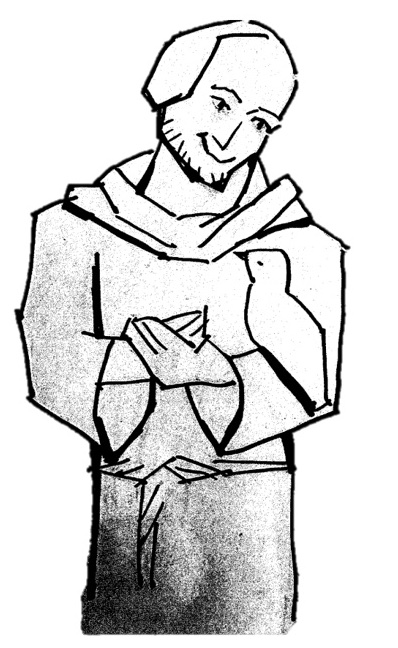
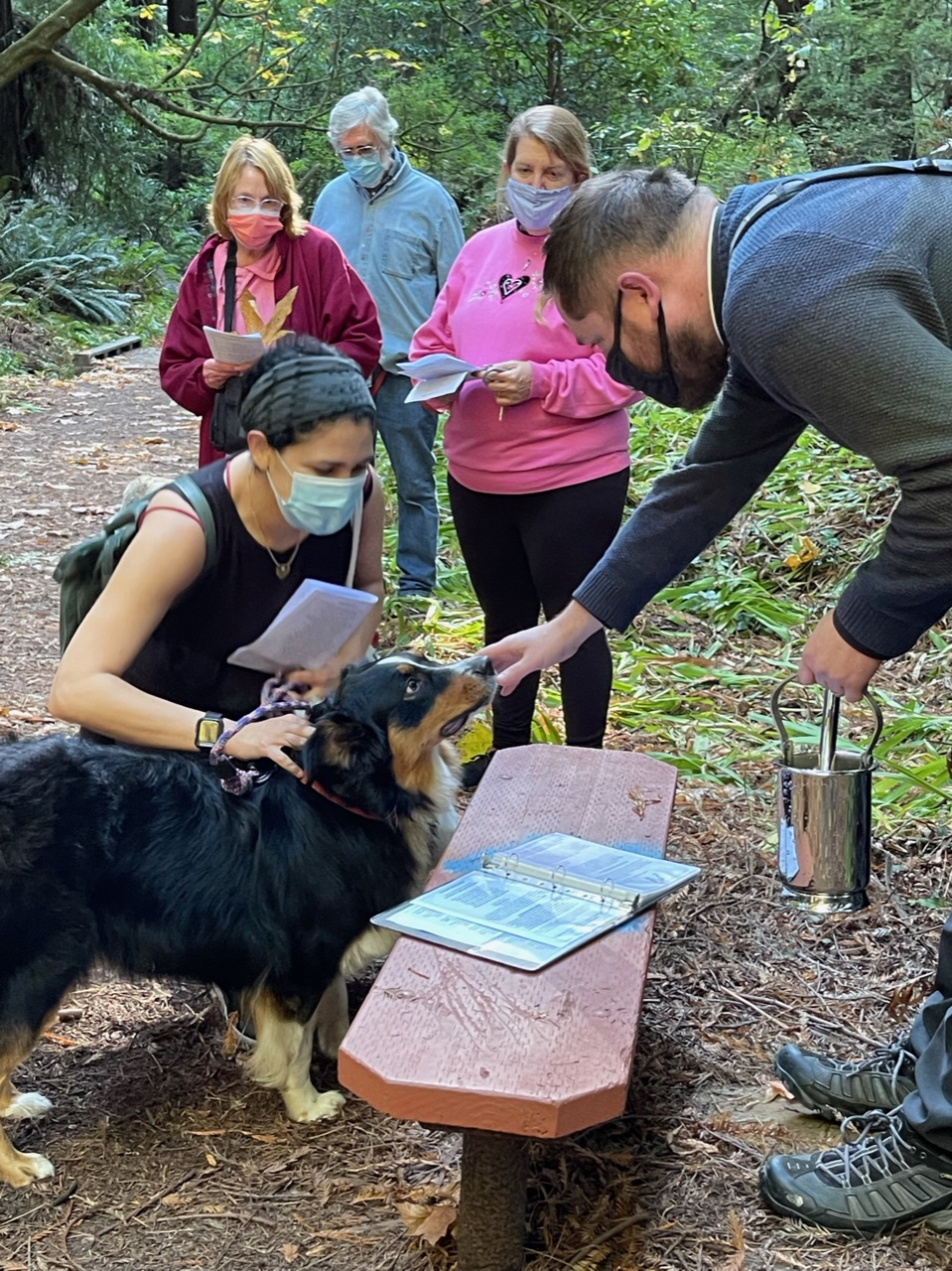
Yesterday, several of us celebrated the Feast of St. Francis by blessing animals, sauntering prayerfully through the woods, and celebrating Eucharist on our tree trunk altar at Sequoia Park. I’ve officiated about a dozen St. Francis Animal Blessings over the years, and I’ve had the privilege to bless horses, iguanas, snakes, hamsters, fish, and countless cats and dogs, but yesterday was the first time I had the joy of blessing my own puppies, Seabury and Gubbio, along with about 10 other dogs (?). Now some of my colleagues disapprove of the Animal Blessing service partly because they think that it contributes to the domestication of the radical Saint of Assisi, that it perpetuates the image of Francis as a tame birdbath saint. However, in my personal experience, the animal blessing service is often the most chaotic, loud, and unpredictable liturgy of the entire year (and I love it; and I thank all of you who were brave enough to participate). Although I disagree with the critics when it comes to the Animal Blessing service, I do agree that St. Francis has frequently been defanged in church culture and rendered as a cute and docile saint best suited for decorating manicured gardens.
Francis of Assisi is arguably the great saint of Christianity’s second millennia and perhaps the most faithful follower of the Way of Love, which was taught and embodied perfectly by Jesus Christ. Francis continues to challenge us today not as a birdbath saint, but as someone who simply decided to take the teachings of Jesus seriously, specifically the teachings of Jesus that we just heard today in this morning’s Gospel. It was this story of the rich, young ruler that transformed the young playboy named Giovanni Bernardone into the holy Poverello (the little poor man) who came to be known as St. Francis of Assisi. So, let’s take a look at this morning’s powerful Gospel…
A man runs up to Jesus, kneels before him, and asks, “Good Teacher, what must I do to inherit eternal life?” That seems like a fair question for someone to ask Jesus, right? But then Jesus responds by saying, “Why do you call me good? No one is good but God alone,” which honestly seems kind of pedantic of Jesus, doesn’t it? And it’s also a bit confusing for us who believe Jesus is the divine Son of God who is one with the Father. If God the Father is good, then it’s not out of line for someone to refer to Jesus Christ the Son of God as good. When I imagine the way St. Francis might have heard these words of Jesus, I notice a couple things:
First of all, Jesus never says he’s not good. He just asks, “Why do you call me good?” and then explains that no one is good but God alone. In other words, Jesus says to the man and to us, “Only God is good and I’m not denying that I’m good, so who do you really think that I am? In other words, Jesus is trying to cut through the superficial flattery by getting to the heart of the matter.
Second, Jesus answers the man’s question by listing some of the ten commandments, which is again strange for us who believe that we receive eternal life not by following the commandments but by believing in the grace and love of God revealed in Christ. We are saved by grace through faith, not by works. (Jesus apparently needs to read some Martin Luther). But look at the commandments that he highlights: “Don’t murder, don’t commit adultery, don’t steal, don’t lie, don’t defraud, honor your parents.” These are the ethical commandments of the Decalogue. He left out the theological commandments, which are: “Have no other gods before me, don’t worship idols, don’t use my name in vain, and observe the Sabbath.” So, it seems like Jesus wants to highlight this man’s relationship with other people by referencing only the ethical commandments of the Decalogue, not the theological commandments. And then look more carefully at the commandments he lists. He leaves out the commandment that I reference all the time: “Do not covet,” the one commandment that if we obey, the rabbis say, we won’t break any of the other commandments. Instead, Jesus says, “You shall not defraud.” He already said, “You shall not steal” but this is slightly different.
I don’t think Jesus the Son of God was having a bad day and just forgot the ten commandments (as I often do) and decided to just repeat the same one twice with different language. Jesus intentionally tweaks the commandments for this man who, the text says, had many possessions or more literally, many properties (ktaymata). Jesus says, “Do not defraud.” To defraud is to illegally obtain money (or land) from someone by deception. It’s a particular type of stealing and during Jesus’s day, the primary way that people acquired land was through a debt-default system that made the big landowners become richer and richer while large numbers of peasants were forced off the land or became debt slaves.[1] Did this young man acquire his wealth and property by defrauding others, by benefiting from an unjust system that perpetuated socio-economic inequality? The fact that Jesus replaces “Do not covet” with “Do not defraud” suggests that that might just be the case.
Now this certainly doesn’t mean that all wealthy people have gained their property and possessions through sinful and unjust means. But there is this tendency, especially in American culture, to assume that if someone has lots of money, then they have obviously been blessed and even awarded by God for all their hard work. This way of thinking has roots in what sociologist Max Weber calls the “Protestant work ethic” and it has fed into what is called the Prosperity Gospel, which insists that health and wealth are the only true signs of God’s blessing. But we see a very different way of thinking being expressed in the Gospels and in the life of St. Francis (as well as in Hebrew prophets like Amos, who has very harsh things to say to the wealthy).
The young man responds to Jesus by saying, “Teacher [notice he leaves out the word ‘good’ this time] I have kept all these [commandments] since my youth.” Remember Jesus has already said that no one is good except God, but this man insists that he’s been pretty darn good at perfectly obeying all God’s commandments throughout his life. He probably thinks that his wealth is the result of doing just that. But then Jesus looks at him and the text says that he “loved him.” I imagine Jesus looking at him and loving him the way St. Francis would look at people who said they wanted to join his order. A loving look that sees that the other person is not quite ready to make the commitment that God ultimately requires. A look of love that one gives right before delivering some hard truth: “You lack one thing; go, sell what you own, and give the money to the poor, and you will have treasure in heaven; then come, follow me.” When he heard this, he was shocked and went away grieving, for he had many possessions. (Mark 10:21-22).
When St. Francis heard these words, he felt like Jesus was speaking directly to him. The word of God was living and active, sharper than any two-edged sword, piercing and judging the heart of Francis; and he did not want to be like the young man who went away grieving. Francis felt deeply that the best way to bring God’s kin-dom on earth was to do his part in dismantling systems of oppression and inequality by relinquishing everything he had to the point of stripping naked in Assisi’s town center. He knew that, before God’s presence, no creature is hidden, but all are naked and laid bare to the eyes of the one to whom we must render an account. And he embraced his most beautiful bride whom he called “Holy Poverty.” For Francis, who is the most beloved and Christ-like saint of the last thousand years (at least), poverty and even sickness were not a sign of God’s curse, but God’s blessing.
The last words of St. Francis were: “I have done what was mine to do. May Christ teach you what you are to do.” May we allow Christ to teach us what we are to do through the Word of God this morning. May the Word of God be alive and active for you, sharper than any two-edged sword. May it pierce us in our hearts and challenge us with our wallets so that we don’t walk away grieving like the rich, young ruler, but rather rejoicing like St. Francis, who was known for singing hymns and songs of praise in the woods, giving thanks for his great high priest who sympathized with his weakness, who helped him in his time of need, and who made that which felt impossible possible. Amen.
[1] Ched Myers, “Say to this Mountain”: Mark’s Story of Discipleship (Maryknoll NY: Orbis Books, 1996), 125. “From a normally meager yield the small farmer had to feed the family, pay the rent, make tithes, cover market tolls and taxes, barter or pay for necessary supplies and tools, and put away enough seed for next year’s crop. When not enough was produced, farmers would fall into debt. They then had to use their land to secure a loan from a wealthy landowner who, in the absence of banks, supplied surplus capital at interest. When farmers defaulted on loans, they lost their land and were forced to sell their labor. This is how big landowners became richer while large numbers of peasants were driven off the land.” Myers, 40.



 DANIEL DeFOREST LONDON