
Readings for the Nineteenth Sunday after Pentecost (Proper 22 – Year B – Track 2)
This sermon was preached at Christ Episcopal Church in Eureka CA on October 3, 2021.
Little Jonny was at Sunday School when the lesson of the day was about how God created everything, including human beings. Little Jonny listened with extra attention when the teacher explained how Eve was created out of one of Adam’s ribs. Later in the week, Jonny’s mother noticed him lying down as though he were sick, and asked, “Jonny, what’s the matter? Are you feeling ok?” Little Jonny responded, “I have a pain in my side. I think I’m having a wife.”
Now Little Jonny isn’t the only one throughout church history who has had difficulty interpreting this morning’s reading from Genesis 2. Sadly, the biblical story of the creation of the first woman has been used to perpetuate misogyny and female subservience. Such gross misreadings fail to understand the powerful significance of Eve’s creation out of Adam’s side. As the medieval theologian Peter Lombard explained back in the 12th century, “Eve was formed not from just any part of [Adam’s] body, but from his side, so that it should be shown that she was created for the partnership of love…Eve was made neither to dominate nor to serve the man, but as his partner.”[1] The great Puritan commentator Matthew Henry expands on Lombard’s reading when he says, “Eve was not made out of Adam’s head to top him nor out of his feet to be trampled upon by him, but out of his side to be equal with him, under his arm to be protected, and near his heart to be loved.”[2]
According to Genesis 2, God’s intention for Eve was for her to be Adam’s helper. Now that does not mean that she was meant to be his secretary or maid. The Hebrew word for helper is ezer, which is most often used in the Hebrew Bible as a term for describing God, who comes alongside us in our helplessness and loneliness and partners with us. Since God is not subordinate to his creatures, any suggestion that the ezer-helperis inferior to Adam is untenable. Eve was made to help Adam do what? To tend the garden and care for creation. To care for what our prayer book calls “this fragile earth, our island home.” The name “Adam” could also be translated as “earthling” since Adam was made from the “adamah,” the Hebrew word for ground. The word “human” comes from humus, which is the dark, organic material in soil. We human earthlings have been made from the dust and soil of the earth and our survival as a species remains intimately linked with the earth and its wellbeing. Adam and Eve, the first human community, were called by God to care for and have dominion over the earth.[3]
Episcopal priest and founder of Interfaith Power and Light, Sally Bingham, writes, “We have a responsibility to protect [the earth]. We have dominion, for God’s sake. Dominion isn’t exploit or plunder, dominion is care, compassion and concern. The kind of dominion that God has over us and is described in one word – LOVE. It is about taking care of what has been given for us to use, but not abuse.”[4]
A couple years ago, this church hosted the Interfaith Thanksgiving Sing at a time when we could all sing freely indoors and not have to worry about social distancing. We hosted choirs from faith communities all over the county and this building was overflowing with people of all different ages, faiths, and backgrounds. We all came together around the themes of Gratitude and Care for Creation and Climate Justice. We defined climate justice as justice and protection for those who are most vulnerable to the catastrophic effects of climate change. I highlight these themes because I see them expressed so clearly in our readings today. The reading from Genesis describes the divinely appointed mission of the first human community and partnership: to care for creation. The psalm expresses gratitude and awe for the beauty of creation to such an extent that the poet wonders, “What are human beings that you are mindful of them, or mortals, that you care for them?” a sentiment echoed in the Epistle to the Hebrews.
In the Gospel, Jesus is not talking about climate justice; however, he is talking about justice; and he’s talking about justice in the context of a particularly controversial social and political issue. Just as there are a variety of opinions today when it comes to climate justice and climate change, there were a variety of opinions in Jesus’s day when it came to marriage and divorce. And when a religious leader made his opinion clear about this issue, he needed to be prepared to lose his neck. Why do I say that? Because that is the very reason why John the Baptist was beheaded. Remember Mark 6 which we read back in July: Herodias held a grudge against John the Baptist because he was not afraid to share his opinion about the unlawfulness of her marriage. So she used her daughter to have him beheaded.
That is the subtext of this question to Jesus about divorce. That’s why the Gospel says, “Some Pharisees came to test Jesus by asking, ‘Is it lawful for a man to divorce his wife?’” In other words, are you willing to lose your neck by sharing your perspective on this controversial subject? Or are you going to avoid talking about this altogether in order to save your neck?
Jesus first answers by quoting Genesis and explaining that divorce is not ideal and that God’s general intention for a married couple is for them to remain together just as his general intention for humankind is for them to care for creation. But then the disciples push him even more regarding this issue until he says, “Whoever divorces his wife and marries another commits adultery against her.” Now this teaching of Jesus really needs to be understood in the context of the debates among the Jewish rabbis at the time. There were two major schools of thought on divorce at the time: the school of Rabbi Hillel and the school of Rabbi Shammai. Rabbi Shammai’s school taught that the only ground for divorce was sexual infidelity while Hillel was much more lenient, allowing men to divorce their wives “for any cause whatsoever,” including overcooking one’s dinner. Now during this time, wives generally could not divorce their husbands, but if a man could divorce his wife for whatever reason he wanted (be it overcooking dinner or just losing interest in her), then the woman would constantly be under the threat of being divorced, which would lead to social ostracism and economic destitution. Although upon first read, it seems like Jesus is being harsh, a closer look at his teachings on divorce shows that he is actually siding with the school of thought that protected women from simply being tossed aside by fickle and selfish men. Often when Jesus comments on the Torah, he emphasizes the parts of the Torah that are intended to protect the vulnerable, in this case women. For Jesus, this is an issue of social justice; and he’s willing to risk his own neck in order to help protect those who are vulnerable. That’s what Jesus does: he risks his own safety and reputation to protect the vulnerable.
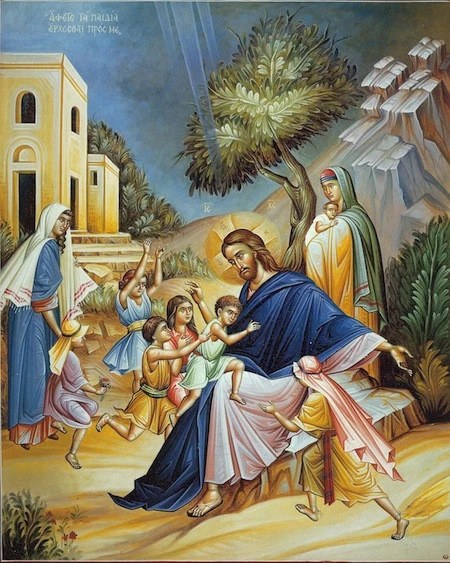
And the Gospel of Mark makes it abundantly clear that Jesus’s main concern here is about protecting the vulnerable (and not condemning people who have been divorced). The Gospel makes this clear by having Jesus literally lift up the most vulnerable people in society (the children!) right after answering the disciples’ question. This is the third in a trilogy or trifecta of Jesus’s teachings about children. Remember two weeks ago when Pastor Paul preached about Jesus taking a little child in his arms and saying, “Whoever welcome this child welcomes me.” In the first century, children had no status, no influence, no income. They were the most vulnerable in society. And Jesus said to his disciples, “Stop arguing about who is the greatest among you. Focus on protecting and caring for these little ones.” Last Sunday, Jesus had very harsh things to say about those who put obstacles in the way of children and their experience of grace and gratitude. And yet today that seems to be exactly what the disciples are doing: putting obstacles between children and grace, preventing the children from receiving a blessing from Jesus. The disciples don’t get it, which is why Jesus becomes very angry (aganakteo – violently irritated, deeply vexed)with them when he sees them keeping the children away because he just told them how important children are in God’s eyes. So now hopefully the third times a charm as Jesus says, “Let the little children come to me; do not stop them for it is to such as these that the kingdom of God belongs. Truly I tell you, whoever does not receive the kingdom of God as a little child will never enter it.” And he took them up in his arms, laid his hands on them, and blessed them.
The readings today are all about God’s preferential care for the vulnerable, including our fragile earth, women in a patriarchal culture, and children. And the readings remind us that we were created by God to partner with each other as fellow helpers and to partner with God the Great Helper in loving and caring for the earth and for the children of the earth who are in need and for the children and grandchildren who will inevitably face climate catastrophes in the future. And there may be times when we will be called to risk our own neck in order to help protect others.

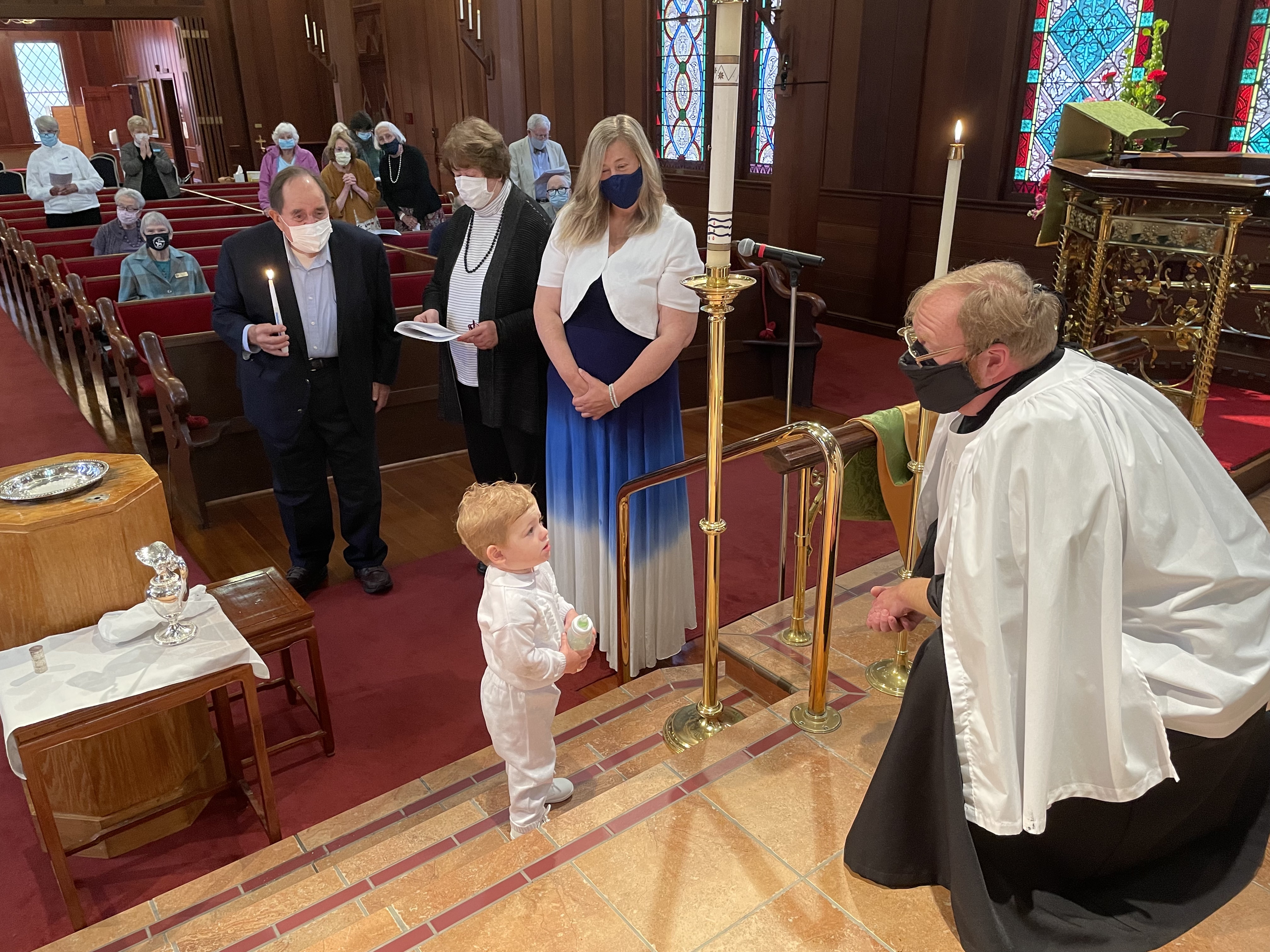
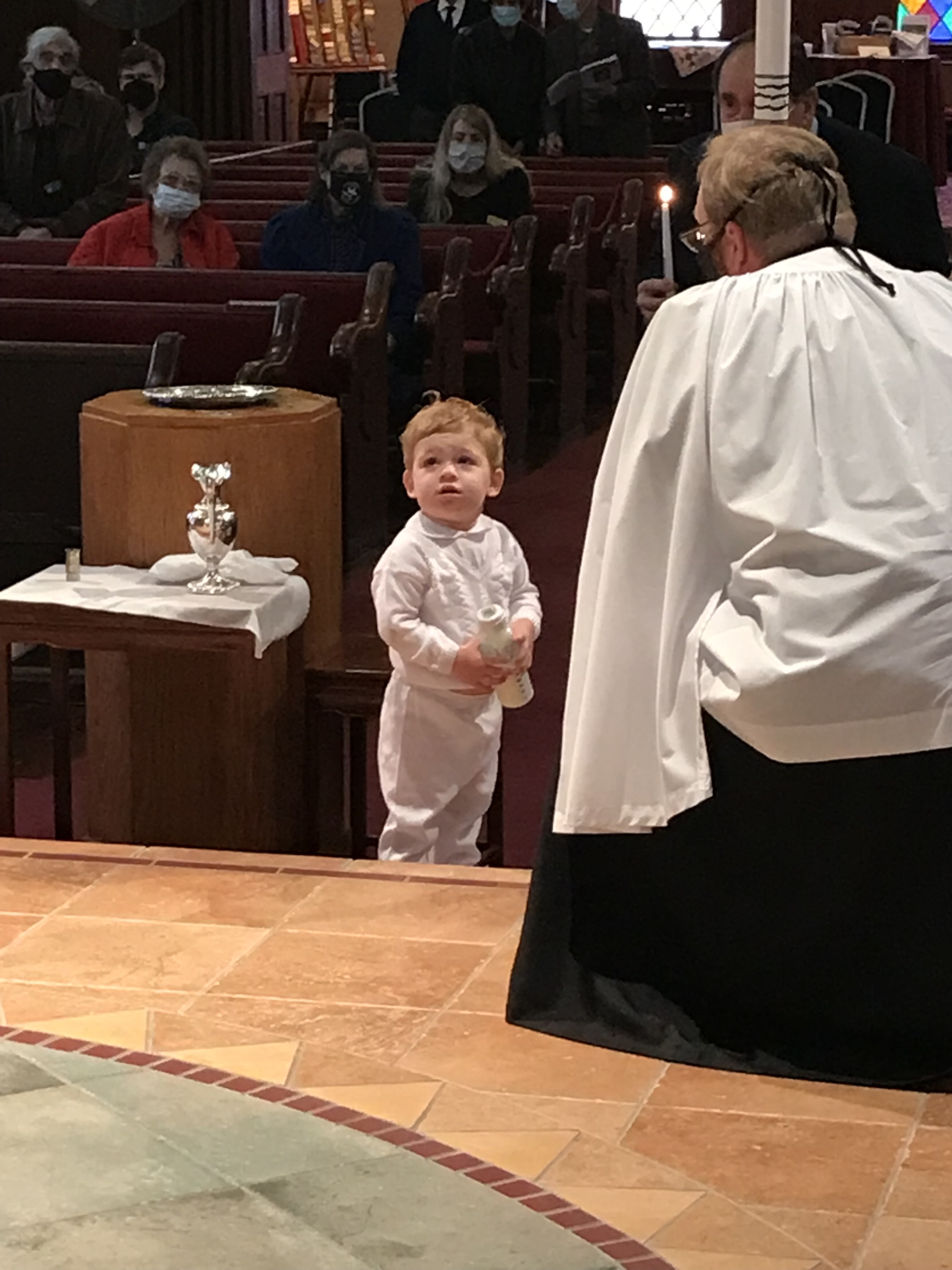
Jesus keeps lifting up the vulnerable child, which is what we will be doing later this morning when we baptize young Jensen and welcome him fully into the family of God. As we do so, let us remember to pray for all the children of the world whom Jesus loves and especially the forgotten children who are in desperate need of care and support. And let’s also not forget to show love and compassion to the vulnerable parts of ourselves, to the child within each of us, for it is by showing compassion to all children, including the child within, that we become recipients of the kingdom of God. Amen.

[1] Peter Lombard, Libri Quatuor Sententiarum (The Four Books of Sentences), Bk. 2, Distinction 18, Ch. 2, from Latin trans. Silano (2007) Bk. 2, p. 77. Silano’s translation is based on Ignatius Brady’s 1971 critical edition. The Latin text is from the Quaracchi edition of 1916, available online at Magister Sententiarum. Footnote from https://www.purplemotes.net/2017/03/19/lombard-conjugal-partnership, accessed October 3, 2021.
[2] Matthew Henry, Matthew Henry’s Commentary on the Whole Bible (Peabody MA: Hendrickson, 1991), 10.
[3] This reading is informed by the interpretive work of Ashley L. Bacchi presented in her lecture “Eden & Eve ~ Eco & Equity: Rereading Genesis as a Call for Ecological Justice,” given in her Fall 2021 course titled “Liberation, Social Justice, Bible.”
[4] The Rev. Canon Sally G. Bingham, Love God Heal Earth (St. Lynn’s Press: Pittsburgh PA, 2009), viii.

 DANIEL DeFOREST LONDON