
This article was written for the September 2021 Chronicle newsletter for Christ Church Eureka
“Our God is a consuming fire” Hebrews 12:29
We read this verse at our last Sacred Saunter service in August when we celebrated the feast of St. Augustine of Hippo: “Our God is a consuming fire” (Hebrews 12:29). These words have taken on a new and challenging meaning for me in light of all the wildfires that are currently consuming our state, including the Knob Fire in Willow Creek, with which I had a close encounter last Sunday.
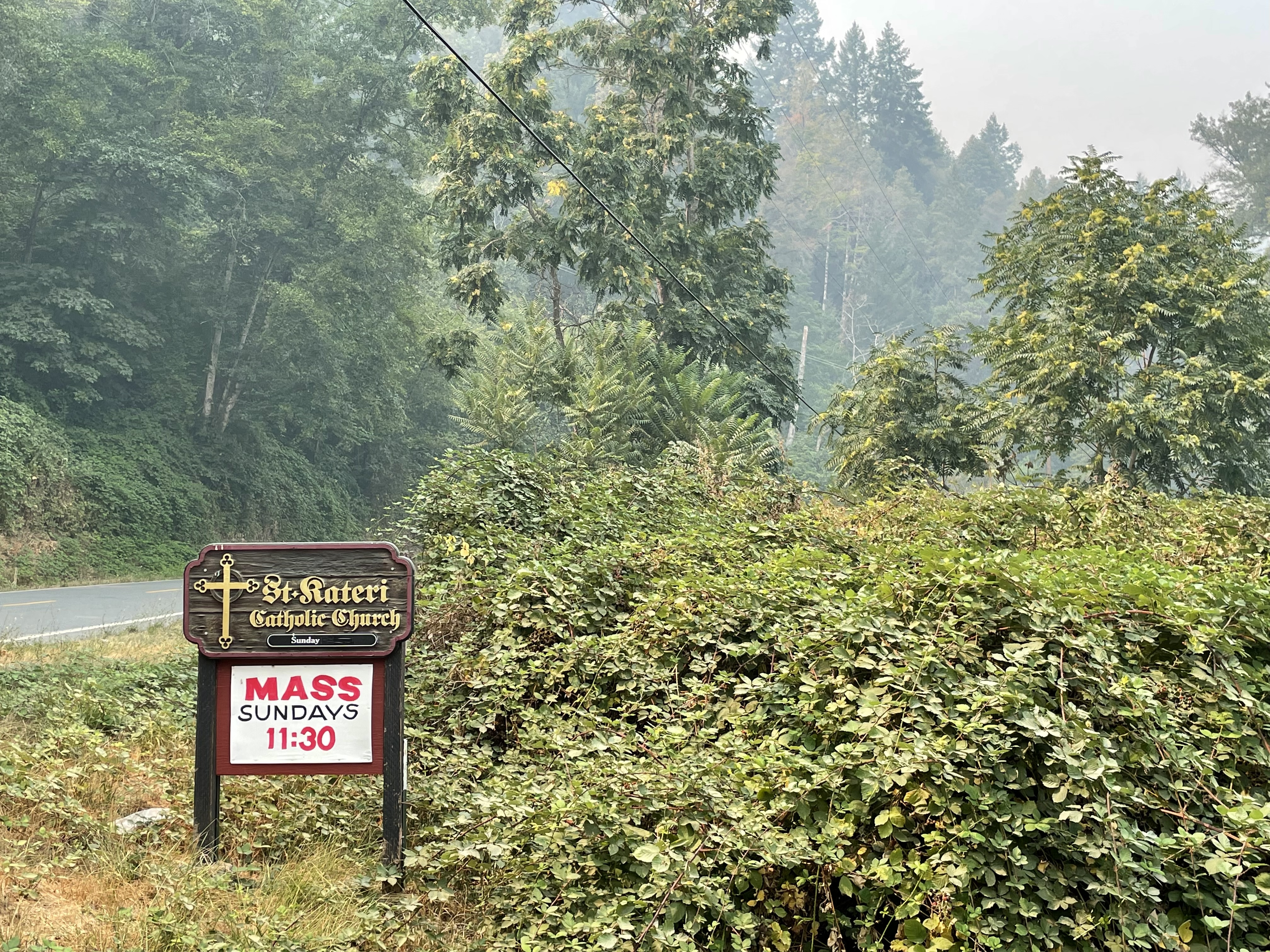
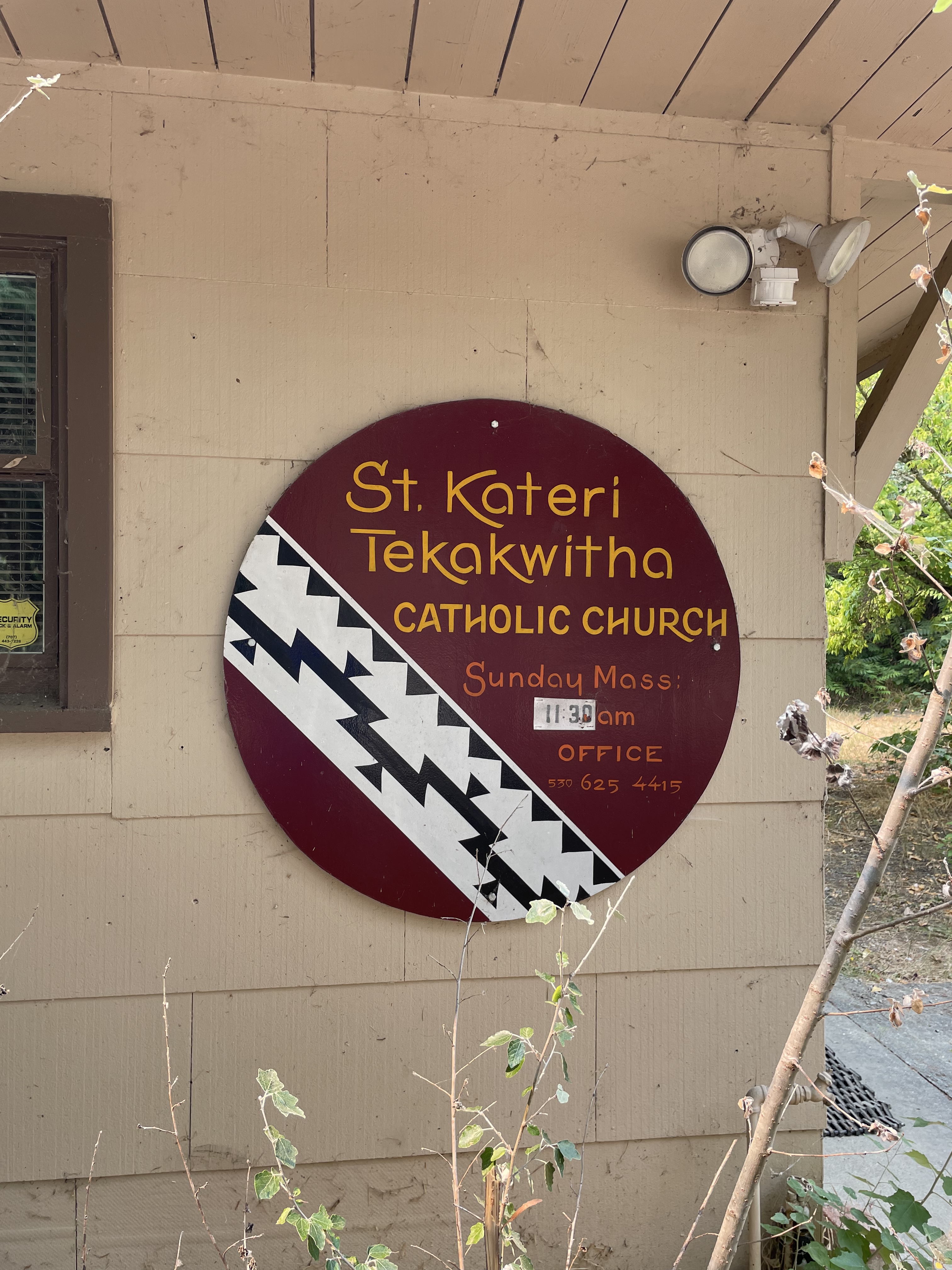
As Mother Lesley shared on Sunday, I went on a two-night prayer retreat last weekend in a small cabin by Hawkins Creek in Hawkins Bar CA, where the temperature was about 90 degrees and the air quality was hazardous due to the nearby Monument Fire. I always find it incredible that the climate and air quality can change so dramatically simply by driving an hour east of Eureka. Fortunately, the small cabin had air conditioning and sufficient insulation. I spent most of the time praying and reading and playing worship songs on my guitar. While reading Morning Prayer, Noonday Prayer, Evening Prayer, and Compline, I prayed for many of you by name; and I joined you all for Holy Eucharist at 10:30 AM on Sunday, when I especially appreciated the luxury of belting out the hymns, mask free (and guilt free!) in the confines of the cabin. On Sunday afternoon, I went on a mini pilgrimage to the St. Kateri Tekakwitha Catholic Mission church in Hoopa. St. Kateri Tekakwitha is a Native American saint, known as “the Lily of the Mohawks,” whose feast day we celebrated at a Sacred Saunter back in April; and I had wanted to visit the church ever since Sanford first told me about it.[1] Although the church has not been holding masses throughout Coronatide and I was unable to peek inside the sanctuary, I enjoyed walking around the premises and sensing the presence of St. Kateri, a patron saint of ecology who was known for saying, “I am not my own. I have given myself fully to Jesus.” I had also read about an Episcopal mission among the Karuk called the Church of the Holy Spirit that gathered in Orleans CA about 80 years ago[2] and I was thinking about driving up to explore that town as well, but too much of the smoke-filled air was seeping into my car.
Later that night, I prayed Compline in bed, and I felt particularly moved by the Antiphon prayer prayed before and after the Song of Simeon (Nunc dimittis): “Guide us waking, O Lord, and guard us sleeping; that awake we may watch with Christ, and asleep we may rest in peace” (p. 134, 135). It is a comforting and quaint idea that God guards and protects us while we sleep at night so that we might rest in peace. After closing my prayer book and snuggling under the sheets for a restful sleep, I noticed an alarm on my phone informing me of an immediate evacuation order by the Sheriff’s department for people living in the Willow Creek area due to the growing Knob Fire. As I began to look on my iPhone map to see whether I was in the evacuation zone, all the power in the cabin suddenly went out. I had no cell phone reception at the cabin, and now I had no internet or air conditioning or light. I would have felt only slightly inconvenienced by the power outage if I hadn’t just learned that I might be in the middle of a fire evacuation zone. I thought, “Well, I could go to bed and simply trust that God will indeed guard and protect me in my sleep or I could grab a flashlight and start packing up my belongings.” Since I was leaving the next morning anyway, I thought that I might as well play it safe and not tempt God, especially since I was completely incommunicado and in the dark, literally.
After packing the car, I drove to a nearby bar called RockSlide Bar & Grill to see if anyone there had more information about the evacuation order. I was wearing my face mask not only for COVID protection but also as a filter for all the smoke. However, no one else in the area seemed to be wearing masks at all so I clearly stood out as an out-of-towner when I walked into the bar and asked about the evacuation zone. They were friendly and jovial in their replies: “Honestly, we’ve probably been in an evacuation zone for several weeks now!” and “Don’t worry, you’ll be fine. If you burn, we’ll all burn with you!” And then the bartender told me that even if I wanted to drive back to Eureka, I probably wouldn’t make it since the roads are often closed at this time of night. Since I had already packed my belongings and cleared out of the cabin, I decided to head west on 299 to find out for myself.
As I drove through Willow Creek, I saw the glow of the Knob fire growing on the mountains beside me. My concern turned into anxiety when a truck in front of me slowed down and stopped in the middle of the highway and then turned around. The air became smokier, and the blaze of the fire grew brighter as I approached a one-lane, unpaved construction zone. I felt that many of the prayers I had been praying over the weekend had been preparing me for this moment when I had to entrust myself fully to God. I asked St. Kateri to pray for me and to help me trust that God would indeed protect me as I prayed a couple hours ago during Compline. My prayers then extended to all those whose cars and homes and bodies were affected by the Knob fire as well as the other major fires ravaging the west and the waters flooding the east. I was reminded of a line from The Cloud of Unknowing in which the anonymous author says, “Be prepared for your heart to be set aflame by the wildfire of God’s love.”[3] It was hard for me to see God present in the fire that was consuming and destroying so much of the stunning landscape, but I felt invited to trust that God was indeed a consuming fire of love, purifying and refining our hearts and compelling us to let go of our idols of false security.
As I turned a corner, I saw several emergency vehicles, flood lights, and armed officers standing by the road. I rolled down my window and asked an officer if the road up ahead was open so that I could return to Eureka. I was relieved when he said, “Yes! Drive safely.” About 30 minutes later, the temperature dropped about 35 degrees and the smoke was replaced by the refreshing Humboldt fog. I felt deep gratitude for the clean air and cool climate of Eureka, especially now when so much of the rest of the country is undergoing ecological crises.
After arriving safely home, I got into bed and opened up my prayer book again to page 135 and smiled as I prayed, “Lord, you now have set your servant free to sleep in peace as you have promised.”

[1] I had learned about the Native American saint originally from a novel written by Leonard Cohen titled Beautiful Losers (1966). Although I love Cohen’s writing and the novel has some lovely parts (including descriptions of St. Kateri’s life), I found the novel too postmodern, disjointed, and vulgar for my tastes.
[2] According to Owanah Anderson’s book 400 Years: Anglican/Episcopal Mission Among American Indians (Forward Movement, 1997), “Sixty years ago there was a vital and visible ministry among the Karuk people in the Diocese of Northern California. The Church of the Holy Spirit, in the hamlet of Orleans, had, according to The Spirit of Missions, been given land in 1914 by ‘Indian Fannie, a medicine woman of eighty-odd years.’ [O]ld records are mute on what happened to the mission…”
[3] See The Cloud of Unknowing Distilled (Apocryphile Press: Hannacroix NY, 2021), 32. Another English Medieval poet and mystic named Richard Rolle wrote a book a few years before The Cloud of Unknowing titled Incendium Amoris, which means The Fire of Love.

 DANIEL DeFOREST LONDON