

Readings for the Thirteenth Sunday after Pentecost (Proper 16 – Year B – Track 2)
This sermon was preached at Christ Episcopal Church in Eureka CA on August 22, 2021.
Yesterday, several of us celebrated the feast of St. Bernard of Clairvaux by sauntering through the redwoods at Sequoia Park. We read a letter that Bernard wrote to his English counterpart St. Aelred of Rievaulx, in which the saint talked about the wisdom that can be gained only in the woods. He said, “You will discover things in the woods that you never found in books. Stones and trees will teach you things you never heard from your schoolteachers.” And as we continued our saunter, we paid attention to the gifts of God’s creation that surrounded us. When we gathered around the altar, we shared what we noticed; and then, on the redwood altar, placed dried leaves, cones, sticks, stumps, lichen, flowers, and pictures we had collected along the way. And a couple people mentioned the fact that nothing is wasted in the forest. Many of those things which we might easily discard become sources for new life and resurrection in the ecosystem of the woods. Fallen branches and dead leaves and discarded cones become part of the nutrient-rich soil that strengthens old roots and creates the conditions for new trees and plants to grow. Although this wisdom might be gained through books, we were able to receive this wisdom in a tangible and holistic way, as active participants in the same ecological community of those ancient and majestic redwood trees. I believe this was some of the wisdom that the woods offered me yesterday, thanks to St. Bernard of Clairvaux and my fellow saunterers. I also see this same wisdom being offered in our readings this morning, which invite us to look more closely at that which we may want to quickly discard, to discover the life-giving potential in that which we might be inclined to dismiss.
In our reading from the Hebrew Scriptures, Joshua urges the tribes of Israel not to dismiss the God who brought them out of slavery in Egypt but to faithfully serve God rather than the attractive new gods worshipped by their Amorite neighbors. Joshua says, “Choose this day whom you will serve whether the gods your ancestors served [before Abraham] or the gods of the Amorites; but as for me and my house, we will serve the LORD.” Even though it may have appeared that God was not performing the same great and glorious deeds he performed with Moses and the Israelites were facing some enormous challenges and failures at the time, they still refused to exchange their God for a shiny new pantheon. They said, “We also will serve the LORD, for he is our God.”
The Israelites chose not to discard their God because they believed that their God would never discard them, as this morning’s psalm declares: “The eyes of the LORD are upon the righteous, and his ears are open to their cry…The LORD is near to the brokenhearted and will save those whose spirits are crushed…He will keep safe all [their] bones; not one of them shall be broken” (Psalm 34:15, 18, 20). God does not discard God’s people but keeps them safe down to their very bones.
In Paul’s letter to the Ephesians, he urges them (and us) not to discard the power of prayer, especially when it comes to facing the enormous challenges in our lives and in the world today because, as he says, “our struggle is not against enemies of blood and flesh, but against the rulers, against the authorities, against the cosmic powers of this present darkness, against the spiritual forces of evil in the heavenly places.” When we feel overwhelmed with the painful reality of Afghanistan, the wildfires, COVID and more, some of us might think that praying is a cop out, but it’s not. According to Paul, it is through prayer that we can take up the whole armor of God and stand firmly on the side of justice and oppose evil in all its many forms. By equipping ourselves with truth and righteousness and faith and peace, we become prayer warriors. Let us not dismiss or discard the power of prayer.
In our Gospel, we arrive at the final words of the Bread of Life discourse. Over the last four weeks, we have seen Jesus transform a motley crew of strangers into a community of companions who converge together around a holy meal of bread. He has responded to their complaining and kvetching with amazing grace and has tried to explain to them that the bread he offers is not just food for their bellies, but the actual bread of the high priestly wisdom that embodies God’s self-giving love. Through Christ, God longs to nourish God’s people the way a mother nurses her child. In this way, we begin to understand what Jesus means when he says, “Those who receive nourishment from my body abide in me, and I in them.” But even with the understanding of the ancient Bread of the Presence (which I described last Sunday) and St. Augustine’s helpful imagery of God nursing God’s children, these teachings of Christ in John 6 remain difficult to penetrate and even slightly distasteful, especially since Jesus keeps referring to his flesh as true food and his blood as true drink which, when consumed, generate eternal life within us. So, we may be able to relate to his listeners when they say, “This teaching is difficult; who can accept it?” It would be easier to discard this teaching and focus on other teachings of Jesus that more palatable. I know many Episcopal priests and preachers who would be happy to see this Bread of Life discourse omitted or at least shortened in the lectionary, rather than being spread across five weeks.
When Jesus senses his listeners impatience, he then says something even more confusing. After speaking in depth about the importance of his flesh, he then goes on to say, “The flesh is useless”! Which one is it? Make up your mind, Jesus! This becomes too frustrating for many of his listeners and disciples. So, they turn their back and discard him and his teachings. Jesus then turns to the twelve (those same twelve we have portrayed in Lewis Hall) and asks them a question that he might also be asking you, “Do you also wish to go away?” Will you also discard me and my teachings because they do not make complete sense to you right away?
Simon Peter says, “Lord, to whom can we go? You alone have the words of eternal life. We have come to believe and know that you are the Holy One of God.” We have come to believe that the one whom others have discarded is, in fact, the divine source of new life. The stone the builders rejected will become the capstone (Psalm 118:22).
Our readings invite us to look more closely at that which we may want to quickly discard, to discover the life-giving potential in that which we might be inclined to dismiss. As a community of companions who, like Joshua, choose to serve the Lord, may we remain open to being transformed and renewed by that which we might initially be inclined to reject. What might that be for you? Who might that be for you?
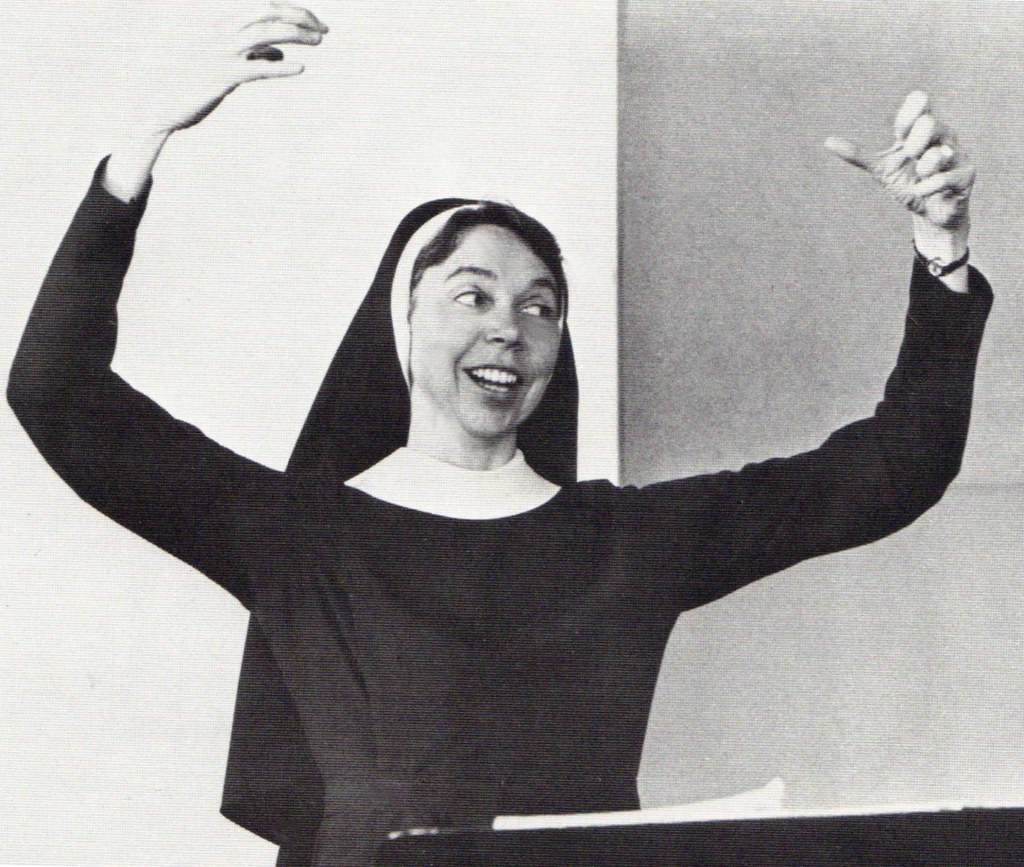
A Catholic nun named Sister Suzanne of the Sisters of Mercy learned the importance of looking more closely at that which she initially discarded while teaching music at the Mercy Center High School in Burlingame CA. During a free period, she wrote a song for an archdiocese event, but then decided that she didn’t like the music, so she tore it up and threw it away in a waste basket. Fortunately, a blond freshman girl heard her playing the song and said, “What was that? It was beautiful!” So, Sister Suzanne chose to look more closely at that which she initially discarded. She took the torn papers out of the waste basket and scotch taped them back together. And thank God she did because that hymn became one of the most widely known and enduring Catholic hymns of the 20th century. Often sung at funerals, the hymn has brought comfort and solace and inspiration to thousands of people. We sang the hymn here at Fr. Doug’s memorial service during my first week and I have heard a few of you say that you wouldn’t mind if we sang this hymn every Sunday. Some have even called this “The Christ Church Eureka hymn.” During the last four weeks, we have been singing it every Sunday because the words of the hymn come directly from the Bread of Life discourse in John Chapter 6. The hymn titled “I am the Bread of Life” invites us to continue chewing on the wisdom of these words of Jesus, even when they seem strange and difficult. The hymn, which was initially dismissed and thrown away, now invites us to continue reflecting on the teachings of Jesus that caused many of his disciples to dismiss him entirely. The hymn invites us to say with Simon Peter, “Lord, to whom can we go? You alone have the words of eternal life.”
May these words of eternal life which we will sing during communion (at the 10:30 AM service) strengthen and nourish us to be a community of companions who choose to serve the Lord, who look more closely at that which is initially discarded, who lament when we need to lament, who embody the high-priestly wisdom of God’s self-giving love, and who walk together in the Way of Christ’s for all, a way that ultimately leads to everlasting life. Amen.

 DANIEL DeFOREST LONDON