
Readings for the Twelfth Sunday after Pentecost (Proper 15 – Year B – Track 2)
This sermon was preached at Christ Episcopal Church in Eureka CA on August 15, 2021.
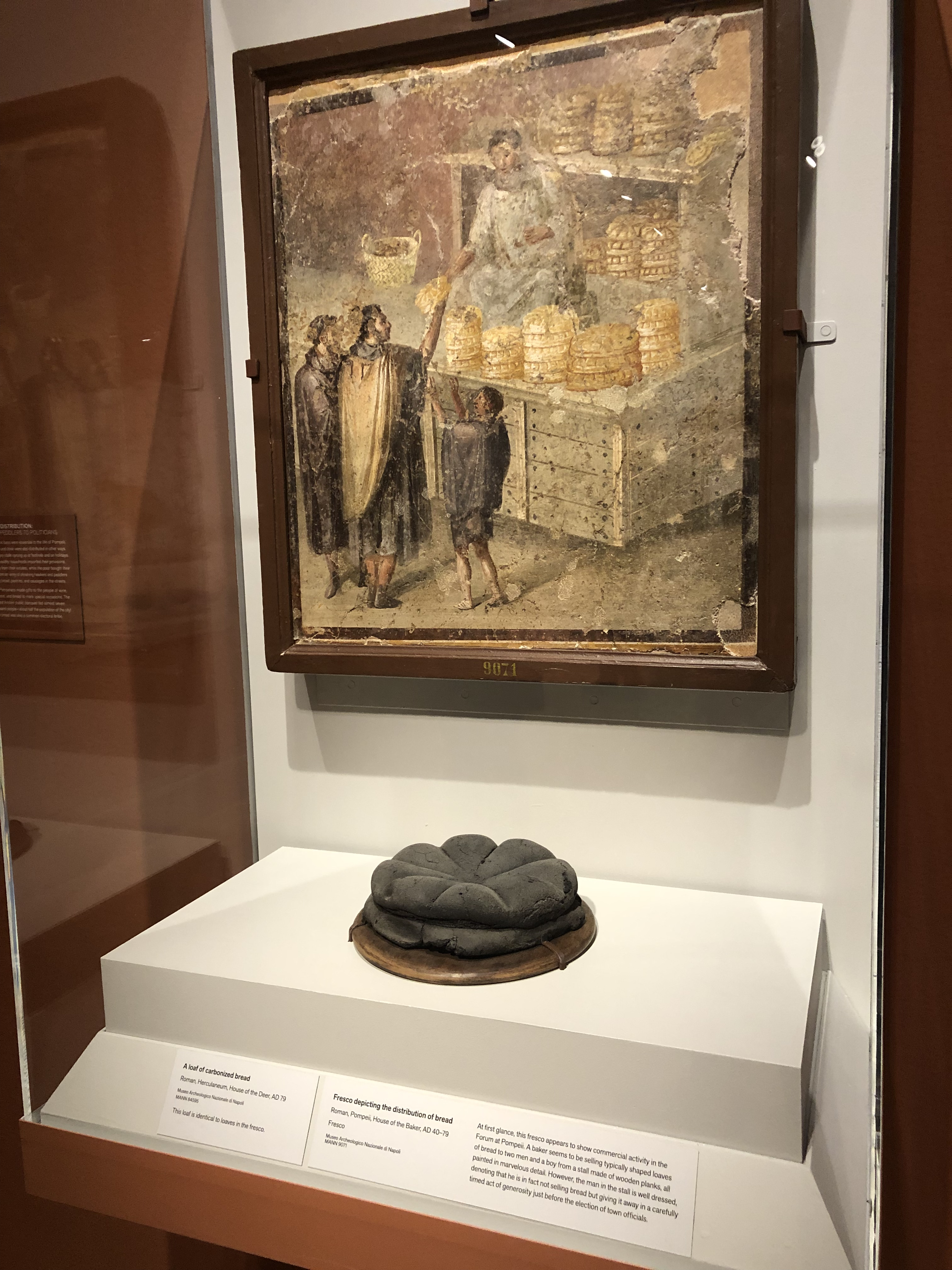
Earlier this summer, Ashley and I visited a special exhibit at the Legion of Honor Museum in San Francisco. The exhibit was titled “Last Supper in Pompeii: From the Table to the Grave” and it focused on the culinary world of the city of Pompeii before it was destroyed by the Mount Vesuvius volcano in 79 AD. The exhibit included the display of a round loaf of carbonized bread, which had the same basic shape of the homemade communion bread we used to serve here before COVID, but it was entirely charred black due to centuries of being buried under volcanic ash.[1] Above the bread was a fresco from Pompeii which appeared to portray a baker selling loaves of bread to two men and a boy from a stall made of wooden planks, all painted in marvelous detail. However, the display caption went on to explain that, upon closer look, the man in the stall was far too well dressed to be a street baker. According to the caption, his clothing denoted that “he was in fact not selling bread but giving it away in a carefully timed act of generosity just before the election of town officials.”[2] So, the person who appeared to be a baker was actually a kind of campaign manager or campaign staff member seeking to boost a candidates’ chances for winning an election. Apparently, this was often done in the Mediterranean world during the first century. An abundance of bread was freely distributed to the public to enhance the reputation of a political candidate or public figure, suggesting to the people that if a certain person were elected, then the people would always be well fed. The distribution of free bread was a public service; and the words “public service” in Greek are “litos ergos,” which is where we get the word “liturgy.” So, in one sense, when we distribute the consecrated bread here, we are performing a public service (a “litos ergos/ liturgy”) to hopefully enhance the glory and reputation of our Lord Jesus Christ, who preached about the kingdom of God in which a loving and nourishing God reigns supreme.
The museum display shed new light for me on the feeding of the five thousand in John 6 as well as the subsequent “Bread of Life” discourse that we have been reading, marking, and inwardly digesting these last several weeks. If you remember, back in July, right after the people were fed, the Gospel says that “Jesus realized that they were about to come and take him by force to make him king” (John 6:15). The people likely associated free bread with a kind of political campaign; and they knew Jesus was a perfect candidate for the Messiah, the King of the Jews, who would overthrow the Roman empire and establish the Kingdom of God on earth. But Jesus, who knew what was in the hearts of men, withdrew to the mountain by himself. And when he saw the people the next day, he tried to explain to them that his mission involved so much more than a political campaign and that the free bread he miraculously multiplied and distributed was so much more than just an attempt to win peoples’ hearts through their stomachs.
Just as a closer look at the Pompeii fresco revealed a new layer of meaning behind the distribution of bread so too can a closer look at the feeding of the five thousand and the Bread of Life discourse reveal a deeper layer of meaning for us, especially when we look at these events within the context of ancient Judaism.
According to the book of Leviticus, the Jewish high priests kept twelve loaves of bread in the ancient Jewish temple, in the presence of God. Three times a year at the major pilgrimage festivals of Pesach (which we call Passover), Shavuot (which we call Pentecost), and Sukkot (the feast of Tabernacles), the priests would bring the bread out of the temple (the presence of God) and show it to the people, lift it up, and say, “Behold, God’s love for you.” This Bread of the Presence (also known as the Showbread) symbolized God’s love for God’s people. The bread was then consumed by the priests, and only the priests; and by consuming this bread, the priests received spiritual wisdom and insight. They received the wisdom described in Proverbs 9, which personifies wisdom as a woman who invites everyone into her home to eat of her bread and drink of her wine so that they can “lay aside immaturity, and live, and walk in the way of insight” (9:6). The Book of Ecclesiasticus develops this image of Lady Wisdom by describing her as one who nourishes her guests with the “bread of understanding” and refreshes them with “the liquid of wisdom” (Ben Sira 15:3).
It was through this spiritual wisdom that the ancient Jewish priests understood the deeper meaning behind the entire temple and its rituals, including all the bloody animal sacrifices that many of us might find disturbing today. They understood that the complex sacrificial system of the Jewish temple was not about sacrificing animals to appease a bloodthirsty god. Instead, according to this high priestly wisdom, the blood of the sacrificed animals symbolized and embodied the blood of God who pours out his life and love for his people, every day. The high priests understood that the temple was all about God trying to communicate and offer his self-giving love to his people in a way that nourished and transformed them so that they could embody God’s love to the rest of the world. That was the high priestly wisdom.
And that’s the wisdom Paul is referring to in his letter to the Ephesians when he says, “Be careful then how you live, not as unwise people, but as wise. [Christ has given us all the high priestly wisdom so] don’t be foolish and don’t get drunk on wine, but rather feast on the bread of understanding and the liquid of wisdom; be filled with the Spirit as you sing psalms, hymns, and spiritual songs, singing and making melody to the Lord in your hearts,” giving thanks to God for the love and nourishment he pours out for us each day. This is the high priestly wisdom that Jesus is trying to communicate in the Bread of Life discourse.
Not long after visiting the Pompeii exhibit in San Francisco, I listened to a Master Class titled “Preaching the Gospel of John with St. Augustine” led by former Archbishop of Canterbury Rowan Williams and Notre Dame professor John Cavadini (who is a St. Augustine scholar).[3] They discussed the passage we just read, particularly the verse in which Jesus says, “Those who eat my flesh and drink my blood abide in me, and I in them.” They found that a helpful way of understanding this verse and the entire Bread of Life discourse was through an image that St. Augustine often wrote about and that is the image of breastfeeding. Those who receive nourishment from my body abide in me. This act, which is at the foundation of our identity as mammals, helps us understand what God was trying to do for us in the temple sacrifices and what God is trying to offer us through Jesus Christ and through the Eucharist. In Christ, God invites us to abide in him and be nourished by his very body like a child abides in the bosom of its mother. There’s that great Psalm (Ps. 131) that says, “I still my soul and make it quiet, like a child upon its mother’s breast; my soul is quieted within me.” Jesus invites us to abide in him like a child upon its mother’s breast.
And when we receive that nourishment from God we are, like the ancient Jewish priests, receiving the bread of high priestly wisdom that not only helps us see God’s self-giving love being poured out lavishly upon us at all times and in all places, but we also become empowered to embody that same self-giving love in the world. We become a community of companions who walk in the way of wisdom, the wisdom that sees God’s nourishment being offered to us every day so long as we abide in him. And with that nourishment, we become empowered to fulfill our vision as a community of companions walking together in the way of Christ’s love for all. Amen.
[1] A loaf of carbonized bread. Roman, Herculaneum, House of the Deer, AD 79. Museo Archeologico Nazionale di Napoli. MANN 84595. “This loaf is identical to loaves in the fresco” Legion of Honor Museum, San Francisco CA. “Last Supper in Pompeii: From the Table to the Grave” May 7, 2021 – August 29, 2021. Date of Visit: June 4.
[2] Fresco depicting the distribution of bread. Roman, Pompeii. House of the Baker. AD 40 – 79. Fresco. MANN 9071. “At first glance, this fresco appears to show commercial activity in the Forum at Pompeii. A baker seems to be selling typically shaped loaves of bread to two men and a boy from a stall made of wooden planks, all painted in marvelous detail. However, the man in the stall is well dressed, denoting that he is in fact not selling bread but giving it away in a carefully timed act of generosity just before the election of town officials.” Legion of Honor Museum, San Francisco CA. “Last Supper in Pompeii: From the Table to the Grave” May 7, 2021 – August 29, 2021. Date of Visit: June 4.
[3] “Preaching the Gospel of John with St. Augustine: A Master Class with Rowan Williams and John Cavadini,” New City Press. June 8, 2021 https://www.youtube.com/watch?v=oLpvRI0v1wI

 DANIEL DeFOREST LONDON