
Readings for the Fourth Sunday of Easter (Good Shepherd Sunday)
Acts 4:5-12
Psalm 23
1 John 3:16-24
John 10:11-18
This sermon was preached at Christ Episcopal Church in Eureka CA on Good Shepherd Sunday on April 25, 2021
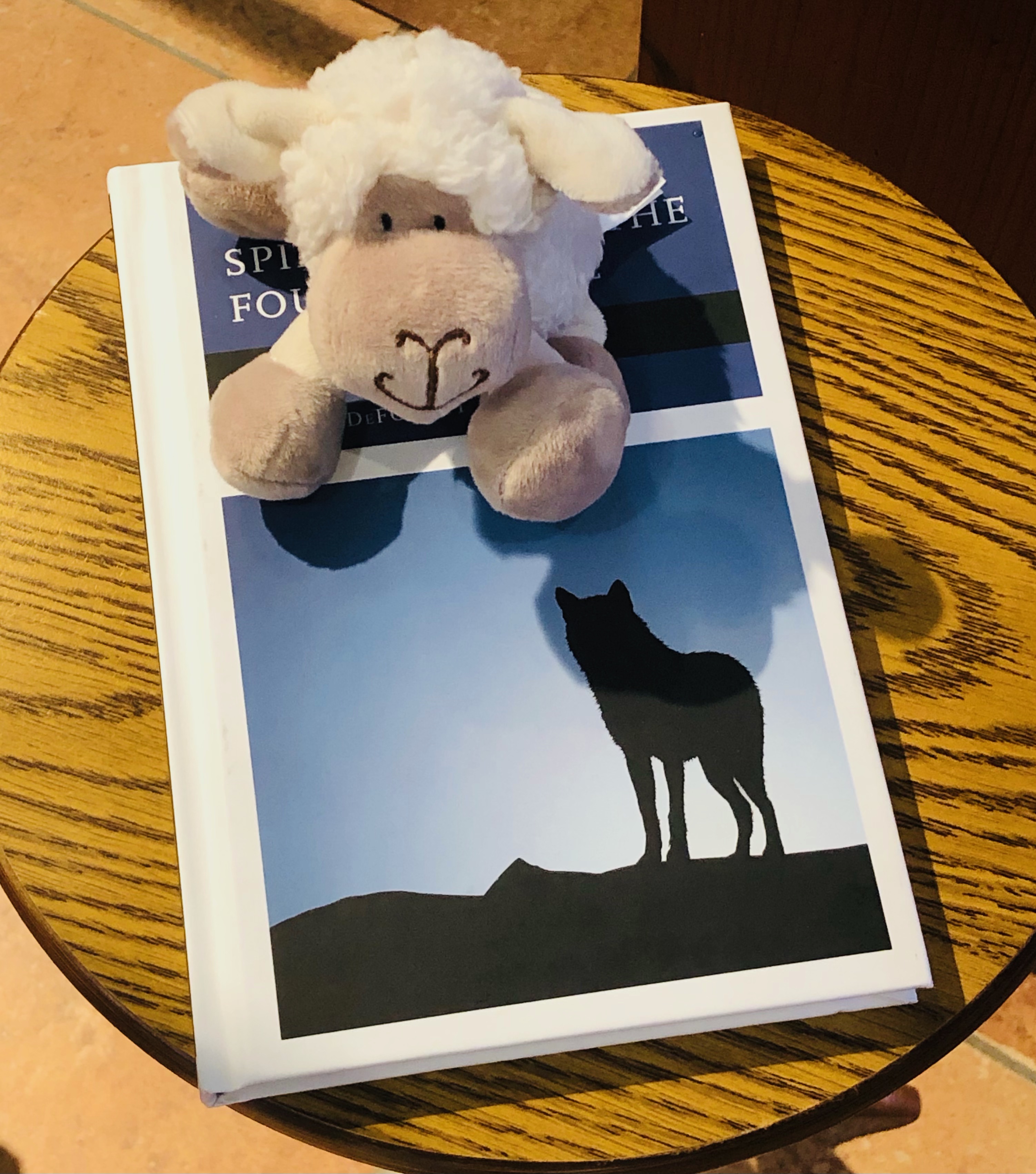
Today, the Fourth Sunday of Easter, is one of my favorite Sundays of the year because it is Good Shepherd Sunday when we read a passage from the Good Shepherd discourse from the tenth chapter of the Gospel of John. One of the chapters in the book I published last summer focuses on this Good Shepherd discourse. In fact, the image that is described in our passage this morning is the same image I underscore in my book and even use for the book’s cover. It’s not an image that we frequently associate with the Gospels, but it appears twice in our reading today. It’s the image of the wolf. In my book, I argue that this Good Shepherd discourse is part of Jesus’s answer to the question of suffering, which is asked at the beginning of John Chapter 9, when the disciples see a blind man and ask, “Who sinned this man or his parents that he was born blind?” In other words, “Who do we blame for this suffering? The victim or this victims’ parents?” Jesus initially answers by saying, “Neither this man nor his parents sinned, so stop blaming the victim. Our job is not to blame others but to heal others and to make God’s healing love manifest in this person’s life and in the world.”
But the Gospel’s answer to the question of suffering continues beyond that. After being healed by Jesus, the blind man is expelled from the synagogue thus revealing our addiction to blaming and excluding others. So, then Jesus speaks directly to the religious authorities who have expelled the blind man and essentially tells them that they’re not being good shepherds because good shepherds don’t abandon their sheep or expel them. He says, “Good Shepherds protect their sheep, even at the risk of their own safety, even at the risk of their own lives. If you really need someone to blame when it comes to the question of suffering, you can direct that compulsion to blame and that anger onto me because I can take it and respond with love and forgiveness. I can receive you and your wolfish rage because I know that underneath all of that, you’re really just afraid. I am the Good Shepherd, who fully accepts you, wolves, warts, and all.” The Good Shepherd helps us see that underneath our wolfish rage, there is often a vulnerable and gentle lamb.
Yesterday we celebrated Earth Day and the feast of environmentalist John Muir as we sauntered in the soft rain. There were several moments when the sun was shining and the rain was falling simultaneously; and I learned that, when this happens, Armenians say that the “wolf is giving birth on the mountain.” And speaking of wolves and Earth Day, I want to tell you the story of the patron saint of ecology St. Francis and the Wolf of Gubbio.
When Saint Francis was living in the town of Gubbio, which is a little North of Assisi, the people of were being terrorized by a ferocious and dreadful wolf who was not only killing animals, but also killing men, women, and children. The wolf was so violent and deadly that the people of Gubbio carried weapons around with them wherever they went; and they refused to ever leave the town, because they were so afraid. They were on lockdown because of the wolf.
St. Francis had compassion on the people of Gubbio and decided to meet the wolf personally, even though everyone in the town said, “Don’t do it! The wolf will kill you; and we don’t want to lose you.” But St. Francis trusted in the protection of his divine Good Shepherd and walked to the outskirts of Gubbio, where the wolf had been living. Before he left, he signed himself with the sign of the cross, and thus aligned himself with the Good Shepherd who meets the Wolf even at the risk of his own safety.
Some of his close companions followed him, but when they saw the ferocious wolf from a distance they said, “We can’t do this. This is suicide.” But Francis said, “Ok. You stay here. I will go alone.” So Francis approached the wolf; and the wolf growled at him and then lunged at him with an open jaw, dripping with saliva. Francis, facing the wolf, made the sign of the cross and at that very moment, the ferocious wolf shut its mouth and stopped in its tracks. And then Francis said, “Come here, brother wolf. I command you in Christ’s Name not to harm me or anyone else.” And at these words, the wolf became as gentle as a lamb and curled up at the feet of the saint.
Francis then said, “Brother wolf (Frate lupo), you’ve done a lot of damage in these parts. You’ve killed God’s creatures and you’ve also had the gall to kill human beings who are made in God’s image. The just punishment for these crimes is death, and everyone in Gubbio would be happy with that punishment for you, but I want to try making peace with you and the people of Gubbio. So let’s make a deal: if the people offer you forgiveness, will you promise not to ever harm them again?”
At these words, the wolf began to wag his tail and nod his head in agreement, as his pointed ears became soft and floppy upon his head. Francis then said, “Friar wolf, because you have agreed to make peace, I promise that you will never go hungry again. I know that the reason you have behaved in this way is because you have been so hungry for food and for love. So I will make sure that the people of Gubbio feed you on a regular basis. And in return, I need you to promise me that you will never harm an animal or human ever again.” Francis then held out his hand to the wolf and asked, “Do you promise?” and the wolf lifted its right paw and gently placed it upon his outstretched hand. And then Francis said, “Let’s go then, Brother Wolf, and establish this peace in Gubbio.”
So Francis returned to Gubbio with the wolf by his side and then stood in the middle of the piazza and preached. Now Francis is known to have said, “Preach the Gospel always and use words only when necessary” because he knew that loving in truth and action was more effective than loving in words or speech (as our reading from 1 John teaches). And the fact that Francis was standing peacefully beside the wolf spoke louder than any words he said. However, his words were still of utmost importance. He said, “People of Gubbio, your fear of Brother Wolf was understandable, but you should never have let that fear become fuel for hatred. The moment you started hating the wolf you became guilty of a great sin. The sin of hatred opens the jaws of hell which are far more perilous than the jaws of any canine. You should have been much more afraid of the consequences of your hatred than you were of this wolf. So, my friends, repent and turn from your hateful ways, and you will be saved from the jaws of hell as well as from the jaws of this wolf.
“Our Lord and Good Shepherd Jesus Christ wisely taught us to be wary of wolves in sheep’s clothing (Matthew 7:15), those violent and hateful false prophets who hide behind a façade of innocence. Today, the Good Shepherd has taught me that sometimes we discover sheep in wolves’ clothing, gentle creatures who hide in fear behind a frightening exterior. The Good Shepherd calls us to see through the monstrous exterior to catch a glimpse of the vulnerable creature who is hiding inside. As you can see right now, this wolf who you thought was a monster now sits beside me, gentle as a lamb.”
“Brother Wolf here has promised to never hurt any of you or your animals ever again. Now I ask you: do you promise to feed Brother Wolf and take care of his needs every day? Because he has been so hungry for food and for love.”
The people of Gubbio repented of their hatred and they agreed to feed Brother Wolf and take care of his needs. Even the dogs of Gubbio warmed up to the wolf, who reminded everyone that all dogs are domesticated wolves, wolves that have been loved and fed by humans. When Brother Wolf eventually died of old age, the people of Gubbio wept because their love for the wolf and the wolf’s love for them had brought them deeper into the heart of St. Francis and the heart of their Good Shepherd Jesus Christ.


 DANIEL DeFOREST LONDON