

Isaiah 25:6-9
Psalm 118:1-2, 14-24
1 Corinthians 15:1-11
Mark 16:1-8
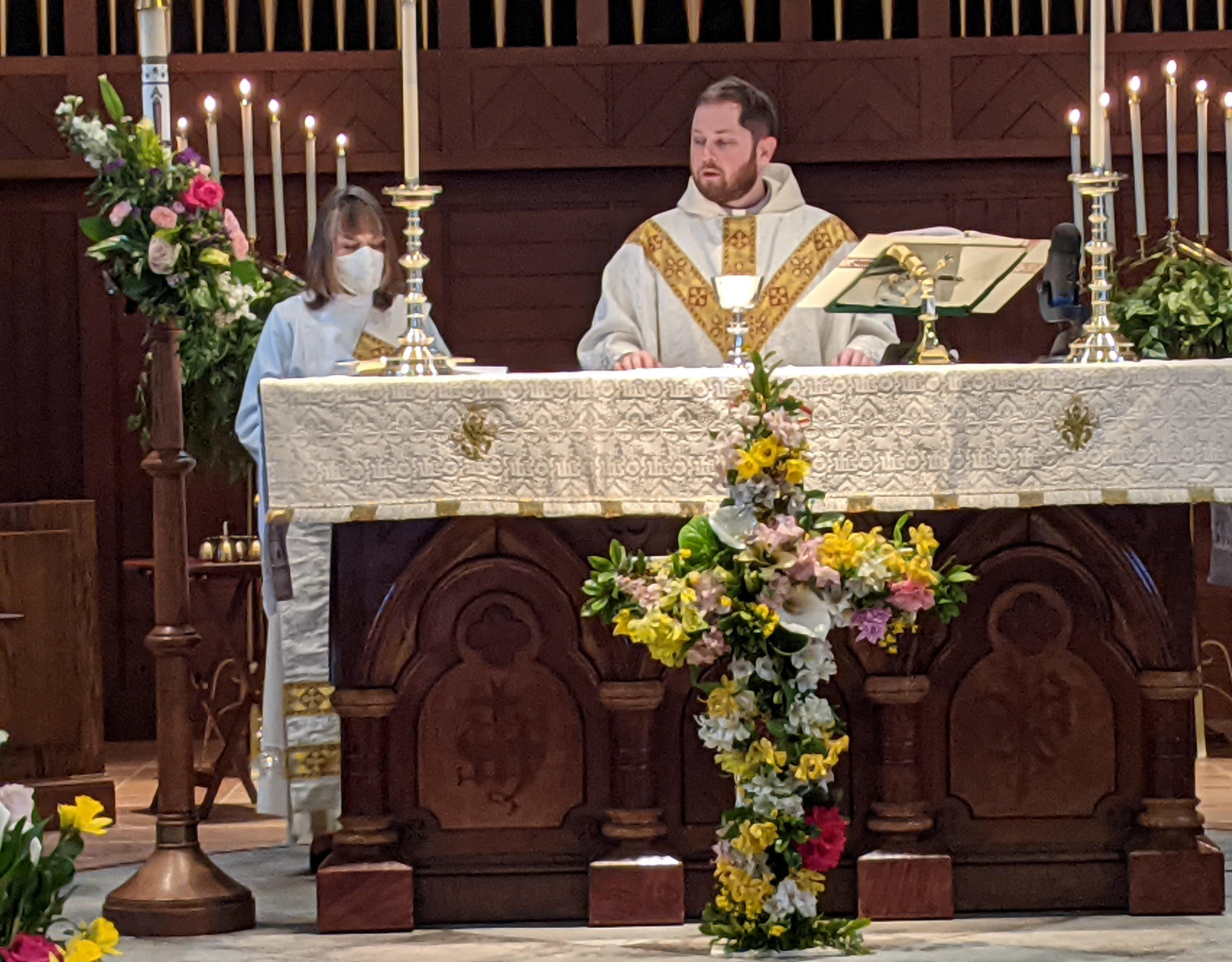
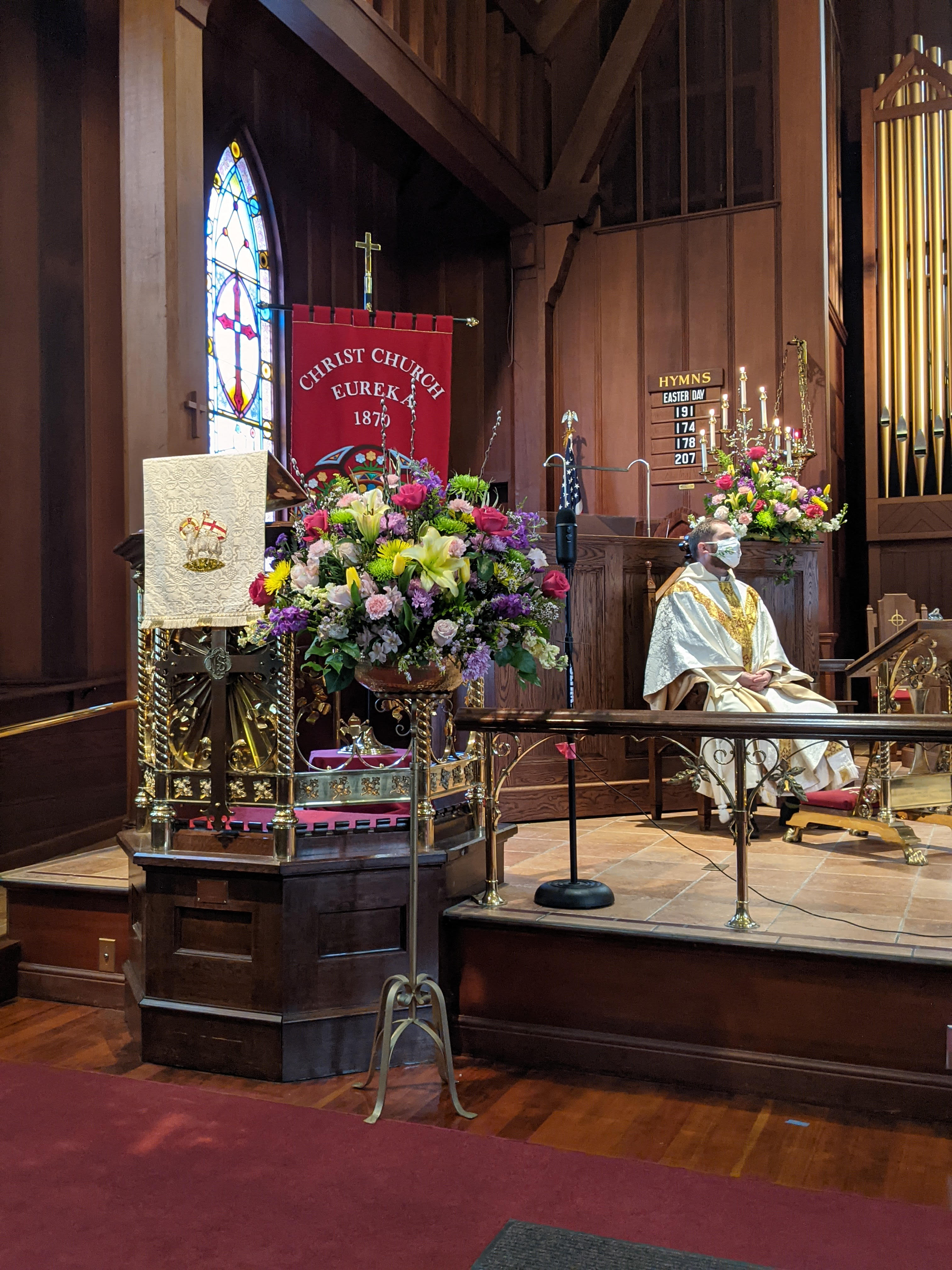
This sermon was preached at Christ Episcopal Church in Eureka CA on Easter Sunday April 4, 2021
Alleluia Christ is Risen! The Lord is Risen indeed. Alleluia! Happy Easter, everyone!
Ever since my first Easter here when this Great Feast of the Resurrection fell on April Fool’s day, I have been starting my Easter homilies with a joke. So, I continue the tradition today with a joke from the Vicar of Dibley that was shared with me by our beloved sister Josie Toy. It’s short and sweet and goes like this: Jesus said unto his disciples, “Come forth and thou shall receive eternal life.” But Thomas came fifth, so he got a toaster.
I’ll be tempted to repeat that next Sunday, which is “Thomas Sunday” when we read about St. Thomas the Apostle (our virtual verger’s namesake), but Bishop Megan will be guest preaching for us next Sunday, so I’ll try to refrain. But thanks for that, Josie!
Last night, we observed the Great Vigil virtually and celebrated the first Eucharist of Easter and you heard me preach about St. Mark’s unique slant on the Easter proclamation. If you didn’t watch the Great Vigil last night, I invite you to do so; it’s still available on YouTube. Now this morning, I want to say a little a bit more about Mark’s unique proclamation, but I’m going to try to keep it short so that we can get on with our Easter celebrations. I also want to keep it short because Mark knew how to keep things short. His is the briefest account of the Resurrection and yet it is jam-packed with meaning. As you heard me preach last night, fear seems to have the last word in Mark’s resurrection account and yet we know that Mark is teaching us the profound Gospel truth that even when we are overwhelmed with fear, God’s love and God’s life still win the day. Amen. Alleluia.
This morning, I want to suggest to you that Mark’s ending is not an ending at all, but a beginning, a crucial part of the great unfolding of God’s creation. We see clear references to new beginning and creation in this passage. Look at verse 2, the second sentence: “Very early, on the first day of the week, when the sun had risen, they went to the tomb.” This is the beginning of an entirely new chapter in God’s creation. The sun is rising on a new era. Can you feel it?
On the way, the women ask each other, “Who will roll away the stone for us from the entrance to the tomb?” In other words, how do we remove the heavy and painful reality of death, which binds us and confines us and separates us from those whom we love? How do we let go of our fear of death, which can be so overwhelming and manifest in so many different ways? How do we roll away the stone?
And then Mark says, “they looked up.” And this has been read as a reference to Abraham, who was trapped and confined in his own death-dealing theologies, which compelled him to nearly slaughter his firstborn son Isaac. But after being told by God to not lay a hand on his son, he looked up and what did he see? He saw the Lamb, which, as you know, is a symbol of God’s life overcoming death. And Abraham began to understand God as a God of life who overcomes death; and that same revelation becomes crystal clear for us and for the women when they look up and they see the massive stone rolled away from the empty tomb, a new symbol of God’s life overcoming death.
And the women are confused and, in many ways, so are we; and this confusion is expressed so well in the text, because Mark’s Gospel has no real conclusion. As theologian James Alison says, “Our [human] stories have a beginning and an end; and our capacity to tell stories depends on death, the great conclusion. Life has a beginning and an end. We don’t know how to tell stories where the apparent end is not really an end.” That’s not the way stories work. Stories need to end. So, the greatest story ever told ends up deconstructing our entire structure for stories in general, because it cannot be contained by the rules and confines of stories (which are informed by death, the ultimate conclusion).
Mark’s Gospel has no conclusion because Mark’s Gospel reveals that death is not the end. Death is not the conclusion. In fact, in many ways, it’s just the beginning. There’s a Bob Dylan song that brought me comfort as I was grieving the death of my father last year. My dad was a huge Dylan fan and Dylan himself had clearly experienced the presence of the Risen Christ in his life. The song is called “Death is Not the End” and in it, he sings, “When you’re sad and when you’re lonely, and you haven’t got a friend. Just remember that death is not the end…. When you’re standing on the crossroads that you cannot comprehend (like Mary, Mary Magdalene and Salome and perhaps many of us), just remember that death is not the end. And [when] all your dreams have vanished and you don’t know what’s up the bend. Just remember that death is not the end. Not the end, not the end. Just remember that death is not the end.” This is the Gospel Truth of Easter that unravels the way we tell stories and the way we understand reality. In fact, we’re still trying to make sense of it, two thousand years later.
Death is not the end. My father believed this. And so did Brenda Glyn-Williams and Josie Toy and Dottie Lewis and Jim Diebold and Judy Rex and Jeanne Fish and others we’ve lost during this long season of pandemic, when death seems to have dominated and overwhelmed us. Last year, on Good Friday, we were lamenting the deaths of 18,000 US lives. At the time, I don’t think any of us were expecting that number to grow to over 550,000, not to mention the nearly 3 million worldwide. Our hearts also grieve for those whose mental and emotional illnesses have been exacerbated by the collective trauma. We think of the tragic death of Helen Hui’s grandson Oliver. And we feel overwhelmed by the power of death and, like the women in the Gospel, we wonder how in the world we can possibly roll this heaviness away or even make it budge an inch. But then we remember that death is not the end. We remember that Mark’s Gospel has no real conclusion because it reveals the inconclusiveness of death for those who are in Christ.
This is why we, as a church, celebrate the feast days of saints on the day of their death because we know death is not the end, but a beginning. While the rest of the country celebrates Martin Luther King Jr. around his birthday in mid-January, we Episcopalians celebrate him especially on the day he died. Early morning April 4th, shot rang out in a Memphis sky, Free at last, they took your life, they could not take your pride because you knew death is not the end. We can all clearly see that death was not the end of Martin Luther King Jr, whose spirit and vision and words continue to inspire people throughout the world today and help usher in the Kin-dom of God among us.
As I conclude with these words of the Rev. Dr. Martin Luther King Jr. on this Easter Sunday (which falls on April 4th, King’s feast day in our calendar), may we experience his words like the words of Mark’s Gospel, which point not to an end but to a new beginning together, to the unfolding of creation, to the sun rising on a new era.
He says, “Death is inevitable. It is a democracy for all of the people, not an aristocracy for some of the people—kings die and beggars die; young [people] die and old [people] die; learned men die and ignorant men die. We need not fear it. The God who brought our whirling planet from primal vapor and has led the human pilgrimage for lo these many centuries can most assuredly lead us through death’s dark night into the bright daybreak of eternal life. His will is too perfect and his purposes are too extensive to be contained in the limited receptacle of time and the narrow walls of earth. Death is not the ultimate evil; the ultimate evil is to be outside God’s love” (126). And according to Paul, nothing can separate us from the love of God in Christ Jesus our Lord, who has rolled away the impossibly heavy stone and has broken the rules of all stories with the greatest story ever told, which speaks to each of us, saying, “When you’re standing on the crossroads that you cannot comprehend, just remember that death is not the end.”


 DANIEL DeFOREST LONDON