
Readings for Ash Wednesday
This sermon was preached at Christ Episcopal Church in Eureka CA on February 17, 2021.
On this first day of Lent, Jesus describes how we fulfill the great commandment, the three-pronged summation of the Law and the Prophets: “Love God, love your neighbor, and while you’re at it, love yourself” Jesus describes three spiritual practices, one for each prong of the great commandment. We love God through our prayer; we love our neighbors by giving generously to those in need; and we love ourselves by fasting, practicing moderation and delayed gratification, and by giving our bodies a much-needed break from the hard work of constantly digesting. We love ourselves by becoming more mindful and aware of what we choose to put in our bodies.
Now it’s important to remember that Jesus is not urging his listeners to start incorporating these practices into their daily lives. No, he assumes his listeners and followers are already doing this. He doesn’t say if you pray, fast and give; he says when [hotan] you pray, fast, and give, because anyone who claims to be a follower of Christ or a God-fearing human being is already doing these things on a regular basis. If we’re not already engaged in these practices, then these teachings of Christ can serve as a wake-up call to us, not to feel guilty, but to order our lives around loving God, neighbor, and ourselves through prayer, giving, and fasting. And there’s no better day to do this than today, Ash Wednesday, a day of prayer and fasting; and a day when we remember that a portion of whatever is given to the church is always given to those in need.
Jesus assumes we are already doing these things because the focus of his teaching is not on whether or not we are engaging in these practices, but on how we engage in them. If we pray, fast, and give in order to be seen by others and receive approval and applause, then we will forfeit the heavenly treasure and reward. Jesus says when you pray and give and fast do so in secret so that your heavenly Father who sees what is done in secret will reward you.
The Greek word for “secret” is krooptos, where we get the word “cryptic.” Jesus essentially teaches us to be cryptic about our acts of piety and devotion. He says, “When you pray, go into your room and shut the door and pray to your Father who is in secret (hidden); and your Father who sees in secret will reward you.” Now doesn’t this teaching of Christ speak directly to us today? as we learn to pray together from within our own rooms? The secrecy of our own rooms, where no one else can see us, where no one else can applaud us for our church-going piety? If you are praying with us today in your own room (living room or bedroom or whatever / live or asynchronously), you are directly obeying this foundational teaching of Jesus Christ on prayer. I know it might not seem ideal, but according to this teaching, this is the ideal way to pray: in your room.
Now I’m not downplaying the importance of the gathering of the saints and I eagerly await our regathering, but this is an opportunity. And I’m certainly not saying that God has caused this pandemic in order to get us to finally follow this basic teaching, but this is an opportunity. An opportunity for us to pray and fast and give when all the outward trappings of approval and social capital have been stripped away, when no one can see us, except God alone.
In many ways, this teaching of Christ is the seed that germinated and grew into the mighty, multi-branch tree of the Christian monastic tradition, which informed and inspired our own prayer book and liturgy. Back in the 4th century when Christianity became the official religion of the Roman empire, it became very easy for people to proudly display their piety to others and to essentially use Christianity as a tool for political power and social prestige. During this time, a young man named Anthony decided to take the teachings of Christ seriously. In order to avoid other people’s applause for his prayers, he prayed to the Father in solitude by going out into the deserts of Egypt, where he lived and fasted and prayed in a cave. He wrestled with his ego and his inner demons for years and then received reward from his heavenly Father. He received revelations of God’s love and was known to have said, “I no longer fear God, but I love Him. For love casts out fear.”

Soon thousands of others joined Anthony in the desert and monastic communities formed around collective rules of life that helped keep the desert monks accountable in their lives of prayer and fasting and giving. These rules of life reminded the desert monks that prayer is about God and not about us and how it makes us feel. The leaders of these communities became known as the Desert Fathers and Mothers, whom we will learn more about this Sunday. Anthony became known as Abba Anthony or St. Anthony the Great of Egypt. And although he understood the importance of community, Anthony kept returning to a life of solitude in order to follow this teaching of Christ: to pray to God intimately.
So when we pray now in our own rooms as you are doing, we are actually returning to our Christian roots. We are praying like the Desert Fathers and Mothers who prayed in solitude and who knew that prayer is about God and not about us.
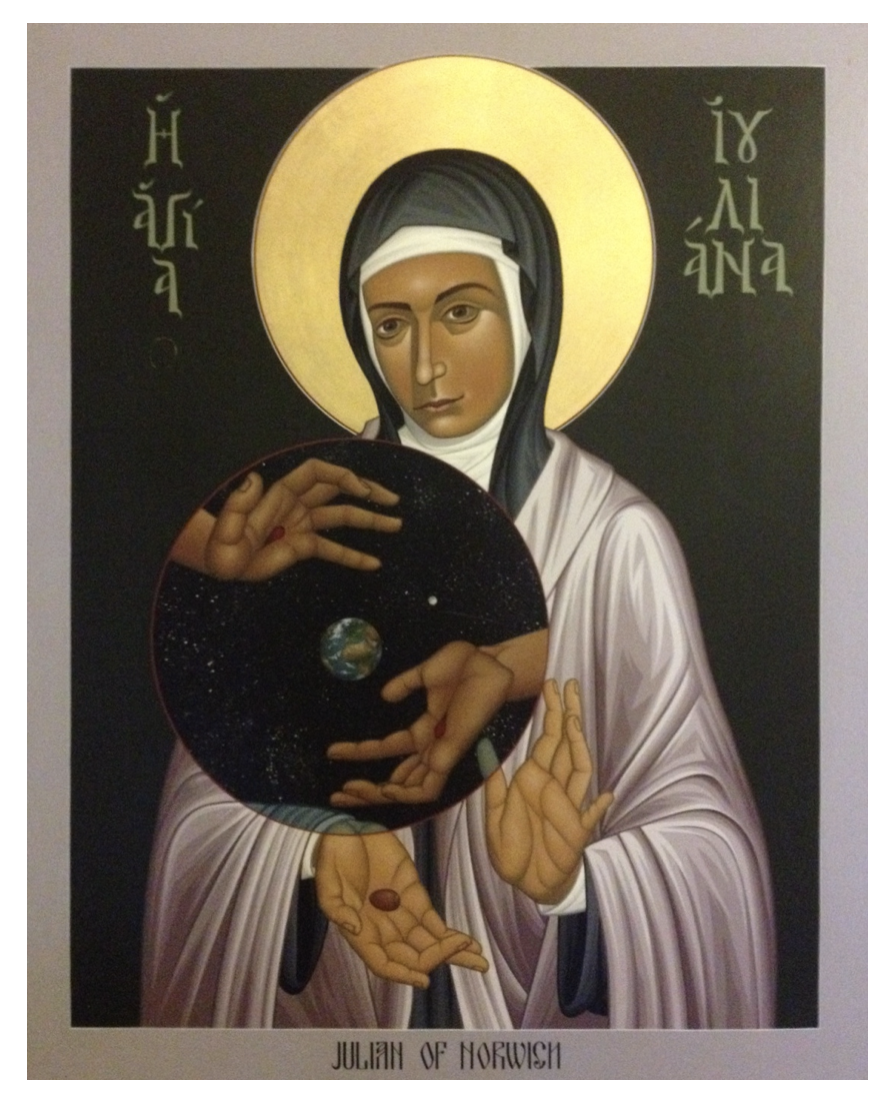
The monastic communities that emerged in the deserts of Egypt and Palestine began to grow and spread all across Western Europe and the British Isles. Over the centuries, the monastic world became more and more vulnerable to the seductive power of wealth, politics and social prestige; and it actually became harder for even monks to pray without seeking other people’s approval and applause. So there was a hunger for new ways to pray to God in intimate solitude during the middle ages. In the 14th century in England, one woman chose to pray to God in intimate solitude by isolating herself in a small room attached to a church called an anchor hold. This woman’s name was Julian of Norwich and she was alive during a pandemic that makes COVID-19 look weak. The pandemic known as the Black Death (or the Bubonic Plague) had wiped out about a third of the population of the Western world. Julian of Norwich chose to quarantine herself for her entire life. She had no companions in her small room except for perhaps a cat. And she could only interact with others through a screen. It wasn’t a computer screen; it wasn’t zoom, but it was basically the medieval equivalent. And she could only participate in Eucharist through a screen. The consecrated bread would be given to her through a slot in the wall.
Julian’s living conditions sound a bit like ours today, don’t they? And she chose these conditions not only because they were safe in the midst of a pandemic but because she felt like they provided the ideal environment for her to pray to God in intimate solitude, to experience God’s love and to interpret her experience of God’s love in such a way that she could then share it with others. Like St. Anthony of Egypt, Julian of Norwich received reward from her heavenly Father in the form of revelations of divine love. She experienced the Holy Spirit as a Mother; she experienced Christ as a Mother; she experienced the Godhead as a Mother; she experienced the Holy Trinity as a Mother holding her and assuring her that all shall be well. Although sin and suffering are real, all shall be well. Julian wrote about these experiences in what is believed to be the first English text written by a woman; and she is considered by many to be the greatest English theologian. She who prayed to God in secret.
As we enter this season of Lent, let us acknowledge the spiritual potential of this unique time. We are living in conditions that St. Anthony and Julian sought out. I honestly have a feeling that five years from now, when COVID is far behind us, we’ll look back at this time and think, “Although it was really rough, there were some real opportunities there to go deep into my own spiritual life; to pray to my heavenly Father who in secret; to spend an entire day in prayer and fasting; to spend an entire day resting in God’s maternal arms of love and trusting that all shall be well.” May we see this most unique Lent as a special opportunity to pray.
Last year, we had no idea how long we’d be in this season of isolation. Initially, we thought it might last just a few weeks. This year, the Regathering Task Force and I have decided that we will not be regathering until after Easter (at the earliest). So I invite us to make a plan this Lent to follow these teachings of Jesus: to go into our rooms and pray to God in personal intimacy; and to reconnect with the roots of our Christian tradition. I invite you to join Father Shewmaker for Centering Prayer on Monday nights and Deacon Anne for Healing Compline on Tuesday nights. I invite you to pray the Daily Office and to read Daily Devotions from Forward Day by Day. I’d love for us to read these together throughout Lent.
Let us love God, love our neighbors, and love ourselves by giving, fasting, and praying in secret to our heavenly Father who sees what is done in secret and who will reward us with the divine love of a mother who assures that all shall be well. Amen.

 DANIEL DeFOREST LONDON