
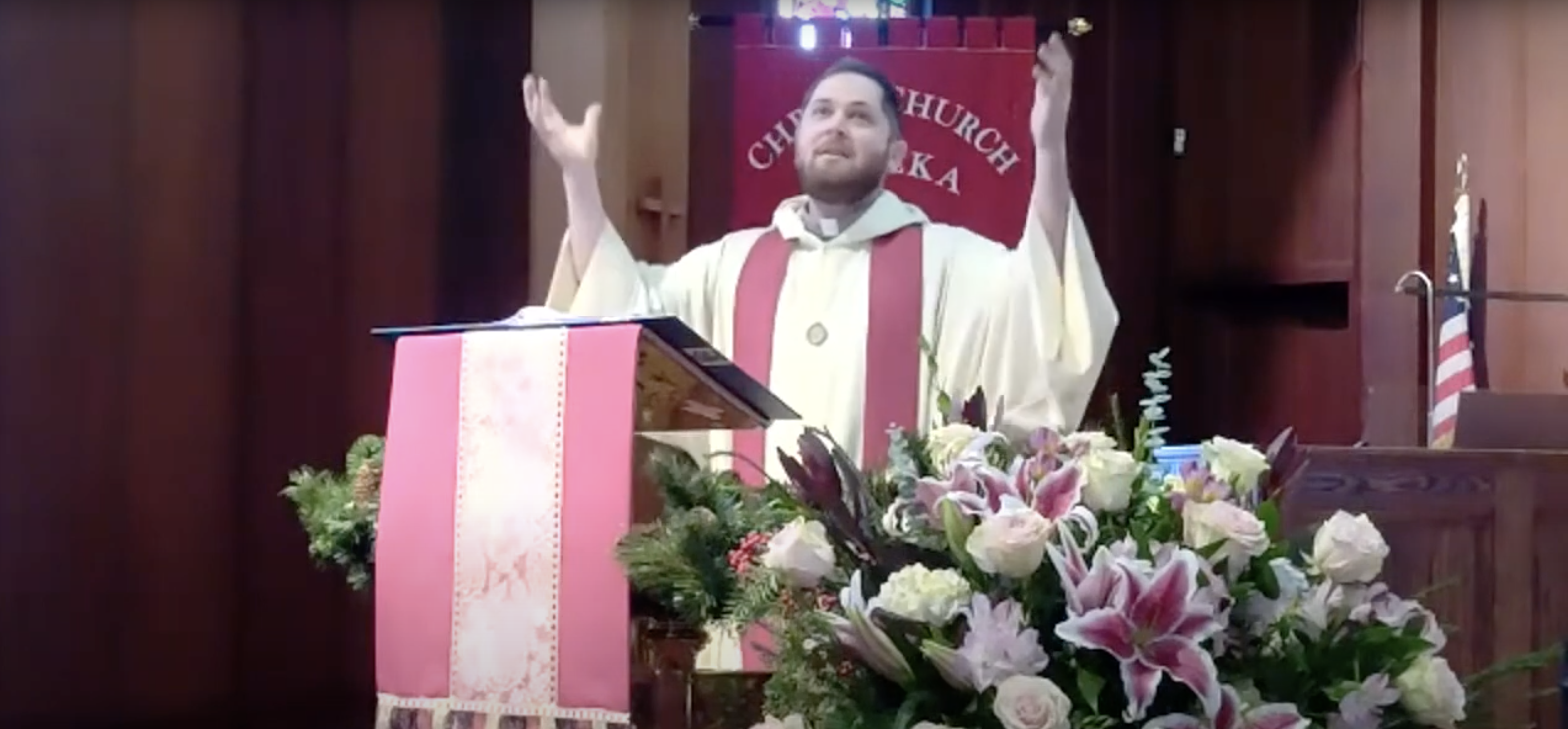
This sermon was preached at Christ Episcopal Church Eureka on Sunday December 13, 2020.
Readings for the Third Sunday of Advent – Gaudete Sunday (Year B)
On this Third Sunday of Advent, we light the pink candle of joy and we get to wear the rose -pink vestments because this is Gaudete Sunday. Gaudete is Latin for “Rejoice!” and we hear that theme in our reading from Isaiah who says, “I will greatly rejoice in the LORD, my whole being shall exult in my God” (Isaiah 61:10). Also, our canticle this morning is based on the Magnificat of St. Mary whose spirit rejoices in God her Savior (Luke 1:46). And in Thessalonians, Paul urges his readers to “pray without ceasing, to give thanks in all circumstances, and to rejoice always” (1 Thessalonians 5:16).
This Sunday derives its name from the traditional introit, the words spoken by the priest on the way to the altar, words from Philippians 4: Gaudete in Domino semper: item dico, Gaudete! “Rejoice in the Lord always and again I say rejoice!” (Phil 4:4). St. Paul and most of the authors of Scripture believed in beneficial redundancy, consistently repeating this most frequent command: rejoice! The lectionary organizers also seem to believe in beneficial redundancy since the Gospel reading for this Sunday is essentially a repetition of last Sunday’s Gospel about John the Baptist, with just a few more added details.
The authors of Scripture and the lectionary organizers knew that repetition is important because we don’t always hear things the first time or even the first twenty times. And even when we do hear something the first time, we don’t often remember. I recall preaching at one of my former congregations on the First Sunday of Advent about the dual meaning of the season. I explained that Advent is not just about waiting for the arrival of the Christ Child at Christmas; it’s also about waiting for the return of Christ in his Second Coming, his Second Adventus. I remember repeating that point several times in the homily.
On the next Sunday, the Second Sunday of Advent, I invited one of my friends to guest preach, a friend who had recently been ordained as a Zen Buddhist priest. It was partly my way of honoring the Feast Day of Thomas Merton, that beloved Christian monk who studied and practiced Zen. And my friend did some research on Advent and learned about its double meaning and ended up preaching on the fact that Advent is the season when we wait both for the arrival of the Christ Child as well as for the Second Coming of Christ. After the worship service, many congregants told me how new this concept was to them, how they had never heard anyone preach about the double meaning of Advent before in the entire Episcopal Church; and they were surprised that it took a Zen Buddhist to teach that to them. I was glad that they had learned something new from our Zen Buddhist guest even though I had made that same point the previous Sunday. Of course, it is beneficial for us to hear different voices; and we do tend to see our own tradition with new eyes when we learn from someone who comes from an outside perspective, but that experience also reminded me about the importance of repetition. Rejoice in the Lord always and again I say, rejoice! Advent has two meanings and again I say Advent has two meanings.
Now that you all will never forget that Advent has two meanings, I’m going to let my friend Thomas Merton, the Zen Buddhist Christian, teach us that there is actually a third meaning to Advent. In his book Seasons of Celebration, Merton writes, “The first Advent is that in which [Christ] comes to seek and to save that which was lost. The [second] Advent is that in which He comes to take us to Himself. The first is a promise and the [second] is a fulfillment. To meditate on these two Advents is to sleep between the arms of God with His left hand under our head and His right hand embracing us.”[1]
“But,” Merton continues, “so far we have only spoken explicitly of the [two Advents]. The [third] is in a certain sense the most important for us. The ‘[Third] Advent’ by which Christ is present in our souls now, depends on our present recognition of [the movement] of Christ through our world, through our own lives…Meditating on the past and future Advents, we learn to recognize the present Advent that is taking place at every moment of our own earthly life.”[2]
During Advent, we celebrate the Adventus of Christ who came, who will come, and who is coming to us right now in the sacrament of this present moment. And with each of these comings, we are given reason to rejoice (Gaudete).
The first Advent invites us to look back on all the blessings that have been poured out upon us, thanks to the coming of the Christ Child. Although church history certainly has a checkered past (and people have done and still do atrocious things in Christ’s Name), I am convinced that Christ’s first coming has ultimately brought more healing into this world than any of us could ever measure or imagine. The first Advent invites us to reflect on the ways that our own personal spheres have been blessed with peace and joy thanks to Christ and his coming into our lives. We may think of a conversion experience or our baptism or a friendship or moments when we felt touched by Christ here in this sanctuary as we gathered together as his body. Christ has come into this world and into our lives; and Advent is a season when we rejoice and remember the ways God has satisfied our longings and rewarded our patience by fulfilling our hopes and dreams.
Advent is the season when we continue to wait for the return of Christ. As we say, “Christ has died, Christ is risen, Christ will come again.” We don’t know exactly what the Second Coming of Christ will look like or when it will happen, but we wait. And right now, we are encouraged to wait for the Adventus of Christ’s healing power in the form of a vaccine that will allow us to gather here safely once again. Now more than ever we must wait! As COVID cases rise in Humboldt County more rapidly than ever before, we must wait and remain patient and stay inside our homes as much as possible. We’re all fed up with this virus and many of us were fed up several months ago, but now is the time when we must enter fully into the Advent season by waiting and watching and praying for Christ and his healing power to come in the form of a vaccine. Come, Lord Jesus! Maranatha! And when that time comes, we will receive the oil of gladness (instead of mourning), as Isaiah says, the mantle of praise instead of a faint spirit. We will sing at the top of our lungs and raise the roof of this church or “rock the roof” as I said at Pentecost; and rejoice like never before!
Christ came and Christ will come and Christ is coming to you now in the Advent of this present moment. Can we meet and receive him here, now? The darkness around us continues to grow, literally as we approach the longest night of the year, and spiritually as sickness, death and political division metastasize. But when the shadows of darkness fall, the stars appear, and we notice lights that remain hidden during the day. The darkness is indeed frightening, and it demands our caution and care, but it also makes it possible for us to see the glorious stars that hide from our vision during the day. The Advent of the present moment invites us to reflect with gratitude upon all the gifts that have become more apparent to us right now like stars in the night sky, gifts that had previously remained hidden from our sight or that we had simply taken for granted. Pay attention and follow those stars because they will lead you, like the Magi, into the presence of Christ, whose joy will be your strength. Rejoice in the Advent that was and is and is to come and again I say rejoice. Amen.
[1] Merton, Seasons of Celebration, 75 – 76.
[2] Merton, Seasons of Celebration, 75 – 76.

 DANIEL DeFOREST LONDON