
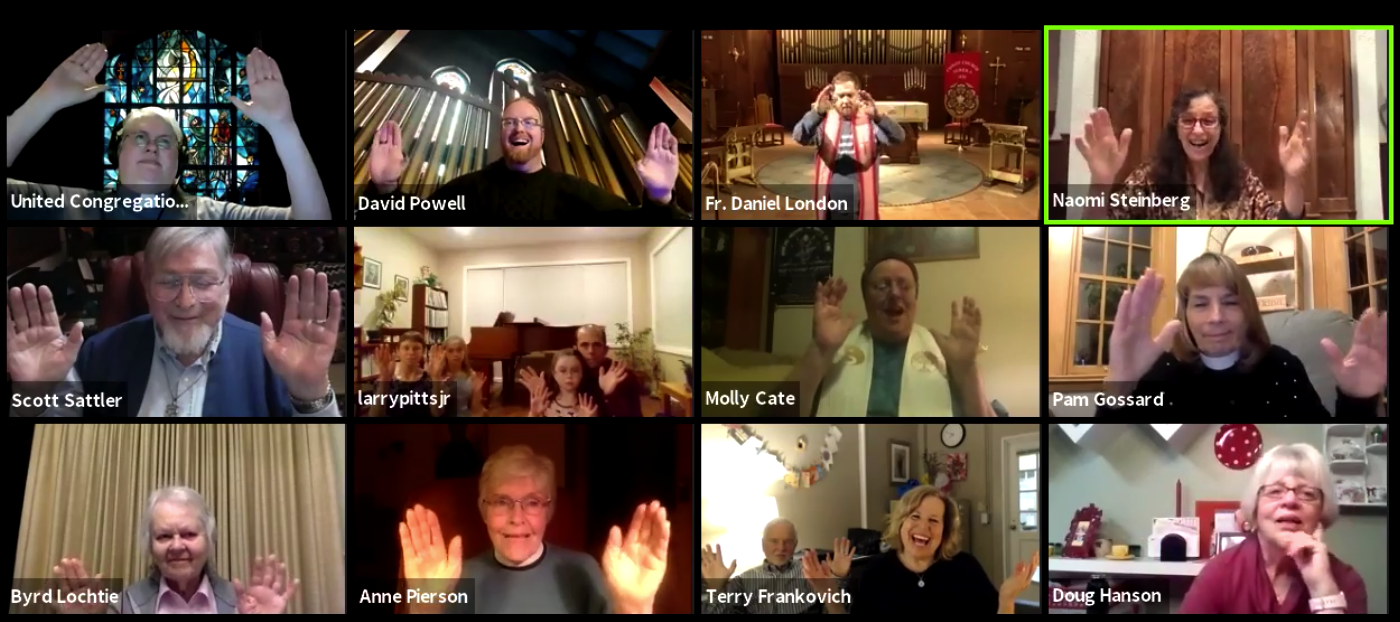
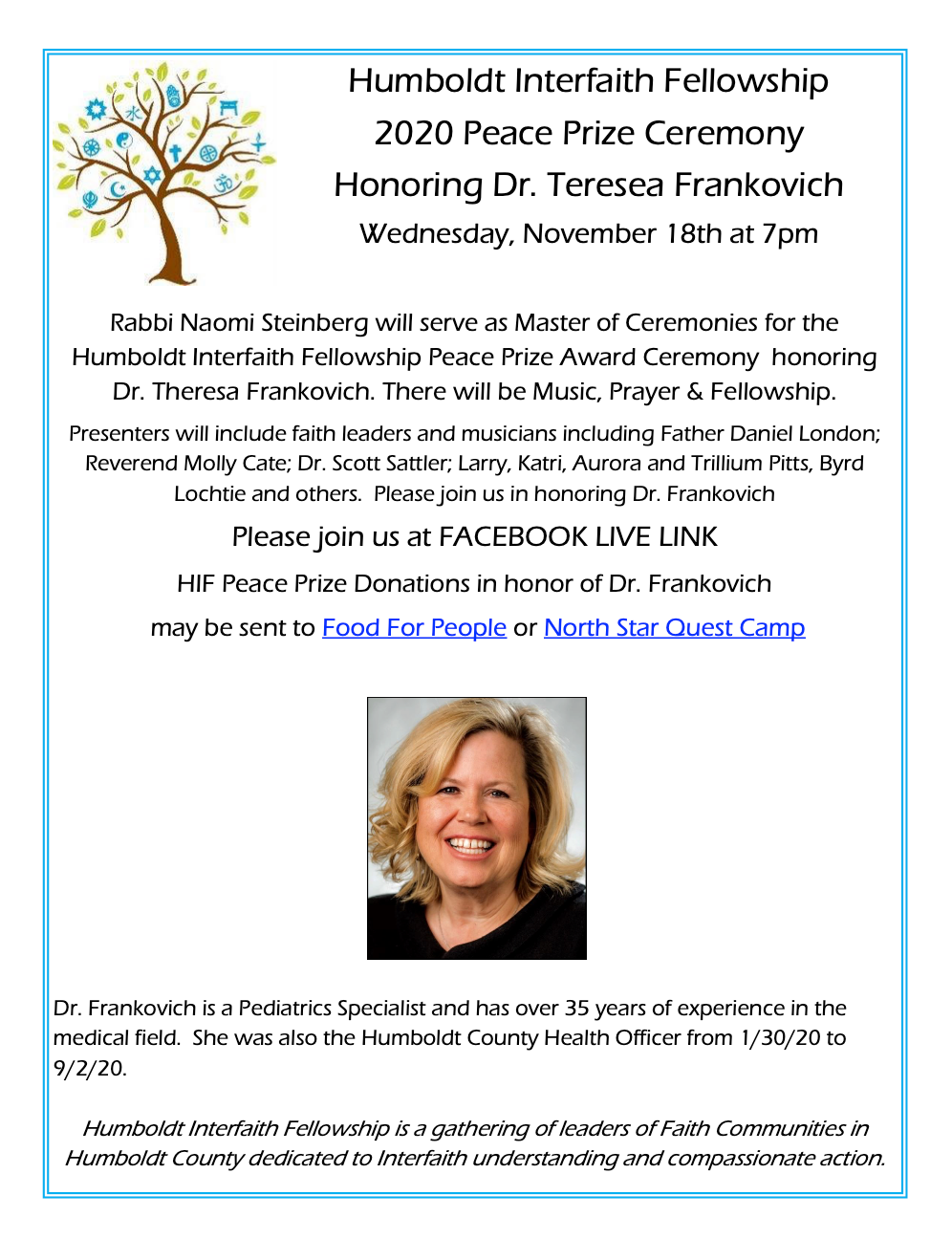
This reflection on peace was presented at the Humboldt Interfaith Fellowship Peace Prize Award Ceremony, honoring Humboldt Public Health Officer Dr. Teresa Frankovich.
Watch the entire ceremony here.
I want to begin with a fairly provocative statement attributed to Jesus of Nazareth, who in Matthew’s Gospel, says, “Do not think that I have come to bring peace to the earth. I have not come to bring peace, but a sword” (Matt 10:34). These are provocative words indeed since Jesus is known by Christians as the Prince of Peace (Isaiah 9:6).
Now in Jesus’s lifetime, the Roman empire reigned supreme, allowing many of the rich and powerful to comfortably enjoy what was called the Pax Romana, the Peace of Rome, the peace of the status quo which was built mostly upon violence and marginalization of the poor and vulnerable. This was the kind of peace that Jesus ultimately rejected in his life and ministry; and eventually Jesus was killed by the empire because of the threat he posed to this peace of the status quo.
As a Jewish prophet, Jesus was informed and inspired by the rich, Hebrew concept of Shalom, which is Hebrew for “Peace,” but it is not the Peace of Rome, not the Pax Romana. Rather, it is a holistic peace for all people, including the weak and vulnerable. Jesus preached about shalom all the time by talking about the Kingdom of God, using parables and metaphors. In fact, for mainline Christian denominations, the Gospel reading for this upcoming Sunday (which is a major feast on the Episcopal church calendar – Christ the King Sunday), Jesus describes the Kingdom of God and the Reign of Shalom by distinguishing between two types of people in a parable.
The sword that Jesus said he came to bring was not a sword of violence and destruction, but a sword of discernment, much like the Buddhist concept of “the Sword of Manjushri,” which is a sword of wisdom that helps discern and distinguish and cut ignorance. In the parable for this upcoming Sunday (in Matthew 25), Jesus uses this kind of sword of wisdom to discern and delineate between those who practice Shalom (the true peace of God) and those who do not. And the distinction that Jesus makes is not between conservative and liberal. It’s not a political distinction and it’s not even a distinction between Jew and Gentile or Christian and non-Christian. These categories don’t seem to matter much to Jesus; and perhaps they shouldn’t matter so much to us either.
For Jesus, the only key distinguishing characteristic of the Shalom people (who stand out among all the rest and who eventually inherit eternal life) is that they care for others, especially the weak and vulnerable. We get to participate in the Shalom of God’s Kingdom by caring for the vulnerable among us. And we do that by relying on God’s grace, by making appropriate sacrifices, and by transforming the human race into the human family.
So when Jesus said, “Do not think I have come to bring peace,” he was essentially saying, “I have not come to affirm the status quo. No, I have come to show you how to be radical people of Shalom by caring for others, especially the weak, even when it is difficult and inconvenient because that is how we embody the peace of God’s Kingdom.” This invitation is especially relevant for us now as we endure a pandemic that has proven to be the most dangerous and lethal within our vulnerable communities. It is by heeding this invitation that we become faithful to our true selves, our true identity as children of God. As Pope Francis said, “Rivers do not drink their own water; trees do not eat their own fruit; the sun does not shine on itself and flowers do not spread their fragrance for themselves. Living for others and caring for others is a rule of nature.” And it is the one great law of God’s peace-filled kingdom.
We in Humboldt County have been blessed by the wisdom and courage of Dr. Teresa Frankovich who, like Jesus of Nazareth, has urged us to be people of Shalom by caring for each other and protecting vulnerable communities, even when it might be inconvenient. And she has walked alongside us with patience and grace, helping us to embrace and embody the true Shalom of God. And so, as we approach the holidays (Thanksgiving, Bodhi Day, Hanukkah, Winter Solstice, Christmas, and Kwanzaa), may we all honor the diligent work of Dr. Frankovich by continuing to care for each other even when it involves sacrifice and thus live into our true identity as people of God’s Shalom.


 DANIEL DeFOREST LONDON