
This sermon was preached at Christ Episcopal Church Eureka for Christ Episcopal Church in Sausalito CA on their Consecration Sunday November 15, 2020.
Readings for the Twenty Fourth Sunday after Pentecost (Proper 28 – Year A)
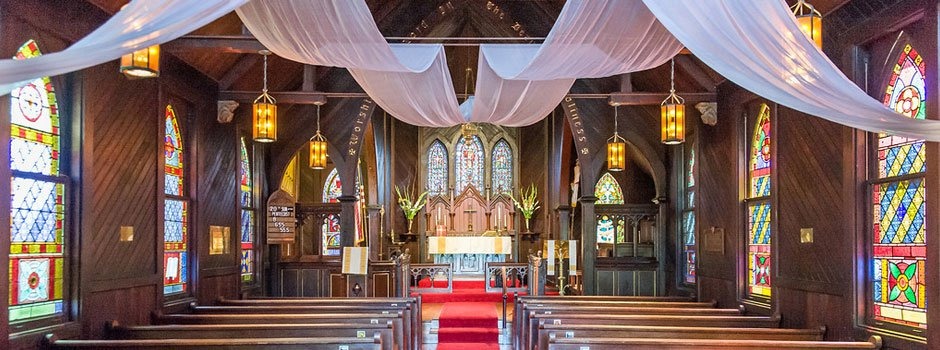
Greetings to you, my Christ Church Sausalito friends! For those who don’t know me, I’m Fr. Daniel London and I’m coming to you from the other Christ Episcopal Church in California that is also blessed with a sanctuary of old growth redwood, wood that was alive at the same time that Jesus Christ was teaching and telling parables, like the one we just heard read by Deacon Alberta. And our stained-glass windows were designed by John Mallon, who I believe designed the stained-glass windows at your church as well. In fact, some of my favorite things about Christ Church Eureka are those things which we share with Christ Church Sausalito, including a warm and welcoming community that feels like family and that is family. I personally still feel part of the Christ Church Sausalito family. I was just remembering that my brother carried the Christ Church Sausalito banner at my ordination to the priesthood in LA seven years ago; and Facebook just reminded me that Deacon Alberta guest preached at Church of the Redeemer when I was serving as priest in charge there three years ago exactly; and I hope you all know that you have family up here and we’d love for you to visit in person, on the other side of COVID.
One thing that you won’t see here which you do see at Christ Church Sausalito is an inscription written on the chancel archway. I always appreciated this inscription at Christ Church Sausalito because the words are an invitation into a spiritual practice that can instantly bring joy to the practitioner. The more we heed this invitation and practice this discipline the happier and more joyful we will become. In fact, studies have shown that this practice actually changes the molecular structure of the brain and makes us healthier and feel more at peace.[1] And this spiritual practice makes us experience overflowing abundance in our lives. I imagine you are wondering what spiritual practice I am referring to; and I wonder if you know or remember what inscription is written on the chancel archway at Christ Church Sausalito? (I’m sure Jerry Taylor knows).
The inscription reads, “Worship the Lord in the beauty of holiness” (Psalm 96:9). I love the inscription because it invites us to acknowledge the beauty that is all around us and because it urges us to do what the Bible urges us to do more than anything else. More than any other commandment in Scripture, the Bible summons us to worship the Lord, to give God our thanks and praise. And that is the spiritual practice that has been proven to enhance and improve our lives: the practice of gratitude. A practice that is at the center of our identity as Episcopalians who celebrate Eucharist (which means Thanksgiving), the sacrament that reminds us to give God thanks because it is right and a good and joyful thing, always and everywhere.
The Sufi Mystics have a saying, “Abundance can be had simply by consciously receiving what has already been given.” Gratitude helps us to see and attend to the ten thousand gifts that are lavished upon us each day, which we so often overlook: every breath we breathe, every moment we share with loved ones, even a simple sip of hot coffee or tea, which you might be enjoying this morning or this afternoon.[2] When it is so tempting these days to fall into despair and to even dread this life in the fear of scarcity, Christ Church Sausalito reminds us to worship the Lord in the beauty of holiness, to give thanks for the beauty that we so often overlook.
I’m reminded of Thornton Wilder’s play Our Town, when one of the main characters Emily Webb dies and then asks to relive one more day of her earthly life. She is given this opportunity and, as she relives one particular day (her 12th birthday), she realizes the overwhelming beauty of each moment and she sees how oblivious humans often are to the wonder that is all around them. She finally can’t bear it anymore and says, “I can’t. I can’t go on. It goes so fast. We don’t have time to look at one another. I didn’t realize. So all that was going on and we never noticed. Take me back — up the hill — to my grave. But first: Wait! One more look. Good-bye, Good-bye world. Good-bye, Grover’s Corners…Mama and Papa. Good-bye to clocks ticking…and Mama’s sunflowers. And food and coffee. And new ironed dresses and hot baths…and sleeping and waking up. Oh, earth, you are too wonderful for anybody to realize you.” Then she looks at the Stage Manager and asks him, “Do any human beings ever realize life while they live it – every, every minute?” And the Stage Manager answers, “No.” (pause) “The saints and poets, maybe—they do some.”[3]
According to Thornton Wilder, the saints and poets might be the only ones who realize the beauty of life while they live it. That’s because they know how to worship the Lord in the beauty of holiness by practicing the discipline of gratitude and expressing that gratitude through generosity.
In this morning’s parable of the talents, Jesus shows us what it looks like to live a life of gratitude and to worship God in the beauty of holiness. He does this by contrasting a life of gratitude with a life marked by fear and dread. The first two servants receive several talents from their master. Now a talent is a measurement of weight for gold or silver; and one talent was about 40 kilograms or about 90 pounds. So a talent is an enormous amount of money, probably equivalent to about a million dollars today. The first two servants who receive talents from their master behave as if their master is a generous and joyful giver of blessings and riches who wants them to take risks and to invest in relationships of mutual sharing and benefit. This becomes clear in the parable when the master rewards them for their profit and ingenuity and says to them both, “Enter into the joy of your master.” Enter into the joy of your master. They experienced their master as joyful, as one who delighted in them and who took joy in them; and they understood the abundance that was lavished upon them as an expression of their master’s joy, which was meant to be shared and multiplied among others.
The last servant, however, did not experience his master as joyful and generous even though he was still given about a million dollars. He failed to notice the abundance he was given and the potential for that abundance to grow through sharing with others. He believed his master to be harsh and punishing and so he dug a hole and hid his master’s gifs in the ground. In Matthew’s Gospel, Jesus consistently urges us not to hide the gifts we have been given. Remember in the Sermon on the Mount when Jesus refers to his followers as the Light of the world. The light that God has generously given each of us is not to be hidden under a bushel basket but placed on a lampstand to give light to all in the house, to shine and to share with others, so that others give glory to God in heaven and enter into the joy of the master. So that others worship God in the beauty of holiness, rather than dread this life in the fear of scarcity
When we dread this life in the fear of scarcity (which we are so often tempted to do), we can easily fall through the downward spiral through which the last servant falls. We can start thinking of God as a harsh and punitive and unjust deity who sees us as wicked and lazy and worthless slaves. And when we start falling down that hole, we enter into the darkness of jealousy and envy, thinking that everyone else has more than us. And we fail to see the abundance that is right in front of us. We see that psychology of scarcity play out in this parable. It’s not that God is a harsh master who condemns us to hell for not making enough money. Certainly not! Jesus is showing us the psychological consequences of dreading this life in the fear of scarcity and believing in a cruel God who thinks that we are wicked and lazy slaves.
At the same time, Jesus shows us the psychological benefits of receiving the abundance that has already been given and of believing in a God who is joyful and generous, who delights in us and is proud to call us his own. Jesus shows us the psychological and spiritual benefits of giving thanks and worshipping God in the beauty of holiness.
Today, on this Consecration Sunday, we have an opportunity to enter more fully into the joy of the master. We have an opportunity to heed that invitation inscribed on your chancel archway and to share and multiply the abundance that has already been given. We express our gratitude for God’s gifts by letting God’s generosity flow through us and by giving back to God, who gave us everything in the first place.
In the midst of a global pandemic and political division and problems in our personal lives, it is easy and tempting to dread this life in the fear of scarcity. But Jesus shows us where that leads: to darkness and bitterness, jealousy and self-loathing. The Gospel invites us to worship God in the beauty of holiness by counting our blessings and sharing that abundance with the beloved community.
As I shared on Monday night with the vestry and leadership of Christ Church Sausalito, there is no better investment in the world than an investment in the church because the church is the embodiment of God’s love in Jesus Christ, the church is the embodiment of the joy of the master. And when you give to Christ Church, you are also feeding the hungry and supporting children through local ministries and making a profound difference in the lives of individuals who are in need. You are transforming the human race into the human family. You are refusing to dread this life in the fear of scarcity and choosing to the worship the Lord in the beauty of holiness. So I urge you to give generously to Christ Church, more so than you have ever given before; and then be prepared to experience and receive the joy of the master. Amen.
[1] https://www.collective-evolution.com/2019/02/14/scientists-show-how-gratitude-literally-alters-the-human-heart-molecular-structure-of-the-brain/?fbclid=IwAR1dfA5s6sHLguvZZFFxNdLqm5inLsW1FbFaBb5vuI5ti-ahZc6u_KgYGXg
[2] “Thou that hast given so much to me give me one thing more, a grateful heart: not thankful when it pleaseth me, as if Thy blessings had spare days, but such a heart whose pulse may be Thy praise.” – George Herbert
[3] Thornton Wilder, Our Town: A Play in Three Acts (New York: HarperPerennial, 2003), 108.

 DANIEL DeFOREST LONDON