
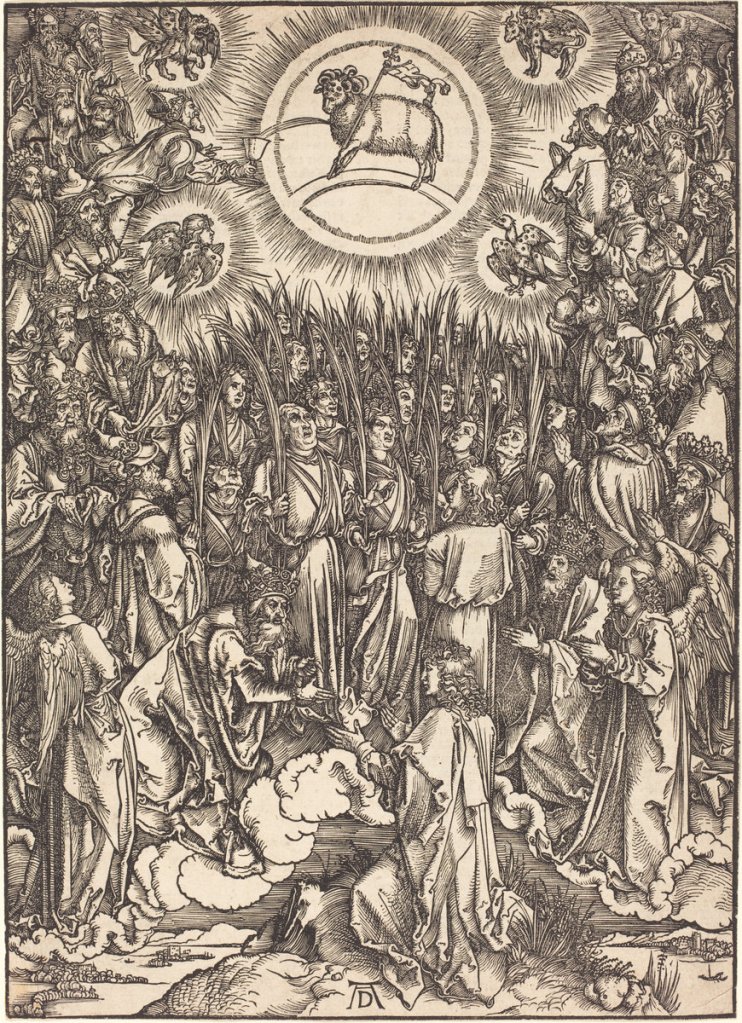
This sermon was preached at Christ Episcopal Church Eureka on All Saints Sunday November 1, 2020.
Readings for the Feast of All Saints (Year A)
“Who are these, robed in white, and where have they come from?” … “These are they who have come out of the great ordeal; they have washed their robes and made them white in the blood of the Lamb.” Revelation 7:13-14
Happy Feast of All Hallows! I love the Scripture readings assigned for this great feast day of All Saints: a reading from the Book of Revelation about saints gathering from all tribes and nations to worship the Lamb; a psalm that reminds the saints that when we revere the LORD we lack nothing; the Johannine Epistle that calls us to behold what manner of love the Father has given unto us, that we may be called the children of God; and in finally, the Beatitudes, the poetic prelude to the most powerful sermon ever preached, the Sermon on the Mount.
This year, the phrase that resonates most deeply for me is the description of the saints in Revelation as those “who have come out of the great ordeal.” This resonates for me on a couple levels. On a somewhat superficial level: yesterday morning’s rehearsal for this service felt a bit like a “great ordeal,” full of unexpected glitches, but I’m glad that we all came out of it in one piece; and I’m so honored to be worshipping with some of the living saints of Christ Church Eureka in our sanctuary right now, as we begin a new phase in our regathering. On another more serious level, we are all in the midst of a great ordeal right now, as a global community and as a nation. COVID-19 cases are skyrocketing in the US after nine months of sheltering in place. And many of us are still reeling from social unrest, destructive wildfires, job loss, grief, profound loneliness, and deep division in our country as we approach Election Day in just a couple days, feeling a strange concoction of fear and hope.
We are in the midst of a great ordeal indeed; and we will come out of it because God is faithful and because the saints and all the faithful departed are with us, encouraging us along the way. I really mean that; and I really feel that, especially here and especially during these days of the Fall Triduum, when the veil between time and eternity becomes more transparent diaphanous[1]: the days of All Hallows’ Eve, All Hallows’ Day, and All Souls Day.
You’ve heard me say (many times) before that the saints and angels join us when we worship God. However, that’s entirely true. What’s really happening is that we are joining them. We are becoming part of the Great Rejoicing, the Great Hymn of Praise being sung by saints and angels and all the hosts of heaven; and if you listen closely, you can hear that same song of praise being sung by the birds, by the ocean waves, and by the trees as the wind blows through their branches. We hear that song being described in Revelation and we even get to read some of the lyrics of the eternal hymn: “Amen! Blessing and glory and wisdom and thanksgiving and honor and power and might be to our God forever and ever! Amen.” And we see that the saints are worshipping the Lamb who is also the Shepherd. These two symbols are the two great symbols of Christ that we use here at Christ Church (our primary symbols): the Lamb and the Shepherd. We have the redwood lamb medallion in Lewis Hall (made by Earnest Pierson) and I’ve always wanted a portrayal of the Lamb on this back wall so that we can enter more fully into the saints’ eternal worship of the Lamb and the Shepherd.
What does it mean to say that the Lamb is also the Shepherd? Well, you’ve heard me preach many times about the Lamb and so you know that the Lamb represents God’s self-giving and overflowing love. It is that divine love (expressed in the Lamb) that reigns upon the throne and it is that love that guides us and leads us and directs us as our Good Shepherd. And it is that love that inspires the eternal hymn of glory.
We enter into the Great Rejoicing of all the Heavenly Saints through our Holy Liturgy, which is not just some set of rituals that we blindly follow. No, the liturgy is the eternal song and dance that is being enacted in heaven as we speak; and it is through the liturgy that heaven and earth coincide and kiss. I’ve heard many people share with me how much their soul misses participating in the liturgy (especially the Eucharist). That’s because we are in communion with the saints through our liturgy and our souls are being nourished by the Bread of Angels. This is why I’m so thrilled that you will be able to partake of the consecrated bread with us at home today. Participation in the liturgy and the sacraments is a sure and certain way to fellowship with our loved ones who have passed on. That is partly why we here at Christ Church give so much care and attention to our liturgy.
We also know that God does not limit himself to the liturgy and the sacraments; there are patterns of countless ways that God reaches out to us and brings us into fellowship with him and the heavenly saints, as long as our hearts are open. The early 20th century English theologian Evelyn Underhill said, “God is always coming to you in the sacrament of the Present Moment. Meet and receive him there with gratitude.”
One invitation I keep receiving during the season of All Saints and All Souls is the invitation to develop habits and attitudes that help me to be present and to receive God and God’s heavenly hosts with gratitude in the sacrament of the present moment. That’s what the Beatitudes are all about. They are attitudes that help us be; attitudes that help us to be present to God and the saints here and now, and every day. And these attitudes can help us live into our own sainthood.
In Thornton Wilder’s play Our Town, one of the main characters Emily Webb dies and then asks to relive one more day of her earthly life. She is given this opportunity and, as she relives one particular day (her 12th birthday), she realizes the overwhelming beauty of each moment and she sees how oblivious humans often are to the wonder that is all around them. She finally can’t bear it anymore and says, “I can’t. I can’t go on. It goes so fast. We don’t have time to look at one another. I didn’t realize. So all that was going on and we never noticed. Take me back — up the hill — to my grave. But first: Wait! One more look. Good-bye, Good-bye world. Good-bye, Grover’s Corners…Mama and Papa. Good-bye to clocks ticking…and Mama’s sunflowers. And food and coffee. And new ironed dresses and hot baths…and sleeping and waking up. Oh, earth, you are too wonderful for anybody to realize you.” Then she looks at the Stage Manager and asks him, “Do any human beings ever realize life while they live it – every, every minute?” And the Stage Manager answers, “No.” (pause) “The saints and poets, maybe—they do some.”[2]
The saints and poets, maybe –they do some.
“God is always coming to you in the sacrament of the Present Moment. Meet and receive him there with gratitude.”
The Beatitudes are attitudes that help us be present to God and to all the saints here and now. Blessed are the poor in spirit. Blessed are the meek for they shall inherit the earth. In other words, you will be a lot happier when you take yourself and your ego less seriously. Blessed are those who hunger and thirst for righteousness; blessed are the merciful; blessed are the pure in heart, blessed are the peacemakers. In other words, have an open mind, practice generosity, be honest, strive for peace and justice among all people, and take some risks for the sake of righteousness. Rejoice and be glad. Practice gratitude. These are the practices and the attitudes that help us be present to God and the saints and that help us discover and live into our own sainthood.
And blessed are those who are human enough to grieve and to mourn, for you will be comforted. I often feel tears well up within me when I look out into these pews and see the faces of Jim Davis, Dan Vega, Pat Toy, Jill Stover, Jeanne Fish, and Irene Hannaford (who just beams her smile at me from her pew). Although I feel sad because they are no longer physically here, I feel tremendously comforted by their radiant presence. They are now counted among those who have come out of the great ordeal and they now encourage us in the midst of our current ordeals. I feel the sturdy presence of Fr. Charles Farrar here, the rector who guided this parish through the last global pandemic. I sense the presence of Fr. Doug, the last long-term rector; and I feel the presence of my own father shining his love and light upon me (and us).
Whose benevolent presence do you feel on this All Hallows’ Day? What attitudes do you cultivate to remain open to receiving God and the saints, who reach out to you in love, in the sacrament of this present moment? If you feel tears welling up, let them come. They will heal you and they will comfort you and they will help you come out of the great ordeal, because (as the Book of Revelation says) the Lamb at the center of the throne will be our shepherd, and he will guide us to springs of the water of life, and God will wipe away every tear from our eyes.” Blessed are those who mourn for they will be comforted.
Let’s cultivate the Beatitudes in our lives, attitudes that help us be present to God and all the saints here and now, attitudes of gratitude and generosity and openness and eagerness to participate in the Great Rejoicing of all the saints who sing, “Amen! Blessing and glory and wisdom and thanksgiving and honor and power and might be to our God forever and ever! Amen.”
[1] Esther de Waal, The Celtic Way of Prayer: The Recovery of the Religious Imagination (New York: Doubleday, 1997) , 54.
[2] Thornton Wilder, Our Town: A Play in Three Acts (New York: HarperPerennial, 2003), 108.


 DANIEL DeFOREST LONDON