
This sermon, which is the eighth in a sermon series on the Book of Exodus, was preached at Christ Episcopal Church Eureka on Sunday October 11, 2020.
Readings for the Nineteenth Sunday after Pentecost (Proper 23 – Year A)
Exodus 32:1-14
Psalm 106:1-6, 19-23
Philippians 4:1-9
Matthew 22:1-14
Last Sunday, after God gave the people of Israel the ten commandments in the midst of thunder and smoke and lightning, the narrator said that the people were “afraid and trembling and stood at a distance” and then they begged Moses to be the mediator between God and them. In our reading today from Exodus, we can understand the people’s trepidation because as soon as they messed up and disobeyed the second commandment (to make no idols) God’s wrath burned hot against them and God was ready to annihilate them. No wonder they were so afraid.
And in our Gospel reading today, we learn about a king who invites people to his son’s wedding banquet, but when the guests turn down the invitation, the king responds by destroying them and burning down their cities; and then when someone does show up at the wedding banquet but isn’t wearing the right clothing, he is bound hand and foot and thrown into the outer darkness. As someone remarked during Lectio Divina this last Tuesday, “No wonder so many people didn’t want to come to the party!”
These are both very challenging readings indeed, full of rage and violence; but frankly, I am glad they are in our Scriptures. I’m glad because they give me permission—and they give us permission—to honestly acknowledge the turmoil and rage that is within us. I don’t think I need to again provide the litany of profound disappointments we have all experienced this year to say that we are likely all feeling some kind of inner turmoil and outrage. If you’re feeling just fine and dandy this year, then I say, “God bless you” but I also might be a little concerned because sometimes the popular maxim rings true: “If you’re not outraged, you’re [probably] not paying attention,” an adage that Heather Heyer posted on her Facebook page soon before being murdered by a white supremacist in Charlottesville. “If you’re not outraged, you’re not paying attention.”
In our readings this morning, we see that God is clearly paying attention and God is full of rage. And these readings give us permission to bring our own inner turmoil to God in prayer because God seems to prefer our raw authenticity over any false politeness. As Episcopal priest and Hebrew Bible scholar and womanist theologian the Rev. Dr. Wil Gafney explains, “The practice of giving voice to rage and outrage in prayer is…very biblical.” And she also says, “In the long tradition of the scriptures, cursing is every bit as prayerful as is blessing. [The prophets and psalmists were masters at it].”[1] Back in April and June of this year, I spoke in a class at HSU (Humboldt State University) as well as some Episcopal churches in and around Half Moon Bay (through zoom of course) about Psalms of Lament, specifically psalms known as imprecatory psalms or psalms of cursing. Our lectionary often leaves out these psalms because they are not the most palatable for a Sunday morning; and they often seem quite disturbing and difficult to interpret in light of Jesus’s teaching to love everyone, including our enemies. However, it is important to acknowledge that these curses are indeed still part of our biblical canon: these prayers that wish physical and spiritual harm upon enemies and even the wives and children of enemies.
I explained that when we enter into an honest, prayerful relationship with God, we should expect to be transformed as God receives our outrage with love and then sheds light on our shadows. Instead of spewing out our vitriol upon each other and ourselves, the Scriptures invite us to bring those parts of ourselves honestly to God in prayer; and then expect to be changed. Maybe not right away, but eventually. As the great Anglican theologian C. S. Lewis said, “I pray because I can’t help myself. I pray because I’m helpless. I pray because the need flows out of me all the time, waking and sleeping… [and] it changes me.”
The powerful irony in our reading from Exodus is that God is the one who is changed by the experience of being a partner in prayer with Moses. And here again, Moses lives up to his name. Remember back in late August when we first began our journey through the book of Exodus, the book of Names (Shemoth), I explained that the name Moses came from the Hebrew verb mashah which means “to draw out from the water.” The baby who was drawn out from the dangerous waters of the Nile river later drew God’s people out from the dangerous waters of the Red Sea, with the help of a powerful east wind [YHWH]. I also explained that Jewish scholar Jerome Segal associated the name of Moses with the story of Noah, specifically with the end of the story when God drew Noah out of the waters and then promised to never again destroy the people of the earth with a flood. God gave Noah a sign as a physical, visual reminder of his promise of love and protection, a sign which God also drew out of the waters and into the sky: the Rainbow. And God said, “When the rainbow is in the clouds, I will see it and remember the everlasting covenant between me and the people of the earth” (Gen 9:17). So “Moses, named by Pharaoh’s daughter to signify ‘I drew him out of the water’ is to function as God’s rainbow,” as a reminder to humanity and to God of the divine promise of love and protection. The rainbow is there to remind God of God’s Name and God’s character which is compassionate and just and loving and honorable and pure.
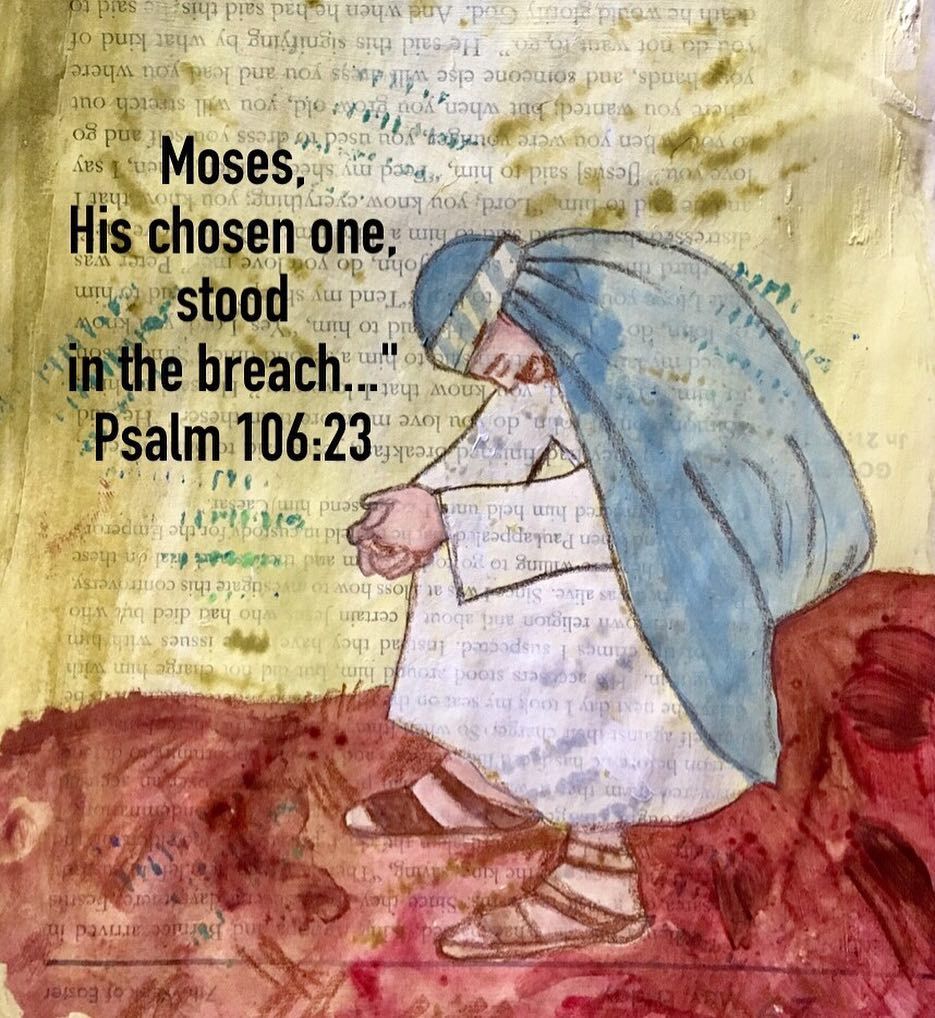
So when God is ready to destroy the Israelites for their sin, Moses stands in the breach (as a true prophet does) and functions as God’s rainbow, reminding God of his true character. Moses prays, “O LORD, why does your wrath burn hot against your people [not my people, your people], whom you brought out of Egypt with great power? The Egyptians will think you’re an evil god for delivering your people from slavery only to destroy them in the desert. And that’s not you! So turn from your fierce wrath; change your mind and don’t destroy them. And remember who you are. Remember your Name. And remember the promises you made to their forefathers Abraham, Isaac, and Jacob.” Moses, like the rainbow drawn out of the water, reminded God of God’s promise. And so, the Scriptures say, the LORD changed his mind because the LORD was reminded of his promise; because the LORD was reminded of his true character and Name. Moses lived up to his Name by reminding God of God’s Name. According to this morning’s Psalm (Psalm 106), God saved his people and God spared his people for his Name’s sake (106:8). You see that phrase often throughout Scripture. In Psalm 23, “The LORD is my Shepherd…he leads me in paths of righteousness for his Name’s sake.”
If you’re wondering why Fr. Daniel is so obsessed with names, it’s because the Bible is obsessed with names, especially the name of God! For his Name’s sake. What does that mean? In one sense, it means “for the sake of God’s reputation,” which Moses appeals to when he says, “God, if you destroy these people, you’re going to get a bad reputation; you’re going to get a bad name.” In another sense, when the Bible says that God does something for his Name’s sake, it means that God is doing something in order for God to fully be who God truly is, to be consistent with the divine identity. Remember God revealed himself to Moses as “I am who I am.” So when God wants to wipe out his people in anger, Moses reminds him, “That’s not who you are.”
The experience of honest prayer transforms us by reminding us of who we truly are and helping us to become who we truly are. And according to Exodus, our prayer can sometimes help remind God of who God truly is. Ultimately, the divine identity which we share in our true selves by virtue of being made in God’s image is loving, honorable, just, pure, commendable and worthy of praise, all those virtues which Paul invites us to reflect on in his letter to the Philippians. That’s who we truly are. That’s our true identity and Name, which we discover and become through honest and humble prayer, as long as we are willing to let God shed light on our shadows and let God change us.
So let us enter into the life-changing and world-changing experience of prayer, which Anglican poet George Herbert called the “banquet.” That’s the wedding banquet. Prayer! And that’s how we get our wedding robe, which is our true self. Notice at the end of Jesus’s parable, the king approaches the guest and says, “Dear friend, how did you get in here without a wedding robe?” In other words, I don’t see any evidence of you engaging in honest and humble prayer (which may even include some rage). And how does the guest respond? He’s speechless. Once again refusing to engage in honest relationship and humble prayer. So, the king says, “You need to get out.”
[I was telling the Lectio Divina group that I thought this parable was Jesus’s way of saying what I often say here: “All are welcome, but not all behaviors are welcome.” Clearly a failure to wear a wedding robe implied a failure to respect and follow the guidelines of the wedding banquet and was thus an affront to the king and a potential threat to the other guests.]
But we all are welcome indeed to the wedding banquet that is prayer. C. S. Lewis said, “I pray because the need flows out of me all the time, waking and sleeping… [and] it changes me.” He also said, “It would seem that Our Lord finds our desires not too strong, but too weak. We are half-hearted creatures, fooling about with drink and sex and ambition when infinite joy is offered us [in prayer], like an ignorant child who wants to go on making mud pies […] because he cannot imagine what is meant by the offer of a holiday at the sea [the invitation to the wedding banquet]. We are far too easily pleased.”
May God strengthen and deepen our desire to join the wedding banquet by praying honestly, with both joy and sorrow, reverence and rage, so that we may don the wedding robe and rejoice in the Lord always for his Name’s sake. Amen.
[1] https://zora.medium.com/should-christians-pray-for-trumps-recovery-31ff7a5af202, accessed October 10, 2020.


 DANIEL DeFOREST LONDON