
Readings for Good Friday Solemn Liturgy.
This sermon was preached at Christ Episcopal Church Eureka on Sunday April 10, 2020. (Sermon begins at 28:05 in video above). Worship program here.
In the words of Joni Mitchell, “Don’t it always seem to go that you don’t know what you got till it’s gone.” I’ve always had profound appreciation for our worship gatherings at Christ Church Eureka, but I must say that my appreciation of those gatherings has grown even deeper now that we are temporarily abstaining from them. The irony is that this year, I have been exploring with you the theme of the five human senses in our Lenten readings from the Gospel of John; and my plan was to focus on the gift of human touch during Holy Week, as we wash each other’s feet on Maundy Thursday and then, on Easter Sunday, as we touch the Risen Christ who promises to be present among us tangibly whenever we gather. Although you can still hear me and see me through the inter webs, you can’t taste the bread and wine made holy, you can’t smell me (which might be a good thing), and we can’t physically share a sign of peace. My hope is that this time of absence makes our hearts grow even fonder of our church gatherings: fonder of the music we hear, the beauty we see, the communion we taste, the aromas we smell, and the people we greet and touch with a sign of peace.
My appreciation of celebrating and sharing the Holy Eucharist with all of you has also certainly deepened. As I am celebrating the Eucharist physically by myself, I am in communion with you by not receiving the elements. They are going to the earth. Because Eucharist honestly feels a little awkward under these current conditions, we will be returning to the great Anglican tradition of praying Morning Prayer on Sundays after Easter Sunday and we will continue to pray Morning Prayer until we safely meet again in our gorgeous church building. May this time of absence from the tangible Eucharist make our hearts grow even fonder of that great mysterious sacrament in and through which Christ promises to be present among us.
Also, may this time of absence help us understand and appreciate the powerful gifts of this extraordinary day in our church calendar, this Good Friday, when “tradition demands that we not consecrate the bread and wine. . .as a way of remembering that Jesus was dead, in the grave, absent from our presence on this day.”[1] May this absence make our hearts grow fonder of Christ’s tangible presence, which we may so often take for granted.
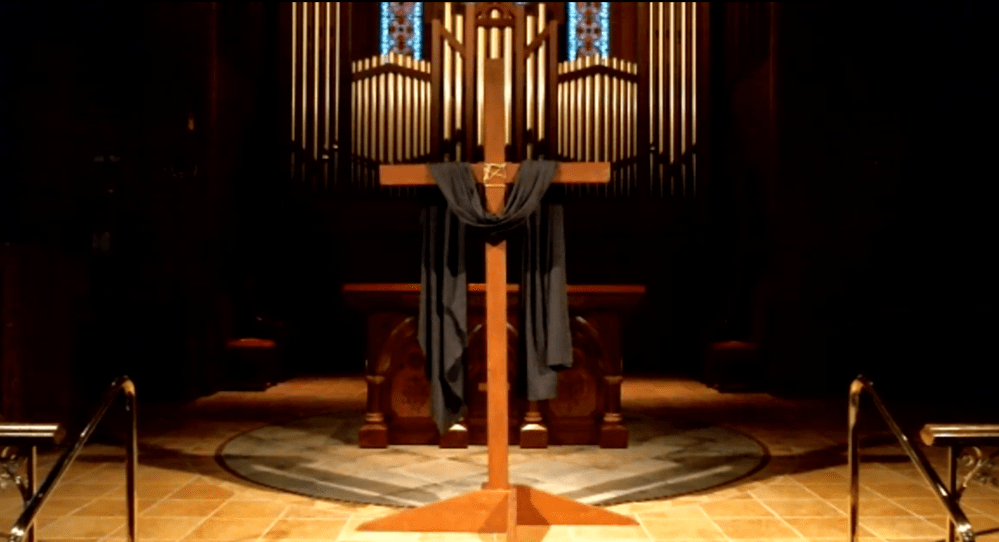
And may we take this time as an opportunity to feast on the Word of God and to reflect more deeply on that great mystery that stands at the center of our faith: the mystery of the cross. What does the cross mean to you? We believe it is the great symbol of God’s self-giving and sacrificial love; remembering that the liturgies of Holy Week are invitations to enter more fully into the most passionate love story of all time and all eternity. One simple way to understand the meaning of the cross is to think of it as God’s answer to our question, “How much do you love me?” The cross is God’s way of saying “I love you this much” as he stretches out his arms so far that he dies.
The cross is also God’s way of taking something that is intended for death and destruction and transforming it into something brimming with everlasting life and love and salvation. The Bible reveals this divine pattern right away at the beginning, in Genesis, when Joseph tells his repentant brothers who tried to murder him, “Don’t be afraid. I forgive you. Although you intended to harm me, God intended it for good to save the lives of many” (Gen 50:20). God takes that which is intended for evil and makes it good.
Remember that in Christ’s day, the cross was a horrifying symbol of a brutal and humiliating death at the hands of a violent empire. But God took that which was intended for harm and subverted its power, and transformed it into the greatest good (the summum bonum), and it is that goodness that we venerate on Good Friday.
The message of Good Friday, which is the message of the Cross, is one that we so desperately need right now as COVID-19 spreads across the globe, making hundreds of thousands of people severely ill and claiming the lives of about 18,000 people (so far). Although from our perspective, this virus seems hellbent on spreading misery, illness and death among the human race, the cross of Christ insists that God will ultimately use this virus for good. We do not deny the reality of suffering and death. We lament. On this Good Friday, we lament and we grieve, but we do not grieve as a people without hope because we believe that God will ultimately take this virus, this symbol of death (much like the cross), and subvert its power so that it can somehow work for the good of the human race, the human race which is already transforming (as we speak) into the human family, as we all realize how tremendously interdependent we are on each other. In the early 20th century, when the Spanish Flu was claiming millions of lives across the globe and many lives here in Humboldt county, Bishop William Hall Moreland (of this diocese) said, “Without attributing to our Heavenly Father the origin of this fatal epidemic, for which our own ignorance or neglect is doubtless responsible, yet we may be sure [God] is working out, by means of it, a solemn and beneficent purpose.” “Beneficent” is the beautiful, early 20th century way of saying “good.” Let me be clear, this virus is not a good thing, but our God is good and God brings goodness and life out of evil and death.
The message of the Cross is God’s self-giving love for each of us and God’s transformation of death into life. And the message of the Cross is a call to compassion. After witnessing blood and water flow out of Christ’s pierced side, the narrator of the Gospel first wants to make sure the reader knows that this really happened. He says, “He who saw this has testified so that you may also believe. His testimony is true, and he knows that he tells the truth.” This is obviously very important for the author, who then interprets the meaning of Christ’s pierced side in light of the Hebrew Scriptures, quoting a part of Zechariah 12:10 “They will look on the one whom they have pierced.” The first century readers of this Gospel would have known the rest of this verse from Zechariah, which reads, “And I will pour out a spirit of compassion so that when they look on the one whom they have pierced, they shall mourn for him, as one mourns for an only child and weep bitterly over him, as one weeps over a firstborn.”
Right before Jesus is pierced in the side, the text says that he bowed his head and gave up his spirit. The Greek, however, is better translated as, “He bowed his head and gave up the spirit.” By referencing Zechariah in this context, the author of John suggests that Jesus is pouring out the spirit of compassion promised in Zechariah while he is dying on the cross so that those who look on him will have compassion on this innocent victim of evil and violence. However, this holy spirit of compassion does not stop there. The spirit arouses sympathy not only for Christ but for all victims of oppression, violence, discrimination, and illness today, in whom Christ continues to suffer. The spirit stirs up compassion within us for all those who are hurting and suffering, for those who are being slowly crucified by a system that keeps them especially vulnerable to sickness and prevents them from receiving proper health care and leaves them in hopeless, traumatic and abusive situations.
According to the Gospel of John, Jesus dies on the cross so that we can see God among the victims of our world and to begin to see the ways in which we ourselves can extend compassion, ways that we can “be compassionate as our heavenly Father is compassionate” (Luke 6:36).
Medieval theologian Peter Abelard also understood the cross as a call to compassion and an invitation to see Christ among all those who are suffering. Peter Abelard wrote a hymn titled (“Alone thou goest forth, O Lord”), in which he prays in the last verse, “Tu tibi compati sic fac nos, Domine” which has been translated as “Give us compassion for thee, Lord.”[2] This is the prayer that the truth of the cross invokes in us. Give us compassion for thee, Lord, so that we may learn to have compassion on each other, so that we may recognize and repent of the ways in which we continue to cry out “Crucify him!” Give us compassion for thee, Lord, so that we may have compassion on ourselves because sometimes we are our own worst enemies and our own worst victims. Give us compassion for thee, Lord, because it is your holy spirit of compassion that will ultimately sustain us as it sustained Christ, even through death, and it is your holy spirit of compassion that transforms evil and death into goodness and life, even life beyond the grave. Amen.
[1] Scott Gunn, and Melody Wilson Shobe, Walk in Love: Episcopal Belief and Practices (Forward Movement: Cincinnati OH, 2018), 147.
[2] Francis Bland Tucker (1895 – 1984)

 DANIEL DeFOREST LONDON