
Readings for the Fifth Sunday in Lent (Year A) – Laetare Sunday (transferred)
This sermon was preached at Christ Episcopal Church Eureka on Sunday March 29, 2020. (Sermon begins at 20:30 in video above).
It is good to be worshipping back in this glorious, sacred space after “sitting shiva” for my father this last week and offering Morning Prayer from the Transfiguration House last Sunday. Thank you all for your kind words of love and sympathy during this time of mourning. I’m thrilled you are able to join us through Facebook Live today from the comfort and safety of your own home, where I hope you have created your own sacred space of worship, your own chapel and altar. I’m so glad you all can still experience Christ Church Eureka with your eyes and your ears through this technology. I just wish there was a way to convey, through the interwebs, the sweet aroma of this warm sanctuary. I always love walking in here and taking a deep breath to enjoy and relish the fragrance of this house of redwood and prayer. It is the aroma of the beauty of holiness.
Throughout this season of lent we have been exploring the gifts of our five human senses. We explored the gift of hearing when Jesus invited us to listen to the wind with Nicodemus. We learned how to quench our deepest thirst and satisfy our deepest hungers with the Samaritan woman, St. Photini. And last Sunday, I talked about spiritual vision, about having eyes to see the divine light of God shining like the sun all around us. Today, I want to explore with you the gift of olfaction, the gift of smelling, which might be one of the more underrated and under-appreciated of the five senses.
As most of you know, smell is connected to our memory and emotion more than any other human sense. A little bit of neuroscience for us this morning: this is because all our other senses are routed through a part of our brain called the thalamus which then sends them to the appropriate processing centers in our body. But smell bypasses that process because odors go straight to what is called the olfactory bulb, which is connected to the amygdala and the hippocampus, parts of the brain that help handle memory and emotion. This creates what is called “odor-evoked autobiographical memory.” We don’t have to be neuroscientists to understand that term (odor-evoked autobiographical memory) because we’ve all had the experience of smelling an odor or an aroma that reminds us of something or someone from our past. It was the aroma of a Madeline cookie that reminded French novelist Marcel Proust of a past experience and partly inspired him to write one of the greatest (and longest) novels of all time called Remembrance of Things Past, which is over 4,000 pages long.
Often smells remind us of people. Although we all grieve in different ways, it seems that grief comes to us in waves. I’m often surprised and caught off guard when a wave of grief comes crashing over me. Sometimes a wave of grief comes as a result of a smell: the scent of an old book or a vinyl record or green tea or even a glass of dark, red wine can remind me of my father and bring me to tears. As I’ve been grieving well this last week and a half, I have been experiencing grief that is laced with profound hope and even joy. So this morning, I want to explore with you how to smell the sweet aroma of grief that is laced with joy.
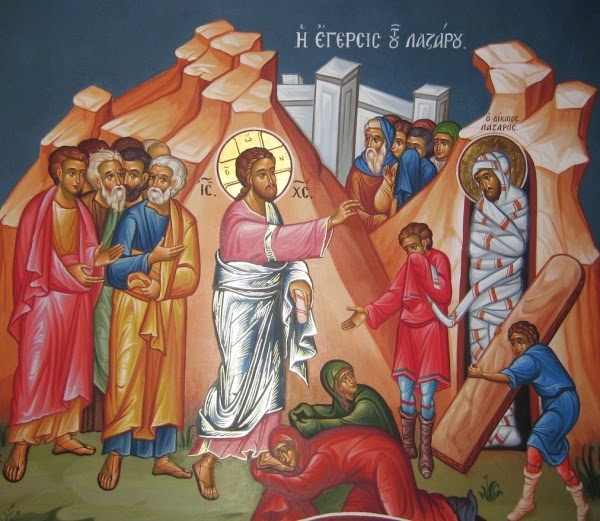
Our reading from John this morning actually begins and ends with references to smell. Towards the end of the reading, as Jesus approaches the tomb of Lazarus, Martha warns him that there’s a stench because Lazarus has been dead for four days (11:39). I prefer the King James Version, in which Martha says, “Lord, he stinketh.” Sometimes the stench of death and decay can also be the fertilizing fragrance of new life and resurrection.
The first reference to smell in our reading appears in the first two verses of chapter 11: “Now a certain man was ill, Lazarus of Bethany, the village of Mary and her sister Martha. Mary was the one who anointed the Lord with perfume and wiped his feet with her hair” (11:1 – 2). A reference to perfume is a reference to smell, but here’s what I find so fascinating and bizarre about this particular reference. Mary of Bethany is introduced as the woman who anointed Jesus’s feet with perfume. However, this anointing of Jesus has not happened yet in the narrative. It doesn’t happen until the next chapter: chapter 12.
Commentators try to explain this aberration in the text by arguing that the editor or redactor of John made a mistake in the final draft by placing the raising of Lazarus before the anointing of Jesus when it really should be the other way around. Perhaps this is true. There’s no way to know for sure, but this leads commentators (like the great Rudolf Bultmann) to rearrange chapters and verses of John’s Gospel to supposedly make more sense. But this approach ends up leading scholars to each have their own versions of the gospel, while I personally prefer to read the gospel as we have it now, as we have received it, trusting that the Holy Spirit has something to say to us, even if the editor may have made a mistake, even if it doesn’t completely make sense to us right away.
When we read the description of the anointing of Jesus in chapter 12, when the Gospel says, “The house was filled with the fragrance of the perfume.” (12:3), it’s hard to not have our senses aroused, especially our sense of smell. By making a reference to this future fragrant-filled expression of love as if it has already happened, the Gospel, I believe, is playing with this connection between our smell and our memory and our emotion. It’s almost as if the gospel is inviting us to consider the possibility that we can, through our sense of smell, not only remember things from our past but also remember things that haven’t happened yet, especially when the memories include people whom we love. This is how the gospel invites us to smell the aroma of grief that is laced with hope and joy in the promise of the resurrection.
When a fragrance reminds us of someone whom we love but see no longer, we may grieve. But can that same fragrance remind us of the promise of the resurrection? Can that fragrance remind us of our future reunion in heaven with the ones whom we love?
On this Laetare Sunday, the Gospel invites us to claim our joy in the promise of the resurrection, knowing that we will one day reunite with those whom we love, and knowing that they are still with us now in ways we cannot even imagine. My time of grief (so far) has been filled with hope because I feel the presence of my father still beside me. Every time the sun shines upon me, I feel like it is my dad beaming his love upon me. In many ways, my dad is still with us. Irene is still with us. Pat is still with us. Fr. Doug is still with us. All those whom we love but see no longer are still with us. And moreover, we get to see them again because of the resurrection of the body. I don’t just say that because I’m a priest. I say that because I believe it. For us, our grief is always laced with hope and joy.
On the day my father passed away, a fragrance reminded me of a memory of my father tenderly holding a child, which initially filled me with pure grief because I miss him so much and I won’t ever see him do that again in this life. But then the tears of grief became laced with hope and with joy as it became so clear to me that God was giving me a memory of something that I have not yet experienced. God was showing me what my father is doing in heaven. My father who died on the feast day of St. Joseph, the patron saint of fathers, is holding a child in heaven right now. In fact, I believe he is caring for and embracing many children, including his older sibling and my younger sibling who both died in miscarriages. I found out later that St. Joseph is also the patron saint of unborn children.
When Jesus wept at the grave of Lazarus, I believe his tears released the aroma of grief mixed with hope and joy. When we weep for those whom we love but see no longer, Jesus weeps with us and I believe our tears release that same aroma, an aroma that God receives with love, an aroma that reminds us of something that hasn’t completely happened yet: the resurrection of the dead and the life of the world to come. Amen.

 DANIEL DeFOREST LONDON