
This sermon / eulogy was preached at the Transfiguration House for Christ Episcopal Church Eureka on Sunday March 22, 2020.
Watch video of sermon/eulogy here
I had a sermon prepared for this morning in which I incorporated some of the main ideas of my new book, which is scheduled to come out late next month. You can actually pre-order it right now on Amazon. It’s called “Theodicy and Spirituality in the Fourth Gospel” and I bring it up today because the book happens to focus primarily on John chapter 9, the chapter we just heard this morning in its entirety.
In the acknowledgements page of the book, I thank the good people of Christ Church Eureka and I thank my father Bob London, who most of you know passed away just a few days ago after a long battle with acute myeloid leukemia. It is because of my father’s recent passing that I have chosen to lay aside the sermon I initially prepared for this morning. Instead, I want to talk about spiritual vision, inspired by this chapter from the Gospel in which Jesus gives vision to a man born blind (a man whom Christian tradition has given the name Celidonius) and this chapter from the Gospel in which Jesus tries to expand the spiritual vision of his disciples and friends and interlocutors. I want to explore spiritual vision with you by telling you about my father.
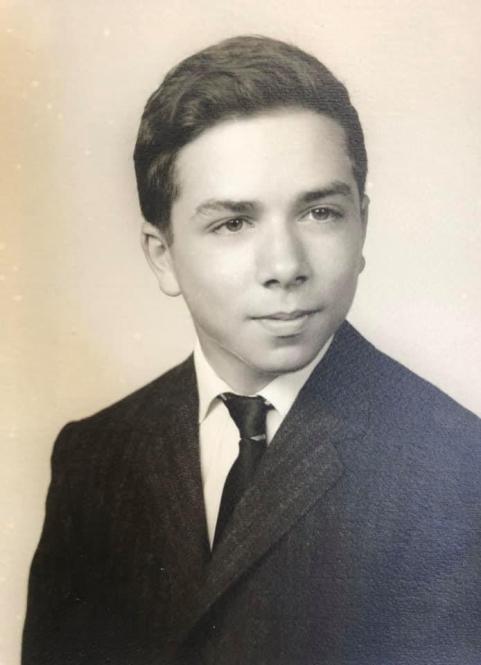
When my father was a 19-year-old college sophomore studying chemistry at Cornell University in Ithaca NY, he fell into a severe depression. He felt that there was no real meaning in life and certainly no importance to his own life. He felt dejected and useless and completely empty inside. The fact that he was significantly shorter than most of his peers and that he was struggling with an extreme case of acne on the face did not help at all. At the nadir of his depression, he was walking from the Engineering quad and main academic area of campus towards his room in College Town. He told me, “The walk from campus to college town was always fraught with danger.” This was not because of crime or harmful wildlife or unsafe terrain, but because of a bridge called Thurston Avenue Bridge. Now the bridge itself was relatively safe even though it was 100 feet above the bottom of Fall Creek gorge. (Ithaca is full of stunning gorges, which is why their city motto is “Ithaca is Gorges”). Thurston Avenue bridge was fraught with danger for my father because it posed a constant temptation for students suffering from severe depression. Every year at least one student would jump off that bridge and commit suicide. In fact, this was so common that they actually gave it a name. They called it “gorging out.” Each year, someone (if not several people) would gorge out off of Thurston Avenue bridge and no one yet had ever survived the fall. Cornell underclassmen crossed that bridge daily and my dad said that every time he crossed it, he contemplated jumping. And on this one day when he felt particularly worthless, he began to succumb to the bridge’s temptation and he thought this would be the day for him to give up and gorge out.

And that’s when he looked down at a simple blade of grass and thought despairingly to himself, “You know, this piece of grass has more life and purpose and meaning than I do. It grows and blooms and shines forth a beautiful shade of green each year. This grass is more meaningful and useful than me.” And then, he said, the grass exploded into a bright, shimmering diamond light. And he thought, “What has happened to this grass?”

Now keep in mind, he was not “on grass” at the time. He was completely sober, but he was having a powerful spiritual vision. He didn’t like to call it a “mystical” vision because it felt so much like he was waking up from a dream, as if the shimmering light that he saw beaming was the true reality.
“Sleeper, awake! Rise from the dead, and Christ will shine on you” (Eph 5:14).
And then he looked up and saw that the clouds were also beaming with that same bright, shimmering, diamond light. And so were all the people. Everybody and everything was emanating with a shining, bright, blazing light. He tried to describe this ineffable experience by saying, “It was obvious that everything had not just life, but really life always had life. It was full of life. It was nothing but life.” And then he realized, “Oh my gosh, there is meaning. There is meaning to everything. There is meaning to everything everywhere. This is the answer to all my questions. There is life and it is full and eternal and everywhere and I am part of it.”
This experience lasted about an hour and my dad knew that other people must have had similar experiences. He knew he couldn’t have been the only one so he began his journey seeking to learn more about this divine light and how to live by it and how to open his eyes to see that light every day in everyone and everywhere.
He decided to change his major from chemistry to psychology and he started studying the works of Freud and Jung and Abraham Maslow who wrote about “peak experiences” and how increasing our capacity to see the sacred and the eternal fosters self-actualization which is really selfless love. He also studied the French Jesuit theologian and paleontologist Teilhard de Chardin who explained that someone with clear spiritual vision can see that we are not human beings having a spiritual experience but rather spiritual beings having a human experience.
My father travelled across the country to study at San Francisco State and then returned back east to graduate from NYU; and he continued to seek the source of that divine light in literature as an English teacher and a manager at the Harvard bookstore; in nature as a mountain climber and the owner of an outdoor supply store; and in meditation as a yoga instructor and a follower of an Indian guru name Sri Chinmoy, who wisely encouraged my father to seek what he was looking for not in Sri Chinmoy but in Jesus Christ.
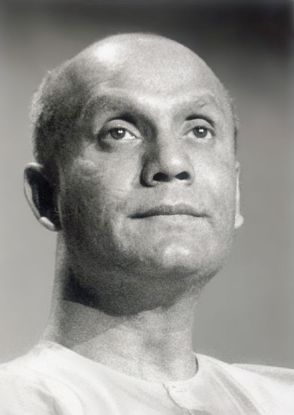
My father then attended Harvard and earned a Masters in Education from Boston University while dating a young woman named Janet, who was working in administration at the Christian Science Mother Church in Boston. After marrying Janet at a Unitarian Universalist Church in Concord MA, he earned a PhD in Education and Computer Science at Stanford University, where he began conversations with Messianic Jews, Jewish people who believe that Jesus Christ is the Jewish Messiah, the Light of the world, the one who opens our eyes to help us see as God sees.
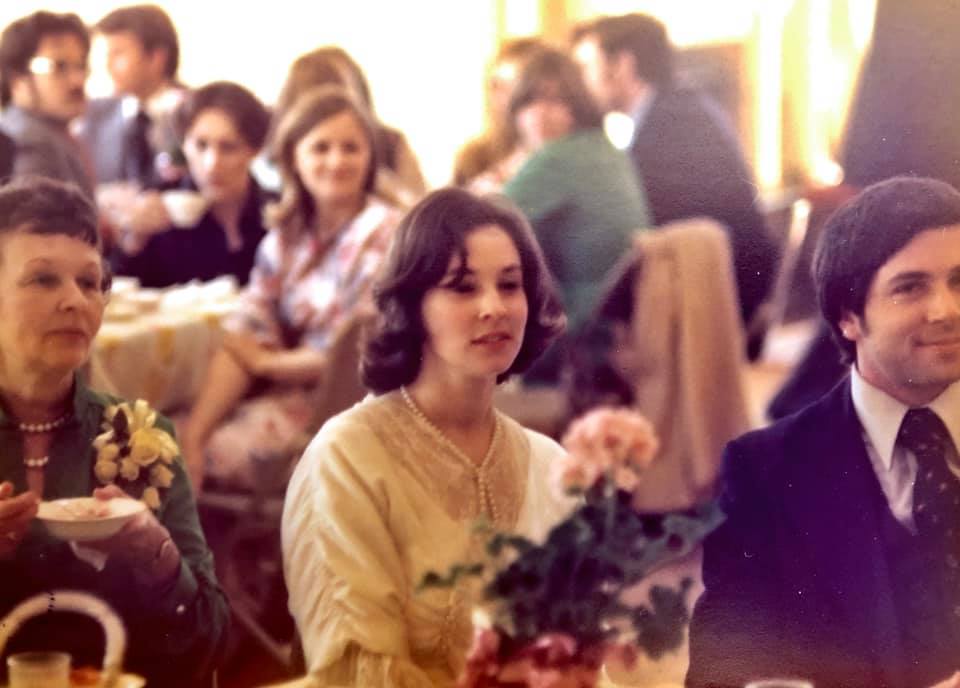

He immersed himself in the Hebrew and Christian scriptures while raising his two sons. My mom remembers him trying to lull my brother Matt to sleep as a baby by reading aloud passages from the book of the prophet Ezekiel, who is one of the greatest and most bizarre visionaries of all time. If anyone had spiritual vision, it was Ezekiel. The Jewish rabbis say, “Don’t read Ezekiel until you’re at least 30 years old,” but my dad thought my 3-month-old brother could handle it.


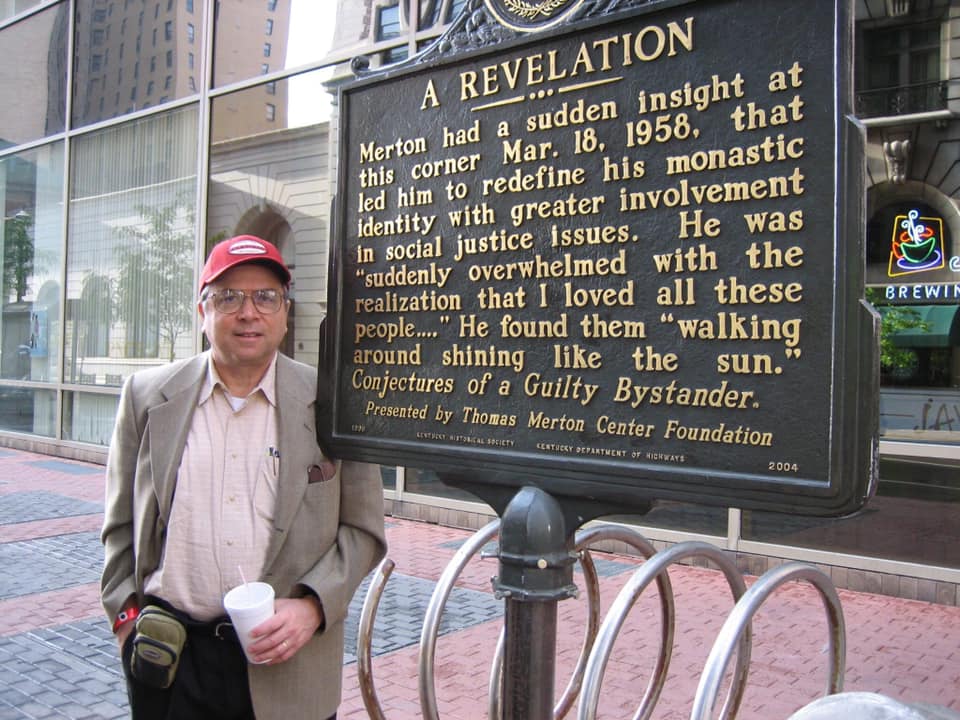
My father then discovered the work of a Trappist monk named Thomas Merton who wrote about his own “peak experience” which he had on the intersection of Fourth and Walnut street in Louisville KY on March 18, 1958. Merton’s description of his experience resembles that of my father’s. Merton said it was “like waking from a dream of separateness, [a dream] of spurious self-isolation.”[1] Merton saw what he described as “the pure glory of God” within us, “blazing with the invisible light of heaven.” It was as if everyone was “walking around shining like the sun.”[2] He said that this pure glory is “in everybody, and if we could see it, we would see these billions of points of light coming together in the face and blaze of a sun that would make all the darkness and cruelty of life vanish completely.” Merton then concluded by saying, “I have no program for this seeing. It is only given. But the gate of heaven is everywhere.”[3] So my father would encourage me and others to humbly ask God to receive this spiritual vision, this way of seeing as God sees, because my father believed Jesus Christ when he said, “Ask, and it shall be given to you; seek, and you shall find; knock, and the door will be opened for you. For everyone who asks receives, and everyone who seeks finds, to him who knocks, the door will be opened [even if that door be the gate of heaven].” My father believed these words may have been the most important words of Jesus Christ, the One who said “I am the light of the world” and the One in whom my father ultimately found the source of divine light and life.
Like all human beings, my father had his flaws and imperfections, some of which he recognized and others to which he seemed to remain mostly blind. However, as an ardent fan of Jewish poets Bob Dylan and Leonard Cohen, he knew full well that “behind every beautiful thing, there’s some kind of pain” and that “there is a crack, a crack in everything / that’s how the light gets in.” And sometimes, that’s how the light shines through, as it did through my father and his beautifully imperfect humanity.
He passed away on March 19th, the feast day of St. Joseph, the patron saint of fathers, which is wholly appropriate since he let that divine light shine through him most purely and powerfully as a husband and as a father; and it was in being a husband and a father that he found his deepest joy and fulfillment.

During this time of social isolation, I invite us all to ask God to open our eyes to see the divine light shining like the sun all around us, especially in those whom we love. May we hold our loved ones extra close during this time; and may our souls be revived as we rest in the arms of our good shepherd who comforts us through the valley of the shadow of death and who pursues us with his goodness and mercy.
I want to conclude with the words of a poem by Thomas Merton, which was written in 1946 the same year my father was born, and which urges us to see the shimmering light of Christ exploding all around us. The poem is called “The Victory.”
“Look up, you captives, crowding to the water,
Look up, Ezechiel, and see the open heaven
Salute you with the vision of the winged Evangelists
You with your ankles in the water and your garments white,
Lift up your heads, begin to sing:
And let your sights, exulting, rise and meet
The miracle of living creatures
In their burning […] flight
The message of their lamps and fires
Warns you: make ready for the Face that speaks like lightning,
Uttering the new name of your exultation
Deep in the vitals of your soul.
Make ready for the Christ, Whose smile, like lightning,
Sets free the song of everlasting glory
That now sleeps, in your paper flesh, like dynamite.”[4]



[1] Thomas Merton, Conjectures of A Guilty Bystander (New York: Doubleday, 1968), 153-154.
[2] Merton, Conjectures, 155.
[3] Merton, Conjectures, 156.
[4] Thomas Merton, “The Victory,” The Collected Poems of Thomas Merton (New Directions: 1977), 115.

 DANIEL DeFOREST LONDON