
This sermon was preached at Christ Episcopal Church Eureka on Sunday March 1, 2020.
Our Christian tradition teaches us to be wary of our relationship to pleasure and possessions and pride. Although these are not evil in and of themselves (they can in fact be every good!), our relationship with them can easily become unhealthy and sinful. Some of the most famous thinkers of the 19th and 20th centuries made names for themselves by exploring the power of these forces in our lives: Sigmund Freud, Karl Marx and Friedrich Nietzsche collectively asserted that everyone is driven by pleasure, possessions and pride, although they preferred different terms: sex, money, and power. You can probably guess which thinker is associated with each: Freud thought that sexual desire drives our unconscious impulses; Karl Marx pointed out ways that we are controlled by money; and Nietzsche thought we are all driven, in one way or another, by the will to power. These thinkers did not necessarily believe that there is anything inherently wrong with sex, money or power, but they helped us see the many (insidious) ways in which we can easily become controlled and manipulated by these forces every day. When we fall prey to these forces or to an inordinate attachment to them, we can very easily fall headlong into sin.

Freud, Marx and Nietszche were each wonderfully creative thinkers, but they were not entirely original. The Jewish and Christian traditions had already recognized the dangerous potency of these three forces, as attested to in our readings this morning. The Scriptures wrestle with sex, money, and power in their own way, but more generally, in terms of pleasure, possessions and pride. In our reading from Genesis, we see these three forces subtly at work in influencing Adam and Eve to eat the fruit of the forbidden tree. The Scriptures say, “[The man and] woman saw that the tree was good for food (to possess), and that it was a delight to the eyes (pleasure), and that the tree was desired to make one wise (pride), so [they] took of its fruit and ate.” Pleasure, possessions and pride easily push humanity to fall headlong into sin.
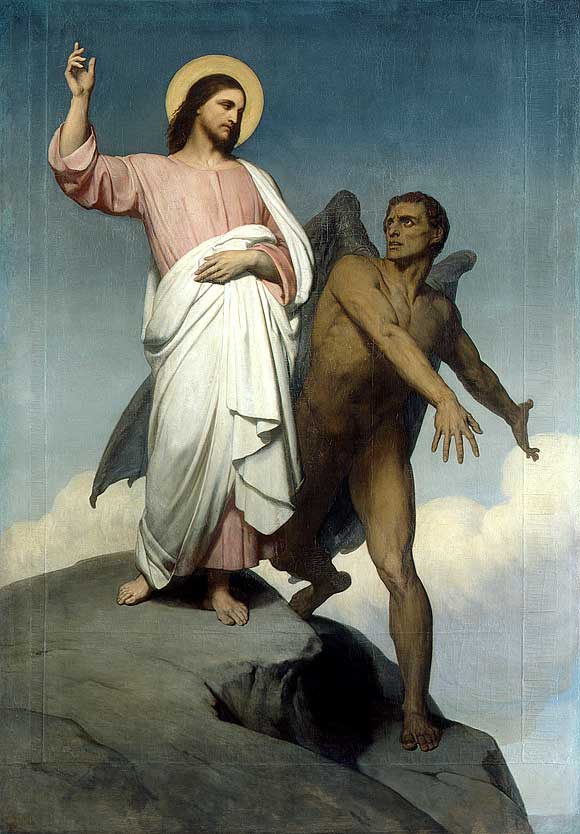
In our Gospel reading, Jesus confronts these same forces in the desert when the devil tempts him to satisfy his hunger by miraculously turning stones into delicious loaves of bread (pleasure), to possess all the kingdoms of the world and all of their splendid riches (possessions), and to assert his power over the angels to protect him from self-sabotage (power). By resisting these temptations, Jesus acts as the new Adam and begins reversing the effects of the Fall and begins renegotiating our relationship to pleasure, possessions, and pride. With this understanding, we can see why Jesus emphasized three particular spiritual disciplines in the Sermon on the Mount, which we heard on Ash Wednesday, when he emphasized fasting, alms-giving and prayer, in order to help temper our attachment to pleasure, possessions and pride.
In today’s Gospel, we get to see Jesus in action, responding to the temptations of pleasure, possessions and pride, which the devil dangles before him with diabolic brilliance. I want to highlight two characteristics of Jesus’s response, which I invite us to emulate throughout this season of Lent.
First of all, Jesus responds to each of the three temptations with words from the Holy Scriptures. He had immersed himself in the Torah, in the teachings of the Prophets, and in the poetic prayers of the Psalms. He knew them by heart. While Jesus was physically fasting in the desert, he was spiritually feasting on “every word that comes from the mouth of God.” So when the devil himself (mis)uses Scripture in an attempt to make Jesus grasp for power, Jesus is fully equipped with yet another reference to Scripture to quote in order to counter the attack. So this Lent, I invite us to feast spiritually on the Word of God so that we too can resist the devil’s many temptations and temper our relationship with pleasure and possessions and pride. This Lent, we will immerse ourselves in the Scriptures by feasting on portions of the Gospel of John on Sunday mornings and in more depth on Tuesday nights in Lewis Hall.
The second characteristic about Jesus’s response to temptation that I want to highlight is slightly more subtle and complex, but equally important. In order to appreciate this characteristic, we need to first appreciate how tempting these offers actually were for Jesus. These offers to miraculously make bread, to escape death and to become the king of all the world were extremely tempting offers for Jesus because he really wanted to accomplish these things. We know he wanted to accomplish these things because later on in Matthew’s Gospel, he does all of them: He miraculously makes bread (to feed thousands of people), he escapes death in his resurrection and then he commissions his followers to make disciples of all the nations of the world. So does this mean that Jesus eventually succumbed to the devil’s temptations? Absolutely not!
Jesus fulfilled his deepest desires, but he did so in God’s time and in God’s way, rather than in the devil’s way. The devil offered him the fast-food approach of instant gratification, which is tempting indeed. But God’s way often requires patience and sometimes sacrifice. The timing was right for Jesus to miraculously make bread when there was more than just his mouth to feed. And the timing was right for Jesus to escape the clutches of death only after he had endured the suffering of the cross and the grave.
Matthew’s Gospel teaches us that when it comes to the spiritual life, the fast-food approach is often the devil’s approach. This is why we don’t just hop (like eager Easter bunnies) from Epiphany to Easter. We first walk the via dolorosa of the Lenten season. In this season, we train ourselves to trust in God’s time and to follow God’s way, even when it is full of difficulty, pain, self-denial, and boredom. It is in this season, that we renegotiate and recalibrate our relationship with pleasure, possessions and pride; with sex, money and power. God wants us to flourish and thrive and God has tremendous blessings in store for each of us here as well as for this church as a whole. But, in order to claim them, we must first walk the way of the Cross. Before we can properly celebrate the glorious resurrection on Easter Sunday, we must first observe a holy and somber Lent. Before we can go to Heaven, we first have to endure death.
So what is this second characteristic of Jesus’s response to temptation that I’m trying to highlight? I would say it is his patience, his calm refusal to rush and grasp at the rich blessings that are indeed in store for him, his ability to be present to the here and now. This Lent, as we read through John’s Gospel, I invite us to practice being patient by being fully present to the here and now. One of the best ways I have learned how to do this (or at least start doing this) is by simply trying to be present to my body, by being mindful and grateful for even a single breath that I breathe, a bite that I take, an aroma I smell, a texture I touch, a beauty I see, or a melodious sound I hear. As we will be reading parts of John’s Gospel throughout Lent this year, I will be highlighting an aspect of John that I noticed while writing my book; and that is the Gospel’s emphasis on the body and the bodily senses, the Gospel’s invitation to experience the heartbeat of God divine pulsing in our flesh, to be refreshed by the God who became flesh in order to help us see our bodies as temples of the Holy Spirit. During this time of heightened anxiety about health, let us give extra care to our temples by resting, eating healthy, and sauntering among the redwoods as we did yesterday
Being present to the here and now is actually very difficult work, especially when the “here and now” is troubling and painful and might be the last place or moment in which we want to be. But ultimately, this practice of mindfulness helps prepare us to receive the many blessings that are in store for us as well as those blessings that are in front of us right now. This mindfulness also helps temper our relationship with pleasure, possessions and pride so that we may more fully enjoy our God-given pleasures, possessions and pride in God’s time and in God’s way.
So once again, in the words of the Book of Common Prayer, “I invite you, in the name of the Church, to the observance of a holy Lent, by self-examination and repentance; by prayer…and by reading and meditating on God’s holy Word,” and, by practicing patience and being present to the here and now through mindfulness and appreciation and care for our bodies, these temples of the Holy Spirit, and by being renewed and refreshed by the divine Word who became flesh. Amen.

 DANIEL DeFOREST LONDON