

This sermon was preached at Christ Episcopal Church Eureka on Sunday February 9, 2020.
This Sunday and next Sunday we will be hearing portions of what is considered by many to be the most significant and influential sermons or speeches ever delivered. It covers three chapters in Matthew’s Gospel: chapters 5, 6 and 7. There is a shorter version of this sermon in chapter 6 of Luke’s Gospel known as the Sermon on the Plain, but Matthew’s version, which is much more thorough and comprehensive, is called the Sermon on the Mount. In the Gospel of Matthew, mountains are full of significance because they are where heaven and earth meet. It was upon a mountain that Moses received the Torah. The Gospel of Matthew is considered by many to be the most Jewish of the four Gospels. In Matthew, Jesus sounds a lot like the Jewish rabbis of that time and he is portrayed as a kind of new Moses, not to replace Moses but to correctly interpret and fulfill Moses’s teachings. So Matthew describes Jesus teaching the law to the people from a mountain, just like Moses.
Jesus begins his Sermon on the Mount with a kind of poem or psalm known as the Beatitudes, which we would have heard last Sunday if the Candlemas readings didn’t override the Propers. The name Beatitudes comes from the Latin word beatus, which means “blessed.” However, Matthew was originally written in Greek and the Greek word used for “blessed” is actually makarios, which translates more literally to “happy.” So Jesus actually says, “Happy are the poor in spirit, happy are those who mourn, happy are the meek, etc.” This is partly why the famous pastor of positive-thinking Robert Schuller (of the former Crystal Cathedral) called them the “Be-Happy Attitudes.” Although I fully support positive-thinking and actually really appreciate Bob Schuller, this understanding is just barely skimming the surface of the immense and profound meaning of these words of Jesus. And it is also important to know that Jesus is not preaching a Prosperity Gospel here, a Gospel that promises that if only we had more faith and could think more positively, then we would acquire perfect health and immense wealth. That is not the Gospel of Jesus; that, in fact, is a dangerous heresy. The Beatitudes are rather attitudes that help us be, attitudes that help us be present to the fullness of being human, present to the God who is working through our humanity, in the midst of all of our messiness, limitations, insecurities, and fears; the God whose strength is made perfect in our weakness, whose wisdom and power are made manifest in our foolish stuttering as Paul explains in his letter to the Corinthians, when he says, “I came to you in weakness and in fear and in much trembling. My speech and proclamation were not eloquent and impressive, but they were a demonstration of God’s Spirit and power, so that your faith might not rest on human wisdom but on the power of God.” The Beatitudes are attitudes that help us to be present to the God whose perfection shines through our imperfections. Jesus concludes his opening poem (the Beatitudes) by saying, “Rejoice and be glad because God is working through you, even when and especially when things seem to be very messy.”

After inviting us to find our true happiness in this God who manifests his power and love most effectively in the midst of our limitations and messiness, Jesus continues his sermon in our reading this morning, saying, “You are the salt of the earth, but if salt has lost its taste, how can its saltiness be restored? It is no longer good for anything, but is thrown out and trampled under foot.” Now salt, which is Sodium Chloride, is a very stable chemical compound. It’s actually impossible for salt to lose it saltiness. However, in Jesus’s time, salt was mined as a white powder from the Dead Sea or the Salt Sea; and because they didn’t have refineries, it was very easy for this salt to get contaminated with all kinds of impurities: dust and dirt and sand, etc. So in that way, what was called salt could lose its saltiness. And no one wants to pour salt mixed with dirt and sand on their food. It’s better for that stuff to be thrown out onto the street. So what does it mean for us to be salt (or to lose our saltiness)?
Well, what does salt do? First, salt preserves food by preventing decay. Second, salt functions as a seasoning: when we sprinkle salt on our food, we not only to keep it from spoiling, we also bring out the food’s true flavor. Salt doesn’t just make food taste salty (unless we’re using too much of it). Salt can also make food taste like it’s supposed to taste, releasing upon our taste buds the hidden and dormant flavors of the dish. It is in both of these ways that God’s people function as salt of the earth: preventing sickness, suffering and decay and bringing out the best in other people and in the world. If we, as God’s people, are not working to combat suffering and to help others discover their God-given potential, then we are about as useful as salt mixed with dirty sand.
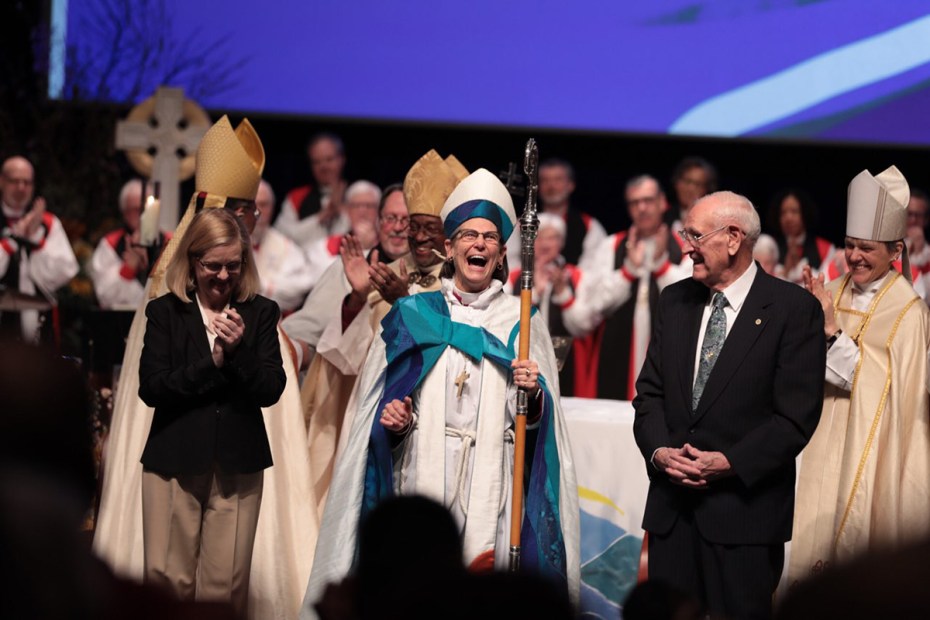
Just yesterday, the Episcopal Church consecrated the first lesbian bishop of the diocese of Michigan, Bishop Bonnie Perry, who says, “The whole point of a faith community is to build people up, to nurture people, and to enable people to live out their calls from God [and I am delighted the Episcopal Church does that].” That is what it means to be salt: to help others discover their call from God and empower them to live out their call in the world. Theologian Frederick Buechner said, “Your call in life is where your greatest joy meets the world’s greatest need.” Being salty salt means helping others discover where their greatest joy meets the world’s greatest need.
As the sermon continues, Jesus says, “You are the light of the world. A city built on a hill cannot be hid. No one after lighting a lamp puts it under a bushel basket, but on the lampstand, and it gives light to all in the house. In the same way, let your light shine before others, so that they may see your good works and give glory to your Father in heaven.” Jesus explains that God’s love and light are to shine through us, not for our own glory, but for the glory of our Father in Heaven. A major theme and message throughout the Sermon on the Mount (and throughout all the Gospels for that matter) is that if we seek God’s glory, we stand upon a sure foundation, but if we seek our own glory, our house will come crashing down. In fact, Jesus concludes the Sermon on the Mount with the troubling image of the walls of a house collapsing from the wind (Matt 7:27), a symbol of the destruction destined for those who seek their own glory, rather than the glory of God, a symbol of the destruction destined for those who believe in their own power and perfection rather than in the power of God that shines most effectively through our humility and human imperfection.

Jesus knows how tempting it is for people, especially religious people like us (like me), to seek our own glory and to feel good about ourselves for going to church and appearing to be pious. But Jesus, as well as the great Hebrew prophet Isaiah (whom we also heard from this morning), point out very clearly that the kind of religion and religious practice that God wants from us must involve feeding the hungry, clothing the naked, and liberating the oppressed. As the book of James says, “The kind of religion God finds useful is one that cares for orphans and widows in their distress” (1:27). Apparently, religion that does not care for orphans and widows in their distress is about as useful as unsalty salt.
So then, what does that imply about our Sunday morning worship here and now? Is this all useless to God? I believe Jesus answers this question as the sermon continues, when he says, “Do not think that I have come to abolish the law or the prophets; I have come not to abolish but to fulfill. For truly, I tell you, until heaven and earth pass away, not one letter, not one stroke of a letter, will pass from the law until all is accomplished.” Jesus wants to be very clear that he is not abolishing the many rituals, rules and teachings of his Jewish religion. Remember Jesus represents the new Moses, correctly interpreting and fulfilling the Torah. He is pointing to the original purpose of the rules and rituals, which is to let God transform us and accomplish his good will for the world through us. Likewise, our liturgies and traditions and texts today ought to be respected, even down to the tiniest detail, because we believe the Holy Spirit is transforming us through them, not in order to make us into pious religious people but in order to make us into salt and light, people of righteousness through whom God shines so that we can heal and bring out the best in others and in the world.
God’s people are called to a righteousness that must exceed the religious piety of those who perform acts of devotion for their own glory. As God’s people, we are called to recognize our profound need for God and for one another. We come to church not to be religious but in order to be fed and nourished and transformed by the powerful liturgy and rituals, the teachings and the fellowship because we are so hungry and thirsty and desperately want to be the change we hope to see in the world. We gather in a place like this because we know we are messy and imperfect and afraid and that we need a God whose strength is made perfect in our weakness. We understand what the Jewish poet Leonard Cohen meant when he said, “Ring the bells that still can ring. Forget your perfect offering. There is a crack, a crack in everything. That’s how the light gets in.” We understand that God’s perfect love and light shine through our cracks and messy imperfections so that we ourselves can be the light and the salt of the earth in a world full of darkness, degradation and decay; so that we can bring out the best in one another and so that the whole world may see the good works the Holy Spirit is doing among us and give glory, not to us, but to our Father in heaven. May we be empowered by our worship and sacraments to be so much more than simply pious, religious, churchy people. May we be the light of the world and the salt of the earth and may we build our house upon the strong foundation of God’s glory, not our own, lest we become like a wall toppled by the wind. May God’s glory shine through our humble humanity so that we may heal others and help others discover their God-given gifts and potential and call, which is where our greatest joy meets the world’s greatest need. Amen.

 DANIEL DeFOREST LONDON