
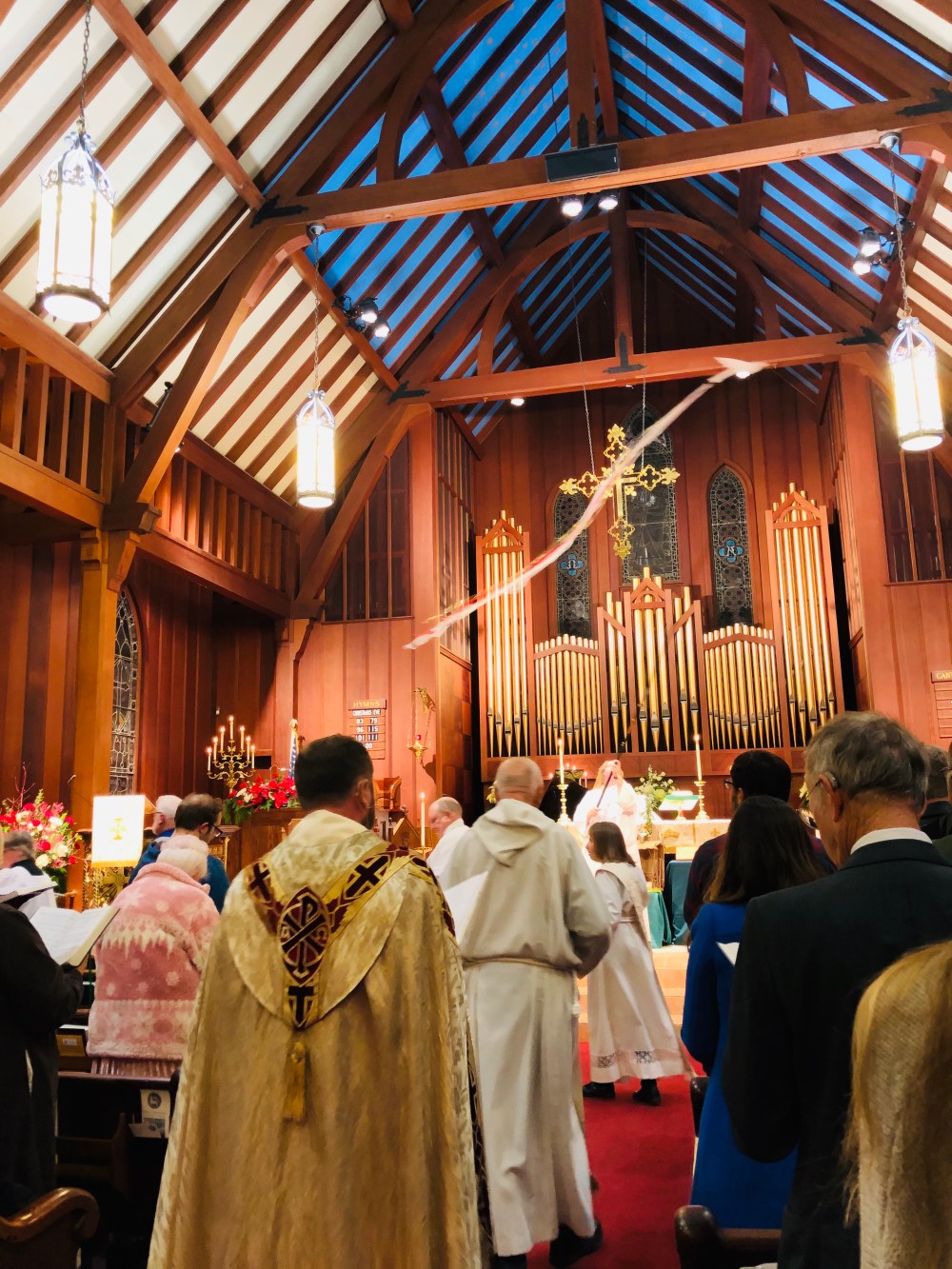
This sermon was preached at Christ Episcopal Church Eureka on Tuesday December 24, 2019.
Merry Christmas! I’m so glad you’re all here to worship God with all the angels in the beauty of holiness, especially on this most sacred night, the eve of the great feast of the Incarnation. I hope that being here on Christmas Eve is a tradition or is at least becoming a tradition for you and perhaps for your loved ones as well.
One of my relatively new favorite Christmas traditions is sending and receiving Christmas cards from family and friends like you. My wife Ashley and I started sending out Christmas cards about 6 years ago and we hope that all of you, on our church email list, have received our most recent e-Christmas card. This year, our card includes a picture of the two of us standing alongside the Van Duzen river in Carlotta and the picture was taken moments before we celebrated the Sabbath with Rabbi Naomi Steinberg and her husband Sal and other guests in the rabbi’s sukkah. For those who don’t know, a sukkah is a Hebrew word for a temporary hut or tabernacle and it is often built outside during the weeklong feast of Tabernacles, the Feast of Sukkot (which is plural for sukkah). In Leviticus 23, God told the ancient Israelites to celebrate the Feast of Tabernacles and to do so by living in temporary shelters (in sukkahs) for seven days in memory of the Israelites who had no other choice but to live in sukkahs when God brought them out of Egypt and they wandered through the Sinai wilderness (23:42 – 43). Over the centuries, this feast and the tabernacles themselves have evolved and taken on new layers of meaning for the Jewish people. It is considered a mitzvah (a good deed) to bring guests into one’s sukkah for food and shelter. In fact, every time we tried to thank Rabbi Naomi for the evening and the delicious meal, she would say, “No, thank you for helping me fulfill a mitzvah.” And one Jewish teacher explained to me how the sukkah serves as a powerful reminder of our mortality and vulnerability as human beings, whose bodies are temporary shelters for our eternal souls. Like the ancient Israelites passing through the wilderness, we are pilgrims passing through this life; and we will eventually shuffle off this mortal sukkah.
Now you’re probably wondering why in the world is this Episcopal priest talking about a Jewish holiday on Christmas Eve. If so, good question. And with that question, I invite us to turn our attention to this evening’s Gospel reading from Luke, which we Episcopalians hear every year on Christmas Eve. Each year, we are invited to hear this story anew, as if for the first time. And this year, I am drawn to the Gospel verse in which an angel of the Lord says to the shepherds: “This will be a sign for you: you will find a child…lying in a manger” (Luke 2:12). I am drawn to this because when I read it in the original Greek, I am compelled by the argument that the word for “manger” would actually translate in the Hebrew to sukkah. So baby Jesus would have been born in a sukkah perhaps even during the Feast of Sukkot. (This actually makes sense in light of the Gospel of John saying that the Word became flesh and, according to the Greek, “tabernacled” with us, lived in a sukkah). Although the sukkah may have served as a shelter for animals, it was also a shelter for guests like Mary and Joseph. (Remember it is a mitzvah to invite guests into the sukkah). It was a temporary and vulnerable shelter, but a shelter nonetheless. And this reading opens up a new perspective on the Nativity story in which God chooses to become incarnate as a child, born inside a Jewish symbol of vulnerability.


Let’s let that sink in. The source of “the Big Bang” or the “Let there be Light” moment—the reality that brought all of the cosmos into existence—chose to become temporarily manifest in a tangible symbol: a helpless baby, born inside a sukkah. God chose to reveal himself to us in and through and as human vulnerability. And just in case we still don’t get it, the symbol of the Cross drives home the point even more as it reminds us that the baby boy grew up to experience human vulnerability in a most extreme way: as a naked man exposed and mocked and tortured on a cross, like a common thief. And before Jesus died, he gave us yet another symbol. He gave us the symbol of a meal (the Eucharist), which is to be shared with the community, to remind us that God continues to reveal himself and his power through our own humanity, our own vulnerability, our own limitations and our own need for each another and for nourishment.
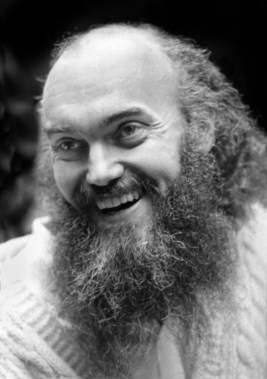
Just a couple days ago, a spiritual teacher and author named Dr. Richard Alpert passed away. Most people today know him as Ram Dass, the author of the spiritual classic Be Here Now, published in 1971. Ram Dass, who grew up Jewish and likely celebrated the Feast of Sukkot as a child, said, “As long as you think vulnerability is weakness, you’re going to be afraid. There’s a kind of vulnerability that is actually strength and presence.” St. Paul came to a similar realization when he prayed to the Lord three times, asking God to remove what he called “a thorn in his flesh.” The Lord did not grant Paul’s request. Instead, he said to Paul, “My grace is sufficient for you, for my strength is made perfect in weakness.” That’s the kind of vulnerability that is ultimately not weak, but is actually strength and presence. This is why Paul says in his letter to Titus (which we heard this evening) that we experience the goodness and lovingkindness of God not because of how righteous and superhuman we think we might be, but because of God’s radical grace, which tends to show up in human vulnerability, whenever people recognize their limitations and their need for such grace. The two great feasts of the Christian church (Easter and Christmas) both revolve around symbols of human vulnerability: the cross and a helpless child born in a sukkah.
This Christmas season, I invite us to not be afraid of our vulnerability, whether it be sadness or loneliness or anxiety or fear or some other “thorn in our flesh.” May we not see it as weakness but as strength and presence. And may bring the vulnerable parts of ourselves to God, lay them at the altar, and pray, “God, we know your grace is sufficient. May you who revealed your power in a child born in a sukkah reveal your strength through our vulnerability and through the parts of us that might seem to be weak. May your love that overcomes hatred, your life that overcomes death and your light that overcomes darkness be revealed through us and through our mortal sukkahs so that we may give glory to you in the highest heaven and on earth peace and goodwill to all people, everywhere. Amen.”

 DANIEL DeFOREST LONDON