
Readings for Gaudete Sunday, the Third Sunday of Advent (Year A)
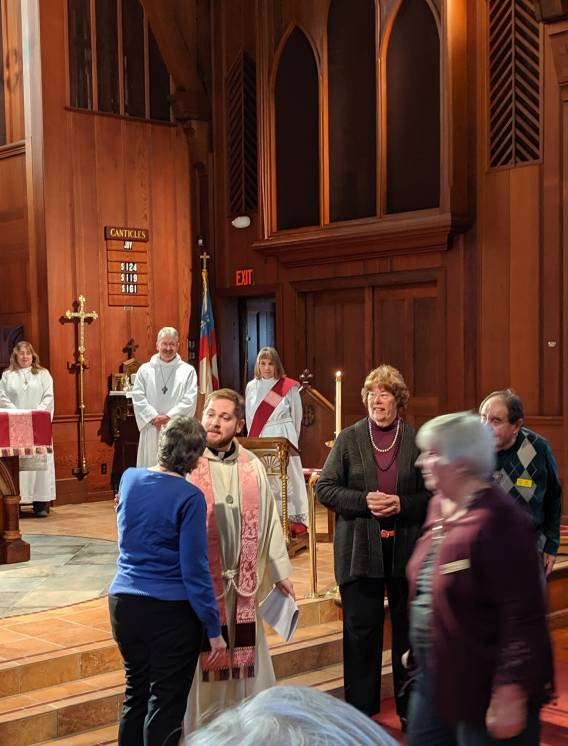
This sermon was preached by Fr. Daniel London at Christ Episcopal Church in Eureka CA on Sunday December 15, 2019.
Several months ago, I received a letter from a visitor who expressed appreciation for the joy that he felt was conveyed in the sermon and the service here at Christ Church Eureka. He was visiting during the penitential season of Lent, but most likely on the Fourth Sunday of Lent, which is Laetare Sunday, the only other day of the year when we wear our beautiful rose-pink vestments. Laetare Sunday and today, Gaudete Sunday, are both intended to be joyful respites in the midst of penitential seasons, reminding us that the glorious feasts that we await (Easter and, in this case, Christmas) are just around the corner. “Laetare” and “Gaudete” are both Latin ways of saying, “Rejoice!”
I was deeply encouraged by this visitor’s letter because, in general, that has been my hope and prayer for all of us whenever we gather here to worship: that we might experience joy. Joy and gladness flow naturally and inevitably out of the communal practice of Eucharist, which means “Thanksgiving.” Joy flows naturally when we gather to give thanks to God because it is a right and good and joyful thing always and everywhere to give God thanks and praise.
Our Sufi brothers and sisters have a saying: “Abundance can be had now by simply consciously receiving what has already been given.” This is the joy of the already. We enter into that joyful abundance every time we gather here to consciously receive what has already been given: to celebrate all of our wonderful blessings that range from a new steeple cross to new chairs, from amazing special guests (including Dan and Karen Price as well as all the Foster care children who were here on Friday) to special birthdays (and we have many to celebrate today), from reconciliation within families to 49ers football (especially this year), from the beauty of the redwoods to the adorable cuteness of Baby Yoda, from the glorious music that echoes in this nave on Sunday mornings and at concerts to the eternal salvation we have been given through Jesus Christ our Lord, our blessing abound indeed.

The readings for today drip with joy as Mary bursts into song to proclaim the greatness of the Lord in the Magnificat. Later this morning, we will sing a contemporary version of the Magnificat, which begins with the words: “My soul cries out with a joyful shout that the God of my heart is great.” The alternative canticle for this morning is a section of Psalm 146, which begins with the words, “Happy [and joyful] are they who have the God of Jacob for their help!” (146:4). And Jesus responds to John’s question in this morning’s Gospel by inviting him to pay attention to all that has already been given: sight to the blind, hearing to the deaf, good news to the poor, and healing to the lepers and the lame. The ancient prophesies of Isaiah, which we just heard, have been fulfilled in Christ. In many ways, the kingdom of heaven is already here, for those with eyes to see. God’s healing and loving presence is among us and within us right now, as Richard Rohr explains in his book The Universal Christ. So let us open our eyes to see Christ beaming with joy in everything and everyone, at every moment. Let us open our hearts to receive the joy of the already. Amen, but there’s more…
When I was a radio DJ at Westmont College in Santa Barbara, I co-hosted a radio show with my Resident Director and friend Scott Schuller. We were both huge fans of the rock band U2 and so our radio show was basically all U2 all the time. In between songs, the two of us would often discuss the Christian faith expressed so poetically in U2’s lyrics and then debate about whether or not U2 was really a Christian band, especially according to the very high standards for orthodoxy that we as evangelicals held at the time. I recently came across an old recording of our show in which we were discussing the lyrics of one of U2’s greatest tracks titled “I Still Haven’t Found What I’m Looking For,” which includes these powerful lyrics: “I believe in the Kingdom come when all the colors will bleed into one; and yes, I’m still running. You broke the bonds and you loosened the chains, you carried the cross and all my shame. All my shame. You know I believe it, but I still haven’t found what I’m looking for.” In my radio commentary, I repeated this last line “You know I believe it, but…” And I said that that was a big “but,” so big that some people think these guys can’t really be Christian. My co-host Scott then said, “Yes, but at the same time, I’ve never met a Christian that didn’t have a big…but.” Realizing how that came across, he quickly followed up by saying, “And I don’t mean that in the physical sense of the word, but in the theoretical belief sense of the word. I mean, anyone that I’ve ever met has had doubts and questions at some point.” Scott was absolutely right and yet that “but” does not necessarily have to express doubt, with which Episcopalians are very comfortable. I believe it was actually the expression of a deep Christian truth.

You see, although we celebrate all of the joyful blessings that God has already poured out upon us, we Christians live in this spiritual state of “already and not yet.” That is what Advent is all about. We discover joy in what has already been given, but we also hope for what is not yet fulfilled, hope for what is “coming” (that’s what Advent means). We celebrate Gaudete Sunday today, but we know it is not yet Christmas. We may be full of joy today, but we also long for so much more. We know that Christ has established the Kingdom of God here on earth, but we also know that the Kingdom of God is not yet fully realized.
The question that John asks in this morning’s Gospel speaks to this deep longing, this sense of “not yet.” He asks Jesus, “Are you really the one who is to come or are we waiting for someone else?” Although Jesus does indeed bring healing wherever he goes, he has clearly not established the Kingdom of God in its fullness and entirety; because John the Baptist is still in jail, where he will remain until he is beheaded by a corrupt despot. And the Kingdom of God has not yet fully arrived because millions of people still suffer every day and hundreds of thousands of people have followed in the footsteps of John the Baptist and have met a similar fate. John the Baptist was not the last preacher to preach politics and criticize the corrupt leaders of his day at the risk of his own health, well-being and life. One of Karl Barth’s closest friends Dietrich Bonhoeffer met the same fate of John the Baptist because he knew that although the Kingdom of God is already present in many ways, it is not yet fully realized; and the kings and political leaders of this world who claim a “godlike status” ought to be firmly rebuked by Christian leaders and not defended and adored. Like John the Baptist, Dietrich Bonhoeffer rebuked the political leaders of his day and was executed as a result, because he lived in Nazi Germany, the Third Reich. And we know that the word “Reich” is German for “Kingdom” and tragically many German Evangelical Christians believed that the Third Reich was the Kingdom of God here on earth. But thank God for theologians like Bonhoeffer and Karl Barth who urged us not to conflate the kingdom of man with the kingdom of God, not to conflate human political power with the divine power of Christ.
So although we celebrate the joy of the immanent presence among us here and now of Christ, who already established the Kingdom of Heaven on earth, let us be very careful to remember that God’s Kingdom is not yet fully realized. Today, we celebrate the joy of the “already” and look with hope and longing towards the “not yet;” and we heed the words of James who says, “Be patient, beloved, until the coming of the Lord.”
The Advent song that I look forward to singing every year is one that captures beautifully this “already and not yet” tension. It is Rory Cooney’s modern adaptation of the Magnificat called the “Canticle of the Turning.” As we hear and as we sing these words, let us claim the joy of the “already” and reach prayerfully in hope and longing towards the “not yet,” towards that which is coming. “My soul cries out with a joyful shout / that the God of my heart is great / And my spirit sings of the wondrous things that you bring to the ones who wait. / From the halls of power to the fortress tower, not a stone will be left on stone. / Let the king beware for your justice tears ev’ry tyrant from his throne. / The hungry poor shall weep no more, for the food they can never earn; There are tables spread, ev’ry mouth be fed, for the world is about to turn. My heart shall sing of the day you bring. Let the fires of your justice burn. Wipe away all tears for the dawn draws near, and the world is about to turn!”


 DANIEL DeFOREST LONDON